Lanterns mark 225 years of canal after fears it would run dry
On Christmas Eve in 1800, a canal in what was then an industrial corridor in Wales saw its first cargo journey.
Now, the Monmouthshire and Brecon canal attracts an estimated three million visitors every year.
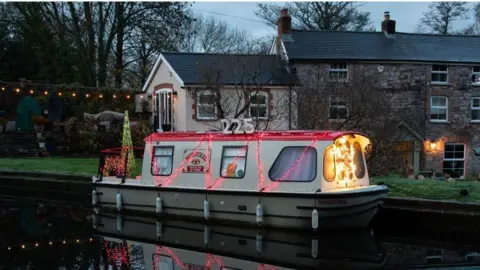
To mark its 225th anniversary, hundreds of people took part in a series of lantern parades along the canal in December, with illuminated canoes and kayaks, a sailing swan lantern, a horse lantern on foot and an otter.
The celebration followed a turbulent time for canal users and residents, as there were fears it could run dry within days in March, upending the 1,000 jobs that rely on the waterway.
But in December the Welsh government and the Canal and River Trust agreed to contribute £500,000 annually for five years to prevent this from happening.
Visitors described the display as "magical", while one canal resident said the community had "shown we shine as bright as a beacon in the darker times".

 Steve Hale
The 35-mile (56km) waterway sits in the heart of the Bannau Brycheiniog National Park, also known as the Brecon Beacons.
Communities in Gilwern, Llangattock, Llangynidr, Tal-y-Bont and Brecon all took part in the celebrations to emulate the same journey made by the the first cargo boats to transport coal along the route, 225 years ago.
Volunteers rallied around to help make the displays happen, as a canoeist dressed in black discreetly pulled the bespoke swan along the canal, while the horse and otter were carried by volunteers on foot.
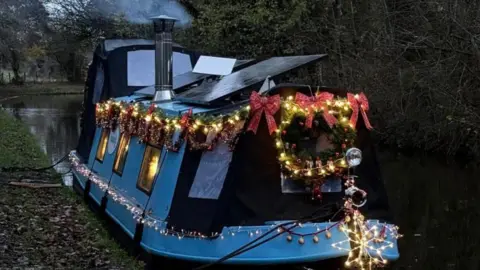
The canal and its pathways lit up for the event, with children clutching their handmade lanterns and illuminated dog collars leading the way.
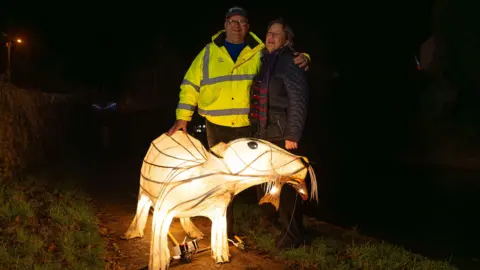
Steve Hayle, 59, who lives in his narrow boat, said the experience "means the world" to him.
He has holidayed along the canal for 10 years, but has been living on his boat Arwen in Llanfoist with his wife Angela for the past four years.
They said they "absolutely love it" but recent years have posed some difficulties.
"We've been through quite a turbulent time in the last few years, with water shortages and other issues along the canal.. and the desperation we felt for the situation on the canal," he said.
The water supply came under threat this spring and summer because of limits placed on how much water could be taken from the environmentally sensitive River Usk.
Up to £400,000 will now be provided by the Welsh government every year "sustaining the water supply", with the Canal and River Trust spending another £100,000.
Steve expressed his relief at the security of the canal for the next five years: "It's just about embracing positivity and coming together as a community to embrace this experience.
"It's everything that Christmas should be. It's communities getting together and enjoying the artery that runs through, which is the Brecon and Monmouthshire canal."
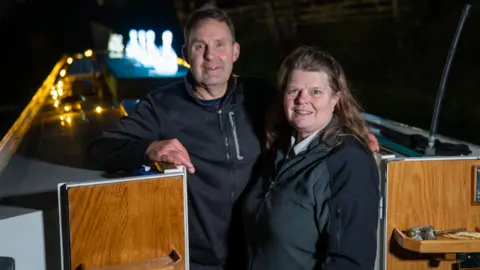
Some visitors even had to cut down trees to make the events, as Samantha Atkins, 61, and her husband Jim, 59, faced obstructions on their journey from Llangattock to the event in Llangynidr as a result of stormy weather.
But the pair said they were determined to show up as "it brings everyone together and proves how important the canal is to the local area".
Samantha described it as a lovely start to Christmas: "It's all so bright and cheerful, everyone has made such an effort it's just nice for everyone to get together and see what we've all done."
The couple, from Newbury, Berkshire, have been cruising along the canal together for the past 15 years, travelling from back and forth on most weekends.
Samantha described the canal as her "happy place" and somewhere they can relax and enjoy the "beautiful scenery".
 Steve Hale
The history of Monmouthshire and Brecon canal
The Monmouthshire and Brecon Canal, also known as the Mon and Brec, originally operated as two separate canals – the Monmouthshire Canal and the Brecknock and Abergavenny Canal.
The two were joined in 1812 at Pontymoile, but the 225 year anniversary celebrates the completion of the more northern Brecon Canal 12 years earlier.
It was originally constructed as an industrial corridor for transporting coal and iron and was a vital part of the industrial infrastructure in south Wales, connecting coal mines, ironworks and limestone quarries.
Both canals were abandoned in 1962, but the Brecknock and Abergavenny route and a small section of the Monmouthshire route reopened in 1970.

Speaking at one of the events in Llangynidr, David Morgan, 62, from the Canal and River Trust, said seeing the amount of people who turned up was "fantastic".
"It shows this canal actually means something to these local communities, it runs through the heart of those communities and its an integral part of those communities," he added.
Lead volunteer on the canal, Paul Motte, 74, from Barry, Vale of Glamorgan, echoed those feelings:
"The canal is an intrinsic part of the national park and it offers an alternative to the mountains and the hills.
"We couldn't lose it and we're really grateful we have been able to find a solution."
Additional reporting by Greg Davies
