'Outrageous' to not charge Bloody Sunday soldiers accused of perjury, says victim's brother

 BBC
BBCThe brother of a man killed on Bloody Sunday has said it is "outrageous" that soldiers investigated for perjury will not face prosecution.
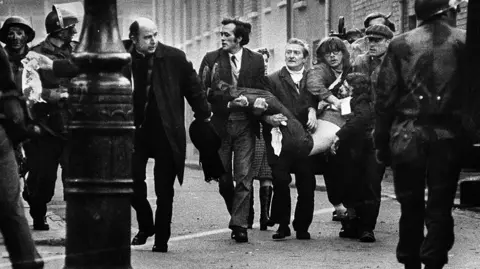
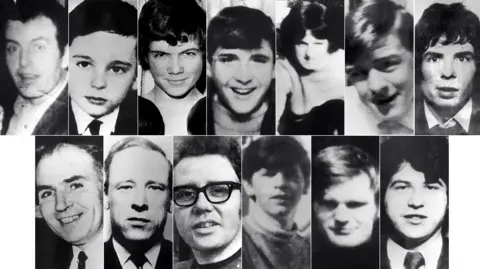
Thirteen people were shot dead and 15 injured, when the Army's Parachute Regiment opened fire on civil rights demonstrators in the Bogside area of Londonderry on 30 January 1972.
The Public Prosecution Service (PPS) has upheld its April 2024 decision not to prosecute a number of people in relation to allegations of false evidence given to the Bloody Sunday Inquiry.
The PPS said on Wednesday that its decision would be "deeply disappointing" for the Bloody Sunday families, but said "the evidential threshold for prosecution has not been met".
 Pacemaker
Victim's brother 'not happy'
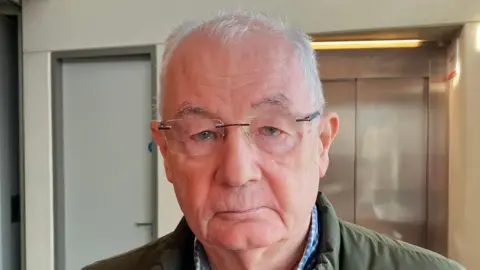
Mickey McKinney, whose brother William was killed on Bloody Sunday, said he and other victims' families are "not happy" with the decision.
"I think it's outrageous," he said.
"We know that these people perjured themselves to both inquiries [Widgery and Saville]. We're just not happy about it."
McKinney said the families will now consider a judicial review of the PPS decision and added: "If that's what it takes, that's what it takes."
He said they would have a "good go" at overturning the decision.
In 2010, Lord Saville's report into Bloody Sunday stated that some soldiers had knowingly given false accounts.
In April 2024, the PPS said there was "insufficient" evidence to prosecute 15 former soldiers and a former member of the Official IRA for perjury.
The PPS was asked by some of the Bloody Sunday families to review the decision relating to eight of the soldiers.
The families and those soldiers were told on Wednesday morning that the original decision stands.
In a statement, the PPS said: "Criminal convictions require proof beyond a reasonable doubt, and prosecutors must assess the prospects of conviction based on admissible evidence.
A spokesperson said detailed written explanation had been provided to the families to help them understand the decision.
"These decisions do not diminish the findings of the Bloody Sunday Inquiry," the PPS said.
"Public inquiries and criminal trials follow very different rules, and much material available to the Inquiry cannot be used in court."
Ciarán Shiels of Madden & Finucane law firm, who represents several of the Bloody Sunday families, said the decision "flies entirely in the face of Lord Saville's conclusions".
"This decision sends out entirely the wrong message in relation to the British military who were involved in committing the gravest of criminal acts in the conflict," he said.
Philip Barden, from Devonshires law firm, represented four of the eight soldiers in this case.
"The fact that no soldiers will face prosecution in connection with the events of Bloody Sunday should tell all politicians that seeking to use the court system to get to the truth will fail, as it has done for over 30 years," he said.
"If there is to be a search for the truth, a new approach is needed, being one that engages all parties involved in the conflict."
What happened on Bloody Sunday?
Bloody Sunday is widely regarded as one of the darkest days of the Northern Ireland Troubles.
Against a backdrop of escalating violence and increased bombings, a new law was introduced giving the authorities the power to imprison people without trial - internment.
In Derry, there was considerable violence in the city both after internment and in the weeks leading up to Bloody Sunday, as concluded in the Saville Inquiry. It details a "serious security situation, with bombing and shooting incidents coupled with daily rioting and arson attacks on the fabric of the city."
About 15,000 people had gathered in the Creggan area of the city on the morning of 30 January 1972 to take part in a civil rights march organised by the Northern Ireland Civil Rights Association to protest at internment.
The Stormont government had banned such protests and troops were deployed to police the march.
After prolonged skirmishes between groups of youths and the Army, soldiers from the Parachute Regiment moved in to make arrests.
Just before 16:00 GMT, stones were thrown and soldiers responded with rubber bullets, tear gas and water cannon. Two men were shot and wounded.
At 16:07 GMT, paratroopers moved to arrest as many marchers as possible and at 16:10 GMT, soldiers began to open fire.
According to Army evidence, 21 soldiers fired their weapons, discharging 108 live rounds between them.
The events after Bloody Sunday
The day after Bloody Sunday the government announced there would be an inquiry led by the Lord Chief Justice, Lord Widgery.
The Widgery Tribunal largely cleared the soldiers and British authorities of blame, although he described the soldiers' shooting as "bordering on the reckless".
It was derided as a whitewash by the victims' families, who spent years campaigning for a fresh public inquiry.
Prime Minister Tony Blair announced a new inquiry would be held, headed by judge Lord Saville and was set up in 1998 and reported back in 2010, becoming the longest-running inquiry in British legal history and costing about £200m.
The inquiry found that none of the casualties were posing a threat or doing anything that would justify their shooting.
It said no warning was given to any civilians before the soldiers opened fire and that none of the soldiers fired in response to attacks by petrol bombers or stone throwers.
Saville found there was "some firing by republican paramilitaries" but that on balance the Army fired first.
Prime Minister David Cameron said the killings were "unjustified and unjustifiable".
What happened after the Saville Inquiry?
The Police Service of Northern Ireland (PSNI) began a murder investigation after the Saville report was released.
It took a number of years to complete and detectives then submitted their files to the Public Prosecution Service towards the end of 2016.
Having weighed up 125,000 pages of material, prosecutors said on 14 March that they will prosecute Soldier F for the murders of James Wray and William McKinney.
He had also faced charges for the attempted murders of Patrick O'Donnell, Joseph Friel, Joe Mahon and Michael Quinn.
On 2 July 2021, it was announced Soldier F would not face trial following a decision by the Public Prosecution Service (PPS).
In a statement, the PPS said after "careful consideration" the decision had been taken due to another recent court ruling which found evidence being relied upon in the prosecution of Soldier A and Soldier C for the killing of Joe McCann was inadmissible.
This was due to the circumstances in which the evidence was obtained.
In 2022, the High Court in Belfast quashed the decision by the PPS to discontinue the case against Soldier F and legal proceeding resumed against him.
The trial got under way on 15 September 2025.
This article was updated on 17 February 2026.
