'My son spotted I had MND before my doctors did'

 Supplied
For three and a half years, doctors were unable to correctly tell dad-of-two Nick Apperley exactly what was wrong with him.
Running regularly and clocking up as many as 60 miles (96km) a week on his beloved bike in the winter and 150 miles (241km) in the summer, he had always been fit and active.
But, in 2020, he found himself with "floppy feet", constantly tripping over during his morning jogs, and having to endure painful cramps throughout the night.
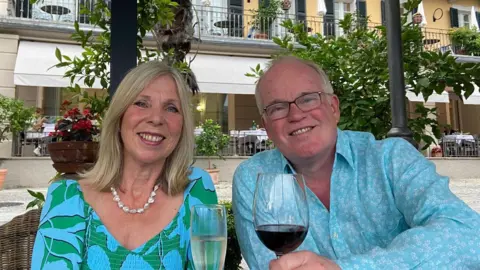
The now 63-year-old, from Ufford, in Suffolk, didn't know it at the time, but the changes to his body were being caused by Motor Neurone Disease (MND).
 Supplied
The debilitating condition, which causes muscle weakness that gradually worsens over time, kills just under 2,200 people in the UK each year.
According to the Motor Neurone Disease Association, six people per day in the UK are diagnosed with the condition – but for Nick, getting a diagnosis proved far from simple.
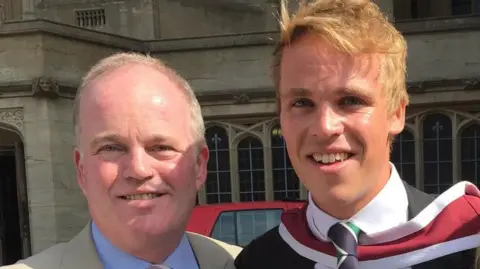
In fact, it wasn't until his own son, who is a paediatrician, said he believed he had a motor neurone condition, that he finally started to find answers.
"I had prepared myself for having some limitations, but not for it being something that was going to be progressive like MND," he said.
"But my son said to me he felt something wasn't right because he said my buttocks and thighs were wasting away, so he suggested I needed to go and see someone."
 Supplied
That someone was a private doctor, who, after a series of tests, officially diagnosed Nick with MND on 1 June 2023 – more than a year after he had first seen his GP.
"Having discussed it with my son, by the time I was given my diagnosis, it didn't come as a complete shock, and we were probably slightly braced for it," he added.
"But then (when I walked five miles and it took me eight hours) I really realised the implications of what was starting to happen to me and that our life was changing."
 Supplied
Before his eventual diagnosis, Nick first saw a GP in April 2020, who suspected his issues could be linked to a muscular problem and advised him to get some rest.
Then, in 2021, after seeing no improvement, he had a full spinal MRI scan, which he was told did not show anything concerning.
The following year, in late 2022, he had an appointment with a neurologist at Ipswich Hospital, who referred him back to his GP for long-term nerve damage.
"Time isn't really of the essence for MND because there aren't really any treatments, and time doesn't help in terms of treatment," he said.
"Twelve to 18 months is usually how long it takes for people with MND to get a diagnosis, and people used to say to me, 'wasn't I really cross that it took so long'.
"But I don't reflect on it, and it doesn't irritate me. If I've got a limited amount of time, the last thing I want to spend my time doing is getting agitated about it."
Catherine Morgan, chief nurse at East Suffolk and North Essex NHS Foundation Trust, which runs Ipswich Hospital, said: "We appreciate how difficult it can be for patients who are in the process of waiting for a diagnosis, particularly if they are in pain and discomfort.
"Our teams do everything they can to provide timely, high-quality, compassionate care and treatment for all our patients.
"We're committed to listening and learning from feedback shared by our patients and their families through our dedicated Patient Advice and Liaison Service (PALS) team."
The Integrated Care Board were contacted for comment.
 Supplied
People who are living with the type of MND that Nick has are expected to survive for between two and three years after their diagnosis.
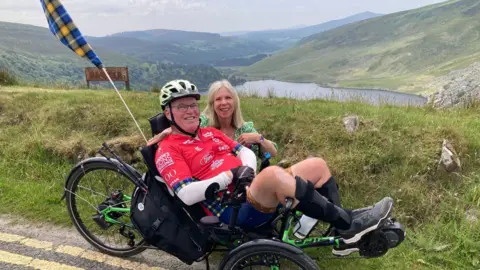
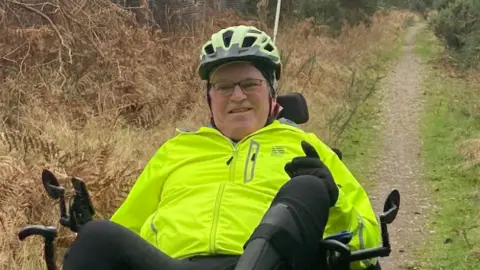
But, despite that prognosis, Nick, who now often uses a powered trike to get around, "gets up every morning positively" with the goal of making a difference to others.
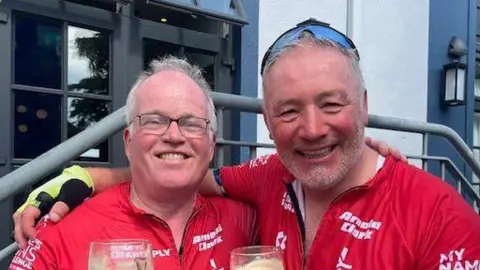
Since being given his diagnosis, he has raised more than £50,000 for the MND Association, the My Name'5 Doddie Foundation, and Challenging MND, all through physical challenges, events and the generosity of his community.
 Supplied
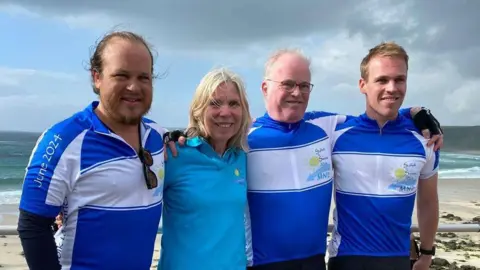
One of his fundraisers was a 444-mile (714km) cycle from Suffolk to Sennen in Cornwall, and he also took part in rugby player Kenny Logan's 555-mile (893km) ride around Ireland, meeting the likes of Ally McCoist and Gabby Logan.
"I don't think 'I wish I could do this, I wish I could do that', because that would eat me up and make me fed up and depressed," said Nick.
"My diagnosis gave me the motivation to get on and do something, and that became an important part of me starting to try and raise money."
Paul Thompson, director of fundraising and communications at the My Name'5 Doddie Foundation, said Nick's determination to turn his diagnosis into something that helped others was "incredibly inspiring".
"He has chosen to focus on what he can still do, using that energy to bring people together and raise vital funds for MND research," he added.
"Through his cycling challenges and the support of his community, he is helping drive the progress we need as we work towards our vision of a world free of MND."
'Hopefully it won't always be a death sentence'
According to the Motor Neurone Disease Association, the condition affects up to 5,000 adults in the UK at any one time.
There is no cure, and it causes the deaths of six people every day.
"We have to keep advocating for and promoting MND to really start to make a difference for those who are diagnosed in the future," said Nick.
"It won't be for me, and it won't be in my lifetime, but I think for people in the future, hopefully MND won't be the death sentence that it currently is."
 Supplied
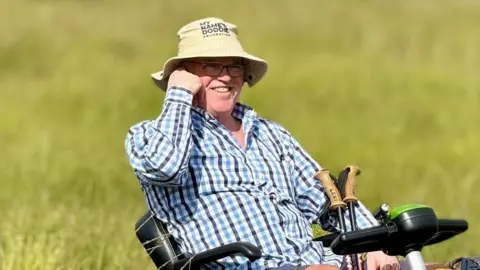
Despite all of Nick's positivity, he knows that his condition is progressing and gradually getting worse.
He can still "just about waddle around the house" and clean and feed himself, but has recently started to encounter greater difficulty with using his arms and hands.
"I don't want to leave the party early," he said.
"But I'm 63 now, and a lot of people don't get as far as I've got. So, I have to accept it and make the most of it and do as much as I can in that time.
"I don't want to make it painful and difficult for my wife and our two sons. So, I keep positive, we keep positive, and we look forward and do as much as we can."
'People must be diagnosed faster'
Dr Nick Cole, head of research at the MND Association, said Nick's journey to a diagnosis had "been far too long" and one of the charity's aims was to cut wait times.
He did, however, acknowledge how hard it can be to diagnose the condition.
"With more than half of people with MND dying within two years of diagnosis, we must do more to ensure people get the help they need faster," he said.
"But MND is a complex disease, and because there is no single test to diagnose it, clinicians must first rule out every other possible condition.
"This process can take months or even years. A further challenge is that early MND symptoms can mimic other conditions, which can delay diagnosis further."
Follow Suffolk news on BBC Sounds, Facebook, Instagram and X.
