Are bodyworn cameras helping NHS staff deal with abuse?

 BBC
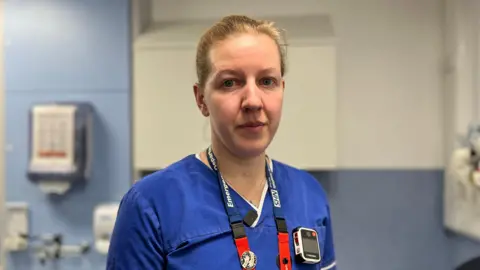
BBCIt is just over two years since bodyworn cameras were introduced at the Queen's Medical Centre (QMC) in Nottingham.
The move formed part of the hospital trust's response to a rise in abuse aimed at staff by patients, their relatives and members of the public.
Hannah Freer, a senior nurse at the emergency department - one of the busiest in the country - recalled being "punched, scratched, bitten, pushed and verbally abused on a regular basis".
So have the bodyworn devices made any difference?
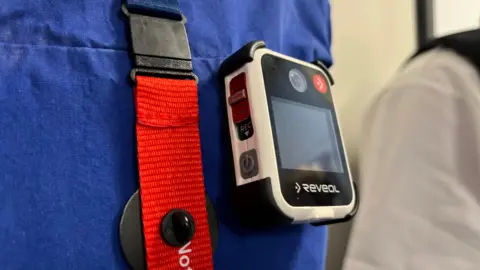
"When they were first introduced, I think we all felt quite awkward with them because in a caring profession, we never expected to come into this job and be exposed to the level of violence and aggression that we are exposed to," Freer said.
Bodyworn cameras were something she associated with a policing or security job but over time, she said staff had become more comfortable using them.
According to figures shared by Nottingham University Hospitals (NUH) NHS Trust, reports of aggression, violence and harassment (AVH) have been steadily increasing each year since the 2020-21 financial year.
In that financial year, 1,320 incidents were reported to the trust by staff. In 2024-25, 2,537 incidents were reported.
The biggest jump was between 2022-23 and 2023-24 - from 1,806 to 2,368 - after bodycams were introduced.
In response to the 2024 annual NHS staff survey - considered one of the largest workforce surveys in the world - 14.38% of staff said they experienced at least one instance of physical violence from patients, service users, relatives or other members of the public in the last previous 12 months.
This was a 0.5% increase from the 2023 results.
Of the respondents, more than 700,000 staff members - 25.08% - had experienced at least one incident of harassment, bullying or abuse by patients/service users in the previous 12 months - a 0.26% decrease from the year before.
The 2025 survey results have not yet been published.
'It's sad to see'
While the devices did not necessarily make her feel safer, Freer said bodyworn cameras sometimes prevented people from behaving badly.
They also provide crucial evidence when incidents were reported to the trust or to police, with the 38-year-old revealing she had reported about seven episodes of AVH to police.
"The verbal aggression feels like it's really, really increased in the last six to nine months," she said.
"And the racist abuse that some our staff are being subjected to really does feel like it's increased significantly in the last six to 12 months."
Freer said abusive behaviour could be attributed to long waiting times, but added factors outside the hospital could also play a part, such as sporting events and protests.
Using the bodyworn camera footage helped staff "come to a conclusion with these patients" - whether limiting them from accessing the emergency department or pursuing criminal charges, Freer said.
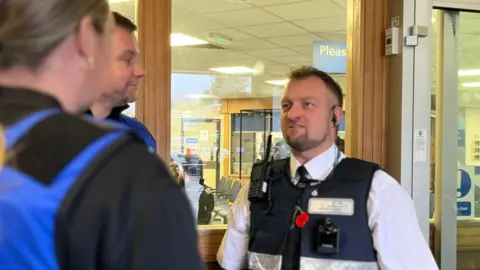
Security supervisor Roger Webb accepts AVH as part of the "nature of our job".
He said he had been threatened with knives, had an oxygen cylinder thrown at him and a fire extinguisher set off in his face - and he believes aggression towards clinical staff is on the rise.
"It's quite sad to see, especially when we're down in [the emergency department] because a lot of those people know what they're doing and they know they're going to cause harm to people if it escalates," he said.
Webb, who has worked for the trust for six years, said bodyworn cameras made him feel "safer in the knowledge that the truth is captured".
"It can de-escalate straight away - as soon as they [perpetrators] see it's on, but it can have the adverse affect as well. It can wind some people up," he said.
Vicky Fensome had moved from a much smaller hospital trust when she joined NUH about three years ago and said she was taken aback by the level of abuse staff faced.
Since then, the director of nursing and professions has played a prominent role in helping the trust address the issue, including starting conferences where staff can share their experiences of AVH.
Fensome said she had seen an increase in the number of reports to police and action being taken in response to AVH since the introduction of bodyworn cameras.
"It has a huge impact on staff morale," she said.
"When you're coming to a place of safety to be given care, to then abuse the people that are trying to provide that care - understandably the staff take that to heart."
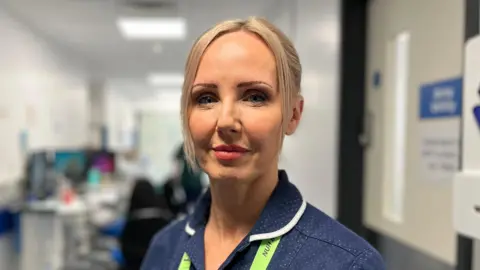
Fensome added incidents of AVH were happening "more and more consistently".
On Friday, one member of staff was physically assaulted and had to go home early.
Some incidents are caused by vulnerable or confused patients, but almost 75% of incidents of abuse are by people who "know what they're doing", Fensome said.
"The majority [of incidents] are caused by people who have full capacity and are aware of their behaviours and actions and that is really difficult to understand," she said.
She wants to encourage more staff to come forward about their experiences.
"We've done an evaluation of the bodycams and what we're finding is whilst they're not necessarily preventative - staff are reporting that it may not escalate like it might have done previously," she said.
'We will take action'
NUH also introduced a red card system in January 2023 in which perpetrators of AVH would be given a verbal warning, followed by a second warning and then a red card - effectively a ban from the hospital, if their behaviour was repeated.
Between January 2025 and December 2025, there were 12 yellow cards issued and eight red cards issued, according to the trust.
Last January, a 28-year-old man was also jailed for eight months after carrying a knife into the emergency department at the QMC.
Fensome said it was "unfortunate" that it took the use of bodyworn cameras for people change their behaviour.
"But that's what we'll do, and we'll use that footage to help support our staff to take the necessary action against anyone that does behave in that way," she said.
Follow BBC Nottingham on Facebook, on X, or on Instagram. Send your story ideas to eastmidsnews@bbc.co.uk or via WhatsApp on 0808 100 2210.
