Can a headset help people with a fear of heights?

 BBC
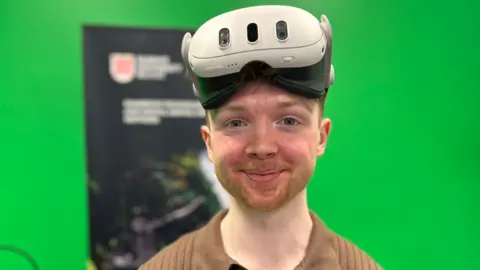
BBCA university student has said he is "over the moon" seeing people test virtual reality (VR) software he hopes will one day help therapists treat phobias.
Liam Harte, a computer science student at Queen's University Belfast (QUB), has spent the past three years developing a therapist-led VR platform.
He and his team have created a session for people with acrophobia - a fear of heights. In it they experience progressively higher environments, ending on a 16 storey crane.
Dr Paul Best, a professor of mental health at the university and study-lead, has stressed that the technology is not intended to replace traditional therapy and is a tool to assist practitioners.
'I would be hyperventilating'
The idea, from Harte's start-up company, Rephobia, was inspired by the 21-year-old's own fears.
Harte, from Strabane in County Tyrone, said he has benefited from exposure therapy techniques in the past, particularly when dealing with his fear of public speaking.
"I would have been sick to my stomach to the point where I couldn't even face the crowd. I would be hyperventilating," he said.
"I know how difficult it is to live with that."
About 20 to 30 participants will take part in a pilot study in collaboration with researchers at QUB to test the technology.
What is exposure therapy?
Exposure therapy gradually introduces someone to the thing they fear in a safe and controlled way.
Harte believes VR can make the process more efficient and affordable.
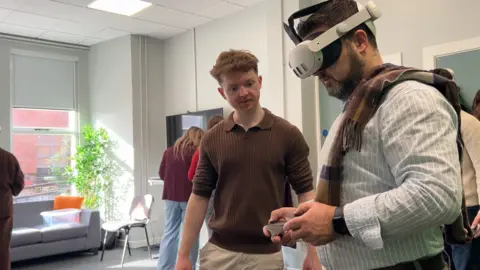
The interactive 3D VR experience guides users through a series of height-based scenarios.
The session begins in a virtual garage where users complete simple tasks to learn the controls.
They then enter a virtual therapist's office, a "safe space" they can return to if the experience becomes overwhelming.
From there, they move to a building site, starting at ground level before progressing to scaffolding eight storeys high and finally the top of a crane.
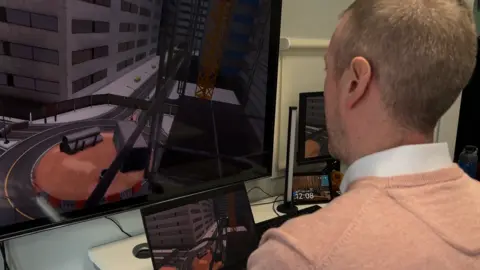
At each stage, participants complete interactive tasks that encourage them to engage with the height to deepen their immersion in the simulation.
Throughout the experience they are asked to rate their anxiety levels on a scale of one to 10.
They also use VR headsets to watch 360-degree video footage of Belfast filmed at similar heights.
Study lead Dr Best said the project was at an early stage.
"I would see this at more of a kind of proof of concept stage," he said.
While commercial products already exist which simulate heights, Best said this study has been designed specifically with clinical use in mind.
He added the study is looking at whether the interactive VR session and 360-degree video footage can generate a sense of height and if one is better at doing it than the other.
Participants at this stage do not have a fear of heights, as the focus is not on treatment yet but on testing how immersive each environment feels.
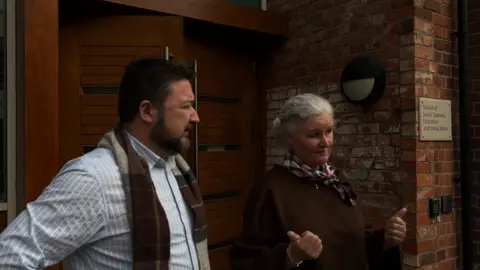
Before the pilot began, a number of guests tested the software.
Arlene Kee, from the Education Authority, said both experiences were very different.
She was more comfortable during the 360-degree video than the interactive experience where she found her "anxiety levels were quite high".
She said it was "realistic" and "loved the fact that you could come back to base if you needed to".
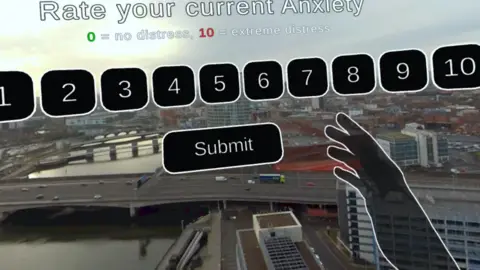 Rephobia
Colm Walsh, a senior lecturer in criminology at QUB, said he is "pretty OK with heights".
"But I think how realistic the VR and the 360 programmes were - it did induce some anxieties and maybe things I didn't realise I had," he added.
"I think there are a whole variety of ways we could use this technology. Today we were thinking about phobia but it could extend much broader than that."
Harte is hoping to eventually expand from acrophobia to other phobias and other anxiety-based disorders.
'This is about VR as a tool to assist practitioners'
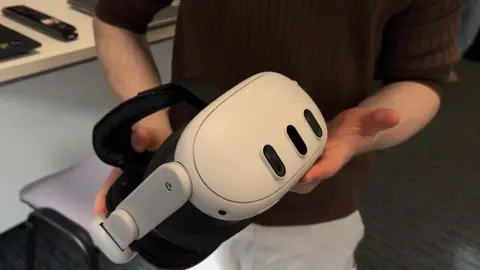
Best said the technology is not intended to replace traditional therapy.
"This isn't about VR therapy as a self-contained kind of intervention. This is about VR as a tool to assist practitioners," he said.
What is the difference between a fear and phobia?
Best said the key difference between a fear and a phobia is the level of disruption it causes.
A fear might be uncomfortable, but a phobia can shape major life decisions including work, travel and daily routines.
"Phobias they're not unfamiliar to us. They can have a really detrimental impact on lives," he said.
"The important message to give out is that they are treatable. It is just about finding the right treatment.
"What we're really trying to do is speed up that process or add value to current treatment practices."
