Quarry cannot reopen due to great crested newts

 Clints Quarry Action Group
Plans to reopen a disused limestone quarry cannot go ahead on conservation grounds, a government inspector has ruled.
Company DA Harrison, which makes ready mix concrete products, lodged an appeal with government planners after the Lake District National Park Authority (LDNPA) refused its proposal to reopen Clints Crag quarry in Moota, near Cockermouth.
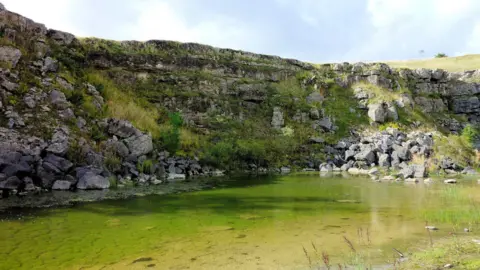
The quarry shut 50 years ago, becoming a Special Area of Conservation in 2005, and the Planning Inspectorate confirmed the LDNPA's decision should stand over fears any development would impact great crested newts at the site.
DA Harrison has been approached for comment.
A report published by the Inspectorate said DA Harrison had wanted permission to reopen the site to overcome supply issues with quality limestone.
The land is owned by members of the Harrison family, including the directors of the Silloth-based firm.
Loss of habitat
The report said the quarry had become a conservation area due to the presence of great crested newt - a protected species.
"[Quarrying] would result in the loss of great crested newt breeding ponds and around 3.8 hectares (9.4 acres) of terrestrial habitat," the report said.
It added that would result in the loss of about about two-thirds of great crested newts there, which would be "an exceptional adverse impact" on the site's conservation status.
DA Harrison proposed to mitigate the impact by creating "exclusion zones" and moving the creatures to newly created habitats.
But the Planning Inspectorate said that would not be a viable option.
"I am not satisfied, on the evidence before me, that there are no feasible alternative solutions that would be less damaging or avoid damage to the site."
It added: "I cannot be satisfied, beyond all reasonable scientific doubt, that the development would not have adverse effects on the Special Area of Conservation."

The company said it believed permission to extract limestone from the quarry was already in existence.
Planning documents showed while permission was given for part of the site in 1966, work at the time was carried out at a greater depth than allowed, the Planning Inspectorate said.
Papers from 1974 gave permission to extend the area to be worked, on condition that development started within five years, but the authority said no such evidence that it had existed.
DA Harrison submitted maps to show what they believed was proof of development, but they were rejected by the Inspectorate.
The report said: "The appellant relies on an old plan setting out the extent of the 1966 permission boundary which appears distorted, most likely because it is an old paper plan which has been folded."
It said that mattered because a "slight change" in the angle of the boundary line would show a different area of relevance being affected by work.
The appeal was dismissed.