Spandau Ballet music video room stars in exhibition

 Getty Images
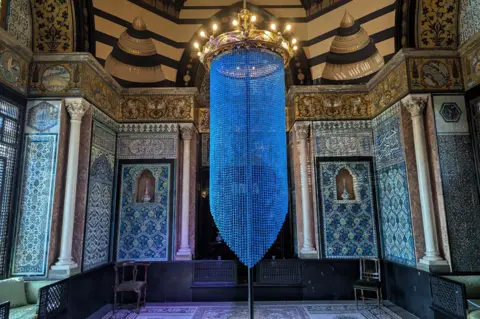
A room in which music videos by Spandau Ballet and The Stranglers were filmed is at the centre of a new exhibition in west London.
The ornate 19th Century Arab Hall is in Kensington's Leighton House, the home of Victorian artist Frederic Leighton.
It was inspired by his travels abroad, including to Syria.
The Arab Hall's Middle Eastern and Mediterranean-influenced style was considered the perfect setting to film videos for the 1980s hits Gold by Spandau Ballet and Golden Brown by The Stranglers.
 BBC/ Luxmy Gopal
"It had a sort of 80s quality about it. It was flamboyant, and I think there was an intrigue about the place that had an exoticism which suited the time," said Gary Kemp, who was Spandau Ballet's guitarist and songwriter.
Allow Google YouTube content?
"The Arab Hall means so much to me because Gold ended up being such an enormous song," he added.
"I ended up marrying - and having a son with - the young woman who was in the video, so there's another importance there in this room for me."

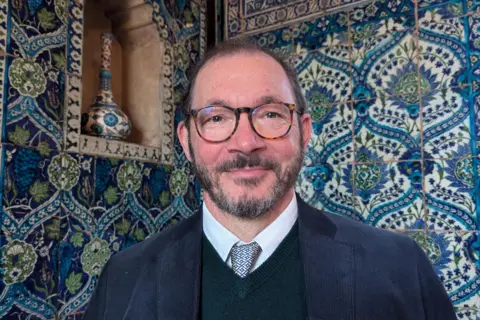
Daniel Robbins, senior curator of Leighton House, said the venue's appearance in film, such as in the videos for Golden Brown and Gold, "brings an audience of its own - perhaps one that wouldn't otherwise seek out the museum".
"We were contacted by somebody who was visiting the setting of every Spandau Ballet video, and they found their way here to cross it off their list!"
Allow Google YouTube content?
"It's a real testament to the Arab Hall that it created this compelling, believable atmosphere of somewhere far more exotic than just off Kensington High Street," he added.
The Arab Hall: Past and Present is the first major exhibition about the room, and is part of the 100th anniversary celebrations of Leighton House becoming a museum in 1926.
 BBC/ Luxmy Gopal
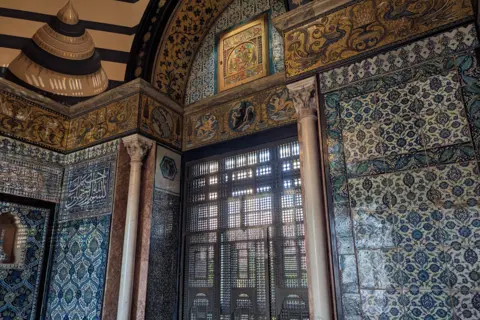
Completed in 1881, the Arab Hall was created by Leighton as an extension to his Kensington studio-house after his travels across North Africa and the Middle East. Its walls are lined with antique Islamic tiles from Damascus, Turkey and Iran.
 BBC/ Luxmy Gopal
The exhibition encompasses a short film about the hall, the publication of new research into its history and three contemporary art installations, over the next few months.
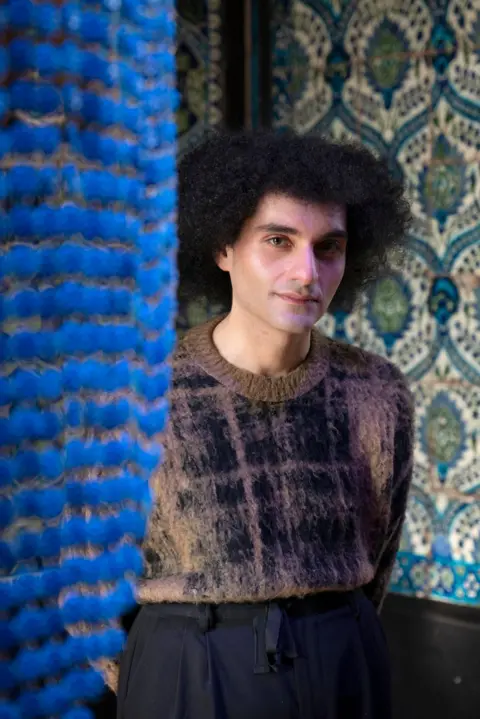
The first is Atlas of an Entangled Gaze, by London-based Lebanese artist Ramzi Mallat. It hangs over the room's fountain.
 RBKC/ Jaron James
"I employ blue ceramic Syriac charms as a means of weaving together cultures and histories, creating a dialogue between Eastern and Western perspectives," said Mallat.
"The work reconsiders the evil eye not merely as folklore, but as an ancient and enduring belief that continues to resonate with contemporary anxieties surrounding visibility, protection and erasure."
 Soudade Kaadan
A short film, titled When The Tiles Spoke, is also part of the centenary celebrations. It is by London-based Syrian filmmaker Soudade Kaadan, who has won awards at the Sundance and Venice film festivals.
"When I first visited Leighton House, it looked ordinary," she said. "Then, once you pass the reception, there it was: the Arab Hall. A hidden Damascene Qa'a-style interior, with blue tiles and mosaics. A fountain at its centre."
Kaadan added: "It felt like entering a Damascene home.
"I was moved to find those tiles here, this small oasis of tranquillity in the middle of London.
"For a moment, I felt I was not so far from home."
The Arab Hall: Past and Present runs until 4 October 2026
Listen to the best of BBC Radio London on Sounds and follow BBC London on Facebook, X and Instagram. Send your story ideas to hello.bbclondon@bbc.co.uk
