'There's no point in an art gallery without artists'

 PA Media
Artificial intelligence is changing creative work at extraordinary speed — but in studios, galleries and writing rooms across the world, artists are deciding what that means for them.
From painters to writers, artists are now weighing the risks, opportunities and pressures that come with machines learning to create alongside them.
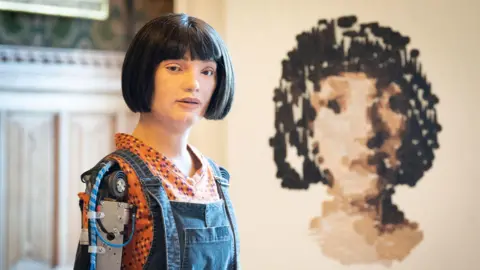
Ai‑Da, described by her creators as the world's first ultra‑realistic robot artist, has already forced the conversation into the mainstream. Her portrait of Alan Turing sold at Sotheby's in 2024 for more than a million dollars (£836,667), a moment that raised fresh questions about what counts as art, and who — or what — gets to make it.
Yet the real debate is happening far from auction houses.
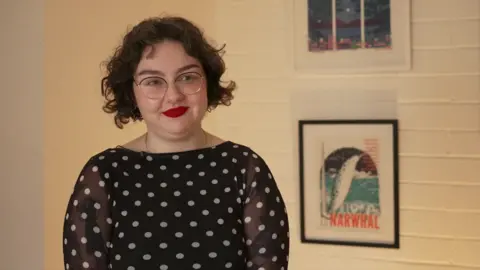
In Hull, curator and artist Lucy Brooke says those concerns began building after a local gallery announced a paid workshop led by an artist from out of town.
Participants were told to bring a laptop to "use ChatGPT to generate images", a detail she says contributed to "a massive public backlash from the local arts community".
She wanted to turn that frustration into something constructive, so organised a free online session for people to "learn a little bit about AI, its environmental impacts and its political and social impacts, and then have an open forum where we can discuss it".
What stood out to her was how quickly the conversation became about working together.
She says "the overwhelming view from the creatives was a lot about the idea of community", challenging the idea that artists are "solitary individuals who work late nights and do lots of drawing and practice all on their own, when in reality we share our practice a lot more now".
That, she adds, "differentiates us from the process that ChatGPT follows, which is a prompt to an image".
But she says the discussion also revealed deeper worries about "copyright, plagiarism and exploitation".
Lucy hopes artists can "build a community to lobby these galleries" and push for "greater policy around AI, AI usage and regulation".
As she puts it: "There's no point in an art gallery if there aren't artists."
'No point getting upset'
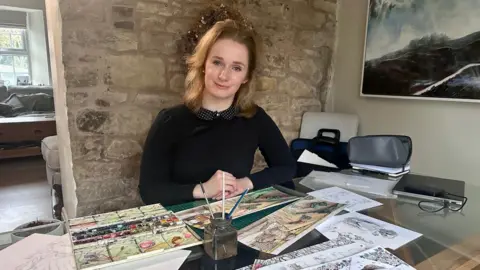
Illustrator Eleanor Tomlinson, from Broomfleet in East Yorkshire, takes a more measured view.
She has worked for herself since her teens, building a career around watercolour pieces that celebrate the countryside and the wildlife within it.
She also became widely known for a sketch of Queen Elizabeth II walking hand in hand with Paddington Bear to mark the Platinum Jubilee in 2022.
Because her work is well known, she has already seen elements of it recreated online.
"I've seen things go around that has my signature on it," she says, even though the images "have been modified and adapted and changed".
At first she found it upsetting, but her attitude has shifted. "There is no point getting really upset and angry about it," she says, adding that she now tries to "help sort of educate people or show people", so others "can be aware and know what to look for".
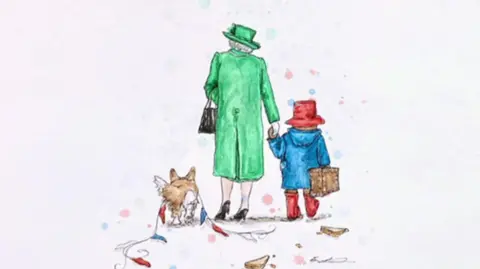 Eleanor Tomlinson
Eleanor is aware that AI can now produce images that look increasingly convincing.
She describes the speed of progress as "scary" and says it is becoming "harder and harder to differentiate what is, and what isn't" created by a human.
But she does not see it as the end of traditional art. She likens it to the arrival of photography.
When cameras first appeared, she says, "there must have been lots of portrait artists at that time quaking in their boots and they didn't go out of business".
For her, the creative industries are in another transitional period.
Although she expects AI to continue advancing, her confidence comes from the personal connection she offers clients, a process she says "AI is not going to do".
'I will get replaced'
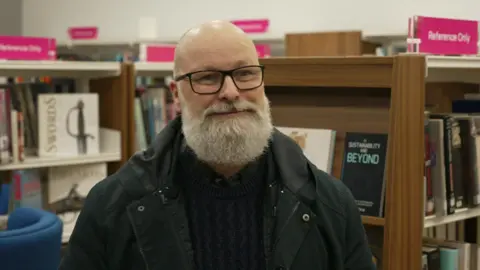
Writer and author Alan Raw is more conflicted. His books draw heavily on personal experience, and he worries about how that material is used.
"I don't like the fact that I have a book which has been published and without permission some AI models are being trained on books which are published, without the publisher knowing, or giving permission," he says.
"So that kind of hurts a little bit because I wrote it, it kind of feels personal to me."
But he is also torn. "I write climate fiction and non‑fiction books about sustainability, if AI is going to train a model on that and then distribute it, maybe that's a good thing?"
For his commissioned writing, he is blunt. "AI is getting really good at doing that," he admits. "I think I will get replaced."
As a creative writing tutor, he has also seen AI creeping into students' work.
Some assignments arrive "which have clearly got AI writing in there", he says, often because students "have been doing research and they've cut and paste rather than putting it into their own words".
This, he says, is a worry for the future. "I think people will lose the skills involved in creating narrative… and just enjoying that self‑expression."
Across these three artists and writers, the picture is far from uniform.
Some fear for the future of their industries; others see a new phase in a long history of technological change.
But all share the belief that creativity comes from people — from lived experience, community and the value of human skill.
In a landscape transformed by algorithms, that human connection may be the thing that endures.
Download the BBC News app from the App Storefor iPhone and iPad orGoogle Play for Android devices
