Why modesty should not stop CPR for women

 Mark Lord Photography
New figures show women are less likely than men to receive bystander CPR as many "feel unsure about touching a woman's chest", an ambulance service has revealed.
In the data released ahead of International Women's Day on 8 March, Thames Valley Air Ambulance reveals one in three women who suffer a cardiac arrest receive no CPR before emergency crews arrive.
The charity says that is not because "bystanders don't care, but because they hesitate" and it urges more people to step forward if they witness a woman in cardiac arrest.
Chief executive Amanda McLean said "modesty should never get in the way of saving a life".
 Catherine McReynolds/ Kayleigh Rockell
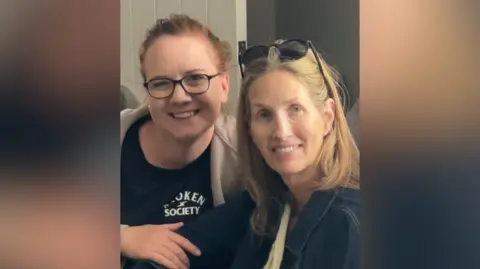
Cardiac arrest survivor Catherine McReynolds received CPR at the roadside in Bracknell, Berkshire, last year.
Bystander Kayleigh Rockell stepped in to save her life.
She had recently been trained in CPR and has a daughter with complex cardiac condition, which helped her recognise that Catherine urgently needed chest compressions.
Rockell recalls her adrenaline kicking in and that it "felt like forever, but it was probably only five minutes".
The charity says at that stage, another bystander took over the chest compressions, "as it is difficult to continue high quality CPR for more than a few minutes at a time".
Rockell also remembers the "amazing feeling" when Catherine's husband, Jonathan, called her saying 'You won't believe it, she's sitting up' after a few days in the intensive care unit.
McReynolds says if Rockell and the other bystanders had not stopped to help her, "I would not be here today".
"Thanks to them, the Thames Valley Air Ambulance crew were able to give me the best chance of survival," she adds.
 Mark Lord Photography
McLean says the critical care paramedic and doctor crews "attend more than three cardiac arrests every day across the region".
"Early CPR gives us the best possible chance of saving a life," she said.
"But we know confidence rates to step in and perform CPR are low and, sadly, they appear to be even lower for women in cardiac arrest."
The Duchess of Edinburgh, who is the Royal Patron of the charity, heard about the disparity during a visit to the headquarters in Stokenchurch in January.
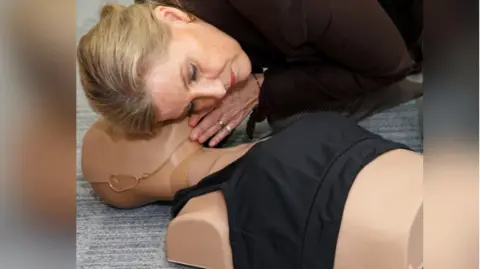
Ahead of International Women's Day, Sophie visited again to learn CPR, practicing on a female manikin.
The charity said she is "supporting our call for more people to step forward with confidence if a woman suffers a cardiac arrest".
In a Facebook post, the charity says many people "feel unsure about touching a woman's chest, removing clothing or cutting through a bra to apply defibrillator pads".
"That's why we include manikins with breasts in our CPR awareness sessions, and we show people how to cut through a bra before applying defibrillator pads," McLean adds.
"Notions of modesty should never get in the way of saving a life."
Rockell, who also backed the call, says a cardiac arrest "can happen to anyone, at any time".
"I couldn't have lived with myself if I hadn't helped Catherine.
"If something doesn't look right, use your initiative and help. You could save someone's life."
You can follow BBC Oxfordshire on Facebook, X (Twitter), or Instagram.
