Calls for government cash to fix 'soil-affected' roads

 John Devine/BBC
A council is calling on central government to provide cash to fix buckled "soil-affected" Fenland roads that are causing damage to vehicles.
The chair of the transport committee on Cambridgeshire County Council, Alex Beckett, said roads built on peat - or "soil-affected" - can cost four times as much to repair as standard roads.
"These roads fundamentally need to be fully reconstructed, and it would cost far more than the county council could ever put in," he said.
"We are calling for central government to help us with these soil-affected roads".
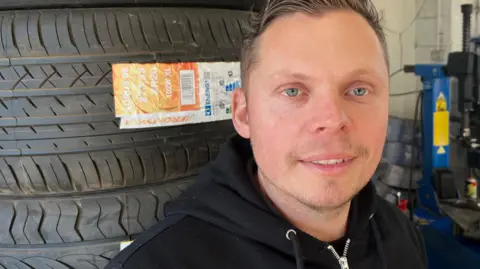
It comes as one tyre fitter says he has seen a 200% rise in demand due to the poor condition of local roads.
Joe Fisher, 35, from March in Cambridgeshire, says he has also seen an increase in related car hardware damage, like alloy wheels needing repairs or replacing.
 John Devine/BBC
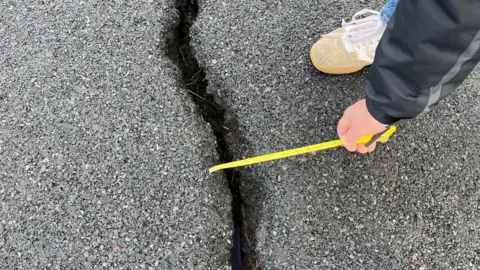
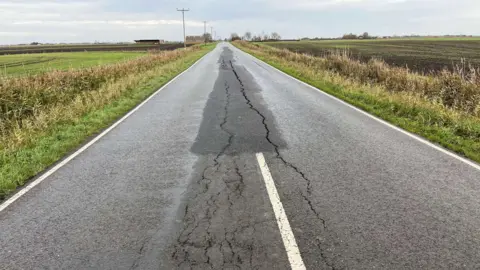
Mr Beckett said many Fenland roads were prone to movement due to being built on peat soil and were critically affected by shrinking and expanding, caused by worsening extreme weather patterns.
He said the effects of drought, heatwaves and floods caused road surfaces to buckle, crack and subside, leaving "rollercoaster" conditions for motorists.
 John Devine/BBC
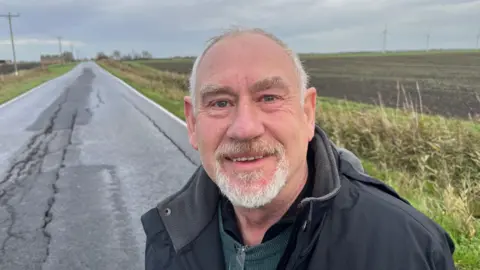
Mike Swann, a motorbike enthusiast and former RAF serviceman who lives in the village of Ramsey Forty Foot, said one accident blackspot near him, Puddock Road, was on a par with conditions found in developing world countries.
He said the road, which links Warboys to the Forty Foot Bank Road near Benwick, was a rat run full of vehicles at rush hour.
"I went to Belize and I never thought in a million years that I would be riding down a road that you would find in Belize, making this part of Cambridgeshire like that, a third world country", he said.
Mr Swann said he regularly saw "sparks" from where the bottom of vehicles caught humps and bumps in the road that were difficult to see coming especially as the road has no lighting at all.
 John Devine/BBC
 John Devine/BBC
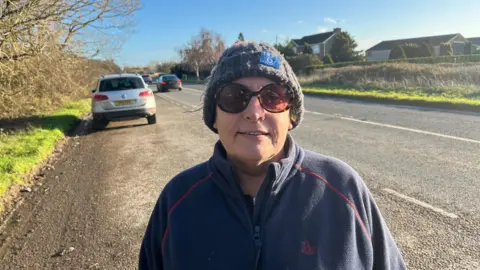
Alison Searle, 58, is a keen horsewoman from March and regularly transports her 12-year-old horse Billy in a horsebox on local roads.
"The A605 is a main trunk route going to Peterborough, and the road condition has damaged my horsebox where Billy is thrown about as the road level changes", she said.
She said she would see motorists driving down the middle of the road, as the outside edges of the carriageway just "drop away".
"It has been patched and mended many times, but within weeks is falling down again, why are they not repaired to the right standard," she added.
 John Devine/BBC
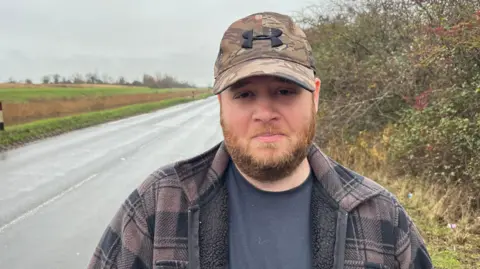
James Fuller is a lorry driver who lives on the 16 Foot Bank Road, the B1098, and says it can be lethal. It has claimed many lives in the past.
"The biggest threat on this road is water submergence, especially in winter time when the risk of hypothermia is a danger," he said.
Mr Fuller said the nearby B1099 Upwell Road that links to March was also a challenge, as it is used by tractors pulling agricultural machinery and heavy goods vehicles, which he said was "causing even more issues with the road".
A spokesperson for the county council said: "We are doing everything we can locally to maintain and keep soil affected roads safe, but addressing this challenge properly requires national support and government funding for long-term solutions.
"This is because it costs four times as much to repair a soil-affected road to the same standard as a non-soil-affected road.
"We have already secured £1.5m of external funding which we are using to undertake a trial next summer to investigate new and innovative ways to repair these roads, and an extra £5m of capital funding has been ring-fenced since 2023 to repair and reconstruct soil affected roads."
The Department for Transport said: "Local authorities are responsible for managing their roads.
"Over the past year alone, we invested an extra £500m – enough funding to fill the equivalent of seven million potholes – to help local authorities maintain their local road networks."
Follow Cambridgeshire news on BBC Sounds, Facebook, Instagram and X.
