Trail hunts 'will find a way to survive' despite ban

 EPA
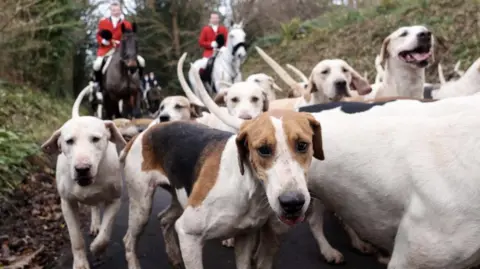
EPATrail hunts will "find a way" to survive despite a potential government ban, a group that works with hunt clubs has told the BBC.
Trail hunting was introduced after the Hunting Act 2004 as an alternative to hounds chasing foxes and involves using an animal-scented rag. Labour first announced a planned ban in its 2024 election manifesto.
Drag hunting, another form of the pastime, is expected to remain legal.
Polly Portwin, from the Countryside Alliance, said hunt clubs wanted to "protect" the rural economy and the 12,000 hounds involved in the sport.
"We want to protect the jobs and homes for the hunt staff and we want to ensure the rural economy can still continue to survive," she said.
When asked if trail hunts could turn to drag hunting after a ban, Portwin said "We will find a way, we've had to find a way and we're going to have to adapt, but the government doesn't need to ban trail hunting."
A 12 week-consultation on the government's proposed trail hunting ban began in March but a spokesman for the Department for Environment, Food and Rural Affairs (Defra) said the government wanted other alternative hunt activities to "continue to thrive".
That includes drag hunting - which uses a fixed course where the hounds often follow an artificial scent like aniseed - and clean boot hunting, where bloodhounds chase the scent of runners they mingle with before they set off.
Lesley Martin, from anti-hunt group Cheshire Monitors, said "proper drag hunts" were "good for a community which is completely opposite to fox hunting or so-called trail hunting".
Fox kills 'unintentional'
Proponents of drag hunting say the fact it uses a fixed course and a synthetic scent means it is less likely that foxes will be killed.
For a successful prosecution under the Hunting Act, prosecutors have to prove that a fox was killed deliberately.
"There are occasionally incidents where a fox has got killed, and hunts will hold their hands up to that if it happens, but it's not intentional," Portwin said.
Last year campaigners filmed hounds from the Wynnstay Hunt killing a fox at Cuddington near Malpas, but Cheshire Police's investigation did not lead to charges being brought.
The Wynnstay Hunt was approached for comment by the BBC.
A Wynnstay hunstman was fined after "deliberately" letting hounds chase a fox in 2023.
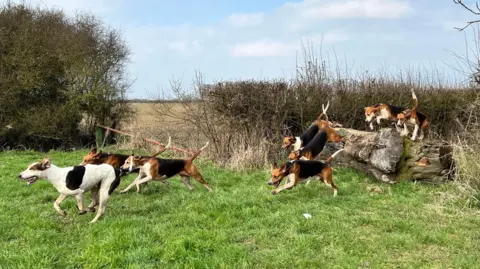
The current law has "way too many loopholes, way too many get-out clauses, and that's why we're in the situation we're in now", Martin said.
Master of the Hounds at the Cheshire Hunt, Robert Walker, said the group did not want to turn towards drag hunting and had "worked hard to ensure that trail hunting works".
The Cheshire Hunt, which has kennels based at Sandiway near Northwich, claims to be the oldest organised hunting club in the world, having been established in 1763.
"I haven't really thought about any other option because we've done what they asked us to do [after the hunting of live animals was banned] and they don't seem happy with that," he said.
Robert Truscott, who manages the hunt's kennels, denied their trail hunts were "a front", adding "there's still a place in the country" for legal hunt activity.
"For one day's trail hunting, we could be planning it for three or four days prior to that day, to be out for three or four hours," he said.
'Still killing foxes'
The Hunt Saboateurs Association recently published a secretly-filmed video which it says shows "an individual associated with" the Cheshire Hunt putting a terrier into a fox hole to force foxes above ground at Haughton near Nantwich.
The association said the video showed the hunt "have intentions to hunt foxes".
The Cheshire Hunt has been approach for comment by the BBC.
Olly Hughes, managing director of the British Hound Sports Association, said: "Both the Cheshire and Wynnstay Hunts operate within the law and under the rules and standards of the British Hound Sports Association (BHSA).
"There is no evidence in the material circulated to support the claims being made. Hunts are regularly subjected to spurious allegations which are rarely upheld.
"Any evidence of criminal wrongdoing should be reported to the police."
Emma Slawinski, from the League Against Cruel Sports, said people "have the option to switch to activities which don't involve the hunting of wildlife such as drag hunting and clean boot hunting" if they "want to continue enjoying the social aspects of going out riding with hounds".
"However, we are concerned that fox hunts will simply switch the excuse that they use from trail hunting to drag hunting while still chasing and killing foxes," she said.
Trail hunting is already banned in Scotland. Hunting with dogs remains legal in Northern Ireland.
Read more stories from Cheshire on the BBC, watch BBC North West Tonight on BBC iPlayer and follow BBC North West on X. You can also send story ideas via Whatsapp to 0808 100 2230.
