Unusual items washing up on Sussex beaches

 Getty Images
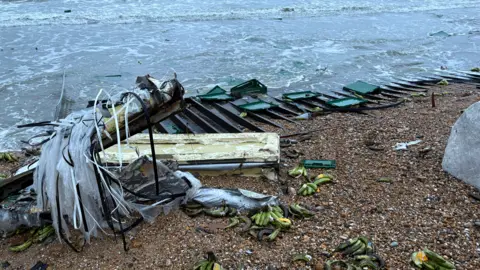
Containers full of bananas were found on beaches across Sussex this week, but they are not the only unusual cargo to wash up on the county's shores over the years.
Sixteen containers fell overboard from the Baltic Klipper on Saturday off the Isle of Wight, seven of which were then found on Selsey beach, two at Pagham Harbour and another two at Bognor Regis.
Back in March 1901 a steamship called the Indiana shipwrecked and its cargo of oranges and lemons washed up in East Worthing.
Residents rushed to the beach to collect the fruits and to this day locals throw oranges and lemons on the beach to commemorate the sinking of the Indiana.
In January 2008, authorities closed beaches along the south coast, including Worthing, Ferring and Hastings as well as further afield in Kent, to prevent looters stealing more than 2,000 tonnes of timber which littered the coast.
 Getty Images
The BBC reported the timber was from the Greek-registered Ice Prince, which sank about 26 miles (42km) off the coast after a storm.
After a major clear-up, authorities arranged for the timber to be sold.
In November 1926, Worthing residents found a wooden crate floating in the water and when they opened the box, they discovered a dead elephant calf.
In memory of the animal, named Jumbo by the town, a statue of the elephant now stands at Worthing's Splash Point.
In October 2023, packages of drugs were found on Goring beach while nearly one ton of suspected cocaine was discovered on Newhaven and Hastings beaches in May 2021.
Authorities reported the street value of the haul was worth £80m.
The BBC also recently reported on large quantities of biobeads being found washed up at Camber Sands.
Last month, up to 10 tonnes of plastic pellets entered the sea at Eastbourne through a 3.4km (2.1 mile) pipe after a fault in Southern Water's treatment tank at the wastewater plant.
 Gavin Jones
Back in April 1919, the people of Hastings were surprised to find a giant German submarine stranded on the beach.
Meanwhile, in January 1980, the Athina B carrying 3,000 tons of pumice and heading towards Shoreham Harbour, suffered an engine failure.
The ship was stuck between the Palace Pier and Banjo Groyne in Brighton.
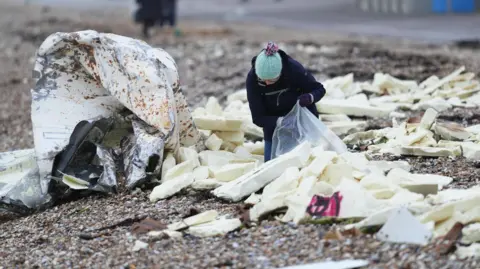
Clare Trotman, beachwatch officer at the Marine Conservation Society, said: "Unusual items washing up on Sussex beaches could pose risks to our local marine life, especially materials like foam insulation which could break down and be ingested by wildlife."
Ms Trotman urged residents to avoid direct contact with potentially hazardous items and report them to the local council or coastguards.
"We encourage people to record what they find, including large items or anything in significant numbers, through our beach cleaning programme," she added.
 Eddie Mitchell
"The data will helps us track pollution trends and push for stronger protections for our seas."
Dean Spears, from Sussex Bay, has also advised residents that any items found from containers should immediately be reported to HM Coastguard's Receiver of Wreck Service.
"Unusual items washing up on Sussex beaches can pose real risks to fragile habitats and marine wildlife," he added.
Follow BBC Sussex on Facebook, on X, and on Instagram. Send your story ideas to southeasttoday@bbc.co.uk or WhatsApp us on 08081 002250.
