Police thought it highly unlikely Noah was in culvert, officer says

 Pacemaker
A senior police witness has told the Noah Donohoe inquest he believed there was a 5% chance of finding the schoolboy in a culvert close to where he went missing.
The 14-year-old's body was found more than 600m downstream from the culvert in north Belfast almost a week after he disappeared in June 2020.
Sgt Barry Hutchings also said his 5% figure was "a spur of the moment" estimation during questioning at the inquest.
Hutchings was the lead police search advisor during the investigation and he helped to set the strategy for physical searches in conjunction with the senior investigating officer.
During questioning at the inquest on Thursday, Hutchings explained that the discovery of the culvert prompted a search of the entrance.
"It was searched but I had other areas to search," he said.
He told the inquest searches were focused on many other areas and at that time they "didn't expect him [Noah] to be in that pipe" because there was nothing to suggest he was there at the time.
He said he believed at that stage that Noah would be found around local homes, sheds or grounds close to where he went missing.
"I wanted to be sure he wasn't there," he said.
'I would have done anything to find him alive'
The witness said other searches were also taking place focusing around areas where he thought the schoolboy would most likely be found, including Cave Hill as it was the schoolboy's intended destination.
The inquest also heard that among the possibilities considered by the police during the search was that Noah was in "a disturbed state of mind" and he may have been affected by the "presence of drugs".
Hutchings said this was "a consideration, nothing more" because Noah's behaviour before his disappearance "wasn't normal".
"It was a consideration as to why he was naked," he said.
"I would have done anything to find him alive.
"Noah was my priority."
When questioned by a lawyer representing Fiona Donohoe, Noah's mother, about his strategy during the searches, the police witness said the line of questioning was "hypothetical", and added: "I deal in facts".
The inquest also heard Hutchings believed Noah's body was found in the water tunnel "as quickly and as safely as possible" given the hazardous environment where the discovery was made.
The witness explained the constraints involved in working in confined spaces under health and safety regulations.
"None of my guys were injured or killed doing that job," he said.
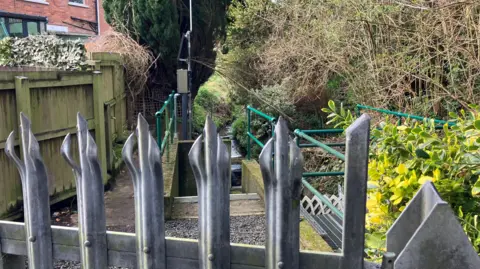
The inquest heard that the downstream part of the underground tunnel, where Noah's body was found, was located in a tidal area around Belfast Lough.
The daily tidal movements were a factor in the timing of searches in that area, the inquest was told.
Hutchings rejected suggestions there were police failures linked to his role in the investigation.
The Donohoe family barrister said there had been failures across a range of issues.
According to the lawyer, these included delays in processing and sharing information linked to the search, as well as locating the entrance to the culvert and treating it as a potential rescue site.
Hutchings insisted the operation "was at no time a rescue operation".
He said it was "a search" to discount that Noah was there.
The witness was also challenged about the timing of searches at the "most dangerous/lower part of the culvert" and "the failure on your part" to deploy appropriate resources at the culvert.
Hutching rejected each claim.
"I deployed the resources as I needed them," he said.
He also explained to a barrister for the Police Service of Northern Ireland that the Cave Hill area of north Belfast remained a priority even after the culvert was discovered and searched.
He said search teams were focusing on Cave Hill in case Noah had fallen in that area.
"It had the height, it had the cliff," he said.
"It was his intention to go there."
Commenting on the timing of searches further down the culvert, the witness said, he felt "jumping down to the far side could have missed him completely" because at that time, police believed there was a better chance of finding him around the area where he went missing.
The inquest also heard Hutchings has been involved in hundreds of missing persons cases during his career.
Inquest time frames to be reviewed
It has emerged that the inquest is running behind schedule.
Addressing the jury at the beginning of proceedings this morning, the coroner Mr Justice Rooney said the inquest was "not moving as quickly" as he had anticipated..
He said there would be a review of witnesses and time frames in an effort to "move things forward as quickly as possible".
