Women's programme helped me rebuild my life - now it's going

 BBC
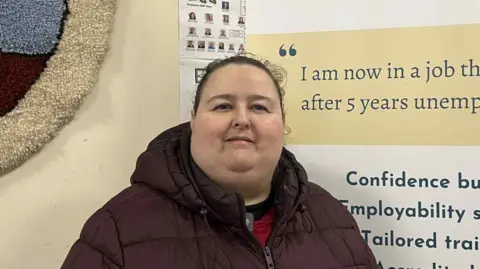
BBCEvery week a group of about 40 women gather at a community centre to talk about everything from how to return to the workforce to what is going on in their local communities and what their plans are for the rest of the day.
This week their meeting took a devastating turn as they found out the funding that organisers rely on to run the scheme has been cut.
For people like Patricia McKeag, it's the loss of an "essential lifeline".
She has been going to the programme for about three years and believes her job prospects – and mental health - will suffer without the weekly catch-ups.
"I actually did a level three childcare course, working with special needs children through the centre," she said.
"What do we do? Do we just go back to sitting at home where it will affect our mental health, our illnesses, and people's daily lives?"
The Women Breaking Barriers programme, which helps people gain workplace qualifications, is one of hundreds of organisations, facing funding changes when the current UK Shared Prosperity Fund is replaced by the Local Growth Fund in April.
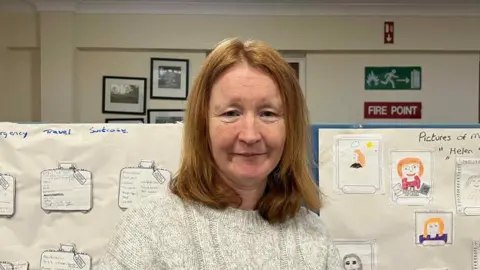
Helen Smyth, the Training and Family Support Officer at Greenway, said the centre has been told it will lose funding for the programme and said jobs are at risk for women who run the Breaking Barriers programme.
She said the loss isn't just challenging for services users, it's "heartbreaking" for the staff too.
Anne McVicker from the Women's Resource and Development Agency said: "There's just not enough funding to provide the services that the women need.
"That's the bottom line. We need the money"
McVicker said that women already get the smallest share of funding from the Shared Prosperity Fund and believes they will be among the worst affected by the cuts.
"The women's sector just doesn't get our fair share," she added.
Why is funding being cut?
The UK Shared Prosperity Fund (UKSPF) replaced the European Union's European Social Fund (ESF) in March 2023, which came to an end in Northern Ireland as a result of Brexit.
It provides funding from the UK government for community and voluntary projects in Northern Ireland, including local regeneration, skills and development and support for economically disadvantaged areas.
The UKSPF is due to change in April, when it will be replaced by the Local Growth Fund (LGF).
But the Northern Ireland Council for Voluntary Action (NICVA) said the funding available to groups through the LGF is 64% less than its predecessor, down from £25m per year to £9.2m.
That will translate to around 400 job losses across 64 organisations, according to NICVA, including jobs at the Greenway Centre.
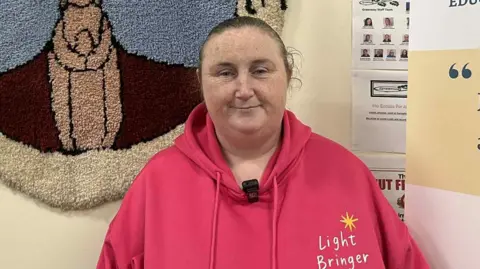
Those who have taken part in the women's group at Greenway said the courses have helped them build self-confidence, as well as giving them access to training courses to provide them with the skills needed to secure jobs.
One of those women is Karen Saunders, who said she feels happier and more confident in herself since joining the centre.
When she joined the group, she was unemployed and had recently lost her husband.
Fast forward two years and she has a part-time job and the support from the other women has helped her deal with the emotional challenges that come from grief.
"Without this funding we're just lost," she said. "We're just back to the way we were, and it gets me around other women."
Celine McStravick, NICVA's chief executive, said the cuts will hit those with the highest needs in society and warned that support is being taken away from young people, women, people with learning disabilities, and ex-prisoners.
"These are people who need that extra bit of support to get into a job, who need wraparound support," she said.
McStravick told BBC News NI that the situation was going to cause "real issues".
"If that safety net isn't there, those young people will turn to crime, drugs and will put more pressure on our existing health and social care system that is already on its knees" she said.
What have the executive said?
In a statement the Executive Office said it was pushing for urgent changes to the Local Growth Fund and had written to Steve Reed, the Secretary of State for the Ministry of Housing, Communities and Local Government.
"We believe there is still time to protect the community and voluntary sector and ensure that the highly valued organisations working in this sector continue to deliver interventions that support economic growth in the future," it added.
A UK Government spokesperson described local growth across Northern Ireland as critical.
"The £45.5 million local growth funding each year is on top of Northern Ireland's record funding settlement announced by the Chancellor last year, which provides the Northern Ireland Executive with additional means to support the voluntary and community sector"
They added that at the request of the Northern Ireland Executive it is directly commissioning economic inactivity projects for 2026–27, to give organisations as much certainty as possible.
