Higher tariffs likely this week, says US Treasury

 Getty Images
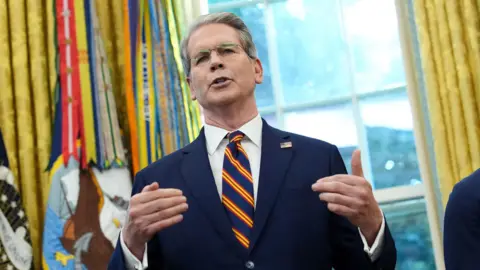
US Treasury Secretary Scott Bessent said the US was "likely" to implement a 15% global tariff this week, following conflicting statements from President Donald Trump about the rate.
The new tariff is intended to replace the sweeping global import taxes Trump imposed last year but were recently struck down by the Supreme Court.
The White House responded to that ruling by imposing a levy at 10% - despite Trump claiming on social media it would be 15%.
The contradiction sparked widespread global confusion at the time, with businesses and world leaders calling for clarity.
White House officials have previously said they were working on paperwork to align the duties with Trump's statements.
They have dismissed the significance of the court ruling, saying they can use other legal tools to restore the tariff policies, which they say will help rebalance trade, boost domestic manufacturing and pay down US debt.
To impose the 10% tariff, the White House used an untested trade authority known as Section 122, which authorises the US president declare a tariff of up to 15% without congressional approval for 150 days under certain conditions.
The White House has said it will also turn to other legal tools as it seeks to restore its tariff regime more permanently.
"It's my strong belief that the tariff rates will be back to their old rate within five months," Bessent told CNBC.
He has said he does not expect the Supreme Court ruling to affect the revenue the US takes in from tariffs going forward.
The administration is currently facing claims from firms who had previously paid the tariffs the Supreme Court struck down. Experts say the government could owe up to $130bn (£97.2bn) in refunds as a result.
A study from the Cato Institute estimated US taxpayers could be on the hook for $23m in interest for each day that refunds are delayed — adding up to some $700m a month.
Significant questions remain about what US import tax policies will look like going forward.
Last April, Trump announced "Liberation Day" tariffs on dozens of countries, with rates starting at 10% and climbing toward 50% in some cases.
The duties kicked off a flurry of trade negotiations as countries pushed to secure lower rates in exchange for promises of investment and other changes.
The US Supreme Court's judgement struck down those "Liberation Day" tariffs, as well as some the administration had previously announced on goods from Mexico, Canada and China, citing emergency powers.
Trump responded by announcing a 10% global tariff, which he claimed on social media the next day he was increasing to 15%. However, the levy eventually came into force at the lower rate.
The move to an across-the-board tariff of 10%, with carve-outs for some kinds of goods, put shipments from all countries on an even footing.
It raised questions about the fate of the deals allies had secured after "Liberation Day", while removing the advantage that some countries such as the UK had agreed to in those deals.
Sector-specific tariffs
The White House has said it will lean on other legal tools, known as Section 301 and Section 232, to introduce tariffs after the 150 days elapse.
Those kinds of tariffs typically target specific countries or industries, allowing the US to impose levies in response to unfair trade practices and national security threats, respectively.
Trump has previously used them to impose import taxes on metals, including steel and aluminium, cars and other items. He has also explored wielding them in fights over digital taxes, pharmaceutical imports and other issues.
Those tools require the White House to follow certain procedures, including presenting a case for the duties after an investigation and providing businesses with set notice and comment periods.
Businesses have said following those rules was preferable to Trump's abrupt policy announcements to date, since they would have more time to adjust to changes even if there is not much difference in the final policy.
Additional reporting by Jonathan Josephs
