We will intervene on energy bills if necessary, says Miliband

 BBC
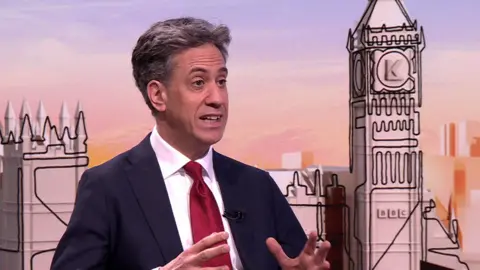
BBCEnergy Secretary Ed Miliband has said "if it's necessary to intervene, we will" if people's energy costs surge due to the US-Israel war in Iran.
Speaking the BBC's Sunday with Laura Kuenssberg programme, Miliband left the door open to interventions on fuel duty and energy bills if the impact of the Gulf crisis demands it.
"We're going to stand by people in this crisis," he said, adding the government was "preparing for all eventualities".
Oil and gas prices have surged due to the US-Israel war in Iran and, with no clear indication of how long conflict will continue, economists have warned about the possible impact on the global economy and cost of living.
Chancellor Rachel Reeves is expected to offer a support package to households struggling with higher heating oil costs this week.
Petrol prices have jumped to an 18-month high, according to motoring organisation the RAC, leading to Prime Minister Sir Keir Starmer warning his government "will step in" if fuel companies "try to rip off customers" last week.
Shown that the largest chunk of petrol cost at the pump was fuel duty at 38%, Miliband was asked whether the government would maintain the current freeze on fuel duty from September.
"With five months to go until September, we'll have to see where we are," he said, adding: "We will stand by the British people in this crisis and we will do what it takes to do that."
Last week, Miliband got into a row with petrol retailers after warning them the independent watchdog the Competition and Markets Authority (CMA) was keeping a close eye on potential "price gouging" around the current conflict.
Petrol retailers labelled the warnings "inflammatory language" and responded by briefly threatening to withdraw from a Downing Street meeting, although they did eventually attend.
Asked what evidence he had for suggesting retailers were unfairly pricing fuel, Miliband said CMA findings showed profits remained "persistently high" and price competition between petrol stations was "weak" in December.
He said: "There is evidence this market isn't working well... Some of them [fuel retailers] didn't like it but that's tough because we're going to fight for the British people in this conflict."
The energy secretary also said there were recent "bad examples" in the heating oil sector, commonly used in rural areas not connected to the main gas grid - with Reeves' support package expected to be announced early next week.
"I don't think these are markets that have been working well, frankly; I think there's a longer term look that needs to be done about how these markets are working," Miliband said.
"The thing I learned from previous crisis was the British people expect us to be by their side and no vested interest, no powerful interest, will stand in the way of that."
UK 'a price taker, not a price maker'
Most people with gas and electric powered heating will still see their energy prices fall for the next three months, following a shake-up of government charges, so any impact of the war will be delayed until the autumn - but bills could rise at that point.
"Obviously we are preparing for every eventuality," said Miliband, acknowledging that people were struggling before the Gulf crisis and "cost of living is people's number one priority".
"If it's necessary to intervene we will," he said, adding that the scale of any intervention was dependent on what the eventual impact of the conflict was by July.
Miliband also dismissed calls from the Conservatives for his government to approve new oil and gas licences in the North Sea, highlighting that the price of gas is set by international markets regardless of whether gas comes from the North Sea or the Middle East.
"We are a price taker not a price maker," he said. "There is one lesson from this crisis, and only one in my view for the long term on energy policy, and that is that we need home-grown, clean power that we control."
Speaking on the same programme, shadow energy security secretary Claire Coutinho called on the government to "implement my cheap power plan" to reduce bills immediately.
The Conservative MP said the "first port of call should be to reduce costs" to people's energy bills, "before we go to the taxpayer again", and said renewables policies championed by successive Tory prime ministers should now be abandoned.
She said the Conservative Party "reserves the right" to call for direct government intervention, such as the subsidised system on energy bills in the wake of the Russian invasion of Ukraine implemented by Liz Truss.
Liberal Democrat leader Sir Ed Davey told Kuenssberg there was a "huge problem with the hike in oil prices, in petrol prices, in energy bills, in mortgage costs, thanks to this illegal and damaging war".
Calling for the US and Israel, as well as Iran, to "stop the bombing", he said the "best way" to get the Strait of Hormuz opened is to "deescalate this war" - which would then provide the "most certain way to help families struggling here".

Sign up for our Politics Essential newsletter to read top political analysis, gain insight from across the UK and stay up to speed with the big moments. It'll be delivered straight to your inbox every weekday.
