Rev Jesse Jackson's links to Londonderry remembered

 John Boyle
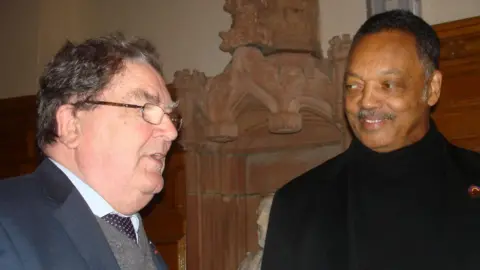
The year is 2011 and two political giants meet in Londonderry, a stronghold of the Northern Ireland civil rights movement in the late Sixties and where it is widely believed the Troubles began.
Nobel Laureate John Hume and Rev Jesse Jackson dedicated their lives to civil rights - on both sides of the Atlantic.
Jackson died on Tuesday and Hume in 2020, 22 years after the former SDLP leader and other political leaders in Northern Ireland signed the historic Good Friday Agreement.
It largely brought an end to 30 years of violence, which claimed the lives of more than 3,600 people.
And though they lived on opposite sides of the Atlantic, they shared a thirst for peace and justice through non-violent means.
Jackson would visit Derry twice, in 2011 and 2017, using both occasions to promote peace, equality and continued reconciliation.
During his 2011 visit, he met community leaders, clergy, and political representatives, encouraging dialogue and warning against a return to violence.
Jackson returned to Northern Ireland in 2017 amid renewed political uncertainty following the collapse of Northern Ireland's power-sharing Executive earlier that year and opened the Museum of Free Derry.
Robin Percival, of the Bloody Sunday Trust, said it was a great privilege to meet Jackson twice.
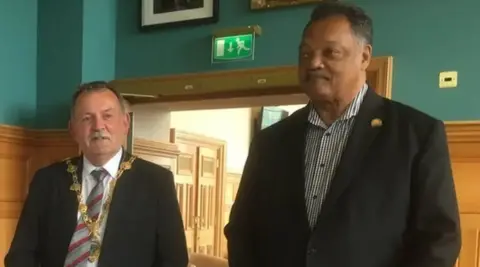
Speaking to BBC Radio Foyle's North West Today programme on Wednesday, Percival said he was struck by his "commitment and belief" in what was happening in Northern Ireland to bring about lasting peace and reconciliation.
He was also encouraged by Jackson's support for the campaign for truth and justice by the Bloody Sunday families.
"He was interested in the various struggles for justice which Derry had come to symbolise, not just in Ireland but internationally," Percival said.
"There's no surprise to that, of course, because the museum tells the story of the civil rights movement and the campaign regarding Bloody Sunday.
"He was very much in tune with all of that because it resonated with experiences in the United States and his attempts to make meaningful change."
Thirteen people were shot dead when the Army opened fire on civil rights demonstrators in Derry in 1972.
Last October, a former paratrooper known as Soldier F was found not guilty of two murders and five attempted murders on Bloody Sunday.
Who was Rev Jesse Jackson?
 Reuters
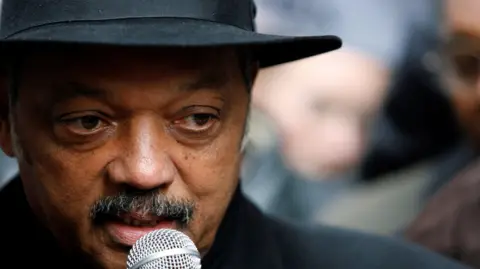
Born in 1941 in Greenville, South Carolina, Jackson became involved in politics at an early age.
He rose to prominence in the 1960s as a leader in Martin Luther King, Jr 's Southern Christian Leadership Conference and was with King when he was assassinated in Memphis, Tennessee, in 1968.
Over the course of his career, Jackson built a movement to bring America's increasingly diverse population together, with a message that centred on poor and working-class Americans.
Running for president in 1984 and 1988, Jackson is remembered as the founder of a non-profit organisation focused on social justice and civil rights, the Rainbow PUSH coalition.
After his presidential runs, Jackson later positioned himself as an elder statesman within the Democratic Party.
He died aged 84 on Tuesday morning surrounded by relatives.
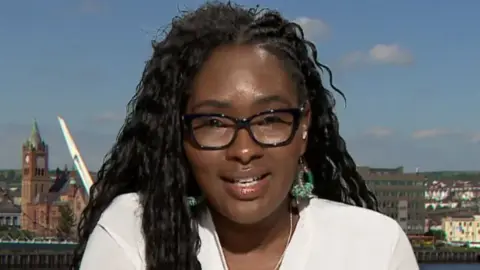
SDLP councillor Lilian Seenoi Barr, who made history as Northern Ireland's first black mayor in 2024, described him as a trailblazer and one of "true giants of the civil rights movement".
Seenoi Barr said her heart went out to the family of Jesse Jackson and "all the people around the world mourning his passing.
"He was one of the true giants of the civil rights movement and someone who believed deeply in the power of people.
"He proved that it was possible for ordinary people to make real change."
She remembered watching him on television when Barack Obama became the first black president of the United States.
"The tears on his face - in that moment, you could see the real emotion and that memory is so vivid to me and serves as an inspiration to all of us."
Seenoi Barr said Jesse Jackson proved that "progress is possible" and that justice is "worth fighting for".
