'We're carrying on the legacy of over a century of rope making'

 BBC
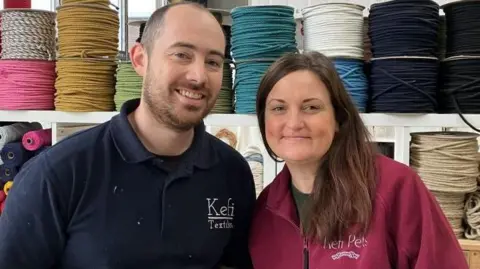
BBC"There's hardly any of us now, but each town would have their own rope maker," Heather Cumpstone says over the gentle hum of machinery. "If we don't keep using those techniques, traditional rope making will die out."
Heather, alongside her husband, Andrew, are one of two remaining businesses in North Yorkshire using heritage methods to weave - or "lay" - ropes by hand.
Their warehouse, near Richmond, is filled with brightly coloured yarn at all stages of development, from braided fibres to thick spools of rope, ready to be used.
Rope making is classified an endangered craft, featured on charity Heritage Crafts "Red List" of trades and skills at risk of extinction.
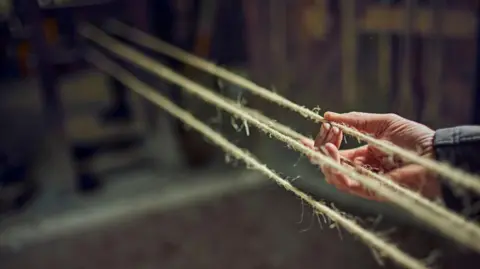
Traditional ropemaking techniques include using a ropewalk, a long, straight area where material can be spread out fully and twisted together by hand.
The charity estimates there are less than 20 craftspeople left in the UK, including Heather and Andrew's business, Kefi Textiles.
North Yorkshire itself has a long history of rope making, one in which Andrew has played a part as a former employee of Outhwaites, based in Hawes.
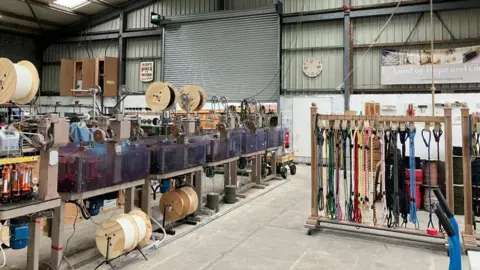
"I was a mechanical engineer, so I went to the rope makers for a job interview to look at their machines and maintain them," Andrew said.
"That quickly progressed from me fixing machines to me operating machines, but it started really as a side hustle sort of thing."
After more than a century in business, Outhwaites closed in 2022, very nearly wiping out the trade completely in North Yorkshire.
However, the Cumpstones stepped in to buy up a number of machines, transporting them to their workshop in Melsonby.
"When we kind of leapt into this, Andrew came with eight years experience and I had absolutely none," Heather said.
"I hadn't made any rope before - I had to jump in at the deep end."
Although they use machines for larger commercial orders, they are both proud to use the traditional ropewalk for lifestyle products like curtain tie backs and banister ropes, Andrew said.
 Getty Images
"I think the retail avenue is the only way to sustainably do the handmade aspect of it, just because of the time involved," he said.
"You couldn't commercially walk things out by hand and sell them at a price that would compete with things that people could be bringing in from anywhere else.
"Whereas when you're turning it into a finished product, it's then got a value that people are willing to pay for.
"It's all handmade in the UK, the carbon footprint and mileage is basically Yorkshire."
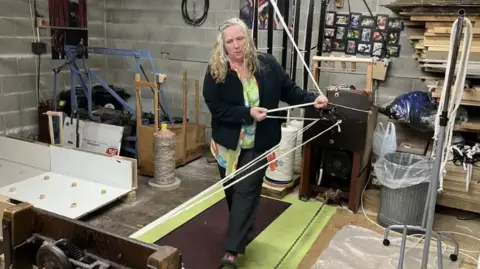
Some of Outhwaites other machines were purchased by Caroline Rodgers, another ex-Outhwaites employee, who set up her business in Askrigg, 12 miles (19.3 km) from Leyburn.
Nestled in the heart of Wensleydale, Askrigg has all the hallmarks of a postcard-perfect Yorkshire Dales village - a fitting location for a traditional rope maker.
Operating from her kitchen table and her workshop, Caroline crafts all of her products, from dog leads to skipping ropes, by hand.
Her customer base generally comes from rural businesses, farmers and dog-owners, and she is a regular attendee of agricultural shows.
Reflecting on when she first turned her hand to the trade, she admits "it wasn't easy to start with".
"I'm not a crafty person, but I'm practical. If I put my mind to something I can do it, but it completely messed with my head when I started," she said.
"I think I used to spend most of my working day watching other people, mesmerised, but I soon picked it up."
 BBC/Emily Johnson
Three years after setting up the business, she said she "absolutely loves" what she does, although being a small business in a niche field comes with challenges.
"People find it so easy, and I'll admit I can be one of those people, who just goes online and orders something quickly, it's too easily done," she said.
Caroline appeared on BBC One's Countryfile in August - an experience she says she thoroughly enjoyed - and, following the episode's airing, online orders shot up.
She said: "It was incredible, but you did get the odd one who after 24 hours would say 'your customer service is terrible, where's my dog lead?'
"What you want to say is 'all your orders are made to order, not pulled off a shelf'.
"I think people can have that mindset of click, 24 hours and it's on your doorstep."
However, most people are supportive of the business, particularly when the aim is to keep a craft alive, she said.
"My aim is trying to get people to not change their mind, but perhaps bend their mind, that there are good quality products made in the UK.
"Outhwaites may be closed, but me and Andrew are open for business."
'A nod to history'
Aside from their employment history, and despite their different retail avenues, something that both businesses share is a passion for keeping the tradition of rope making alive.
In the future, Andrew and Heather would love to offer educational sessions to schools parties and other groups at the Kefi Ropemakers workshop, Heather said.
And while Caroline has no current plans, she too said it would be nice to pass along her knowledge to the next generation, to ensure the trade could survive for longer.
"Too many things are dying off, too many crafts are disappearing," she said.
"The heritage is important - there's been a rope maker in the Dales since at least 1905."
Heather adds: "It would be really sad to see that history die out.
"Although there are efficient ways for making rope when we're looking at larger quantities, there's that lovely balance - it's a nod to history really."
Listen to highlights from North Yorkshire on BBC Sounds, catch up with the latest episode of Look North.
