Footballer killed in WW1 honoured in exhibition

 BBC/Green Howards Museum
The only Victoria Cross medal ever to be awarded to an English professional footballer has gone on display in his home county.
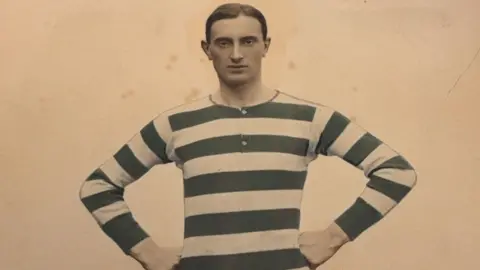
2nd Lt Donald Simpson Bell, from Harrogate, North Yorkshire, was given Britain's joint-highest award for gallantry in recognition of his bravery during World War One.
Bell was playing football for Bradford Park Avenue when war broke out, saying he was "duty-bound to join the ranks".
More than a century later, his Victoria Cross (VC) features in a new exhibition about links between football and the military at the Green Howards Museum in Richmond.
The VC recognises an act of extreme bravery in the presence of the enemy and awarded to recipients across the British Empire and Commonwealth.
Since 1940, it has been seen as equal in status to the George Cross, which recognises acts of bravery when an enemy is not present.
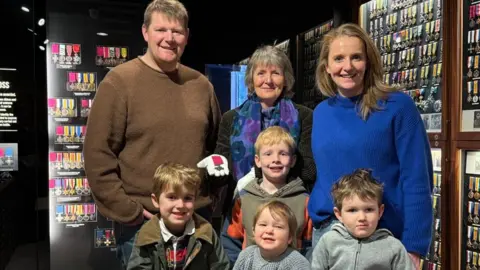
After being shown the VC, Bell's great-great-great-nephew Archie, six, said: "I'm proud because I've never seen it before.
"He wanted his friends to be alive so he did it for his friends."
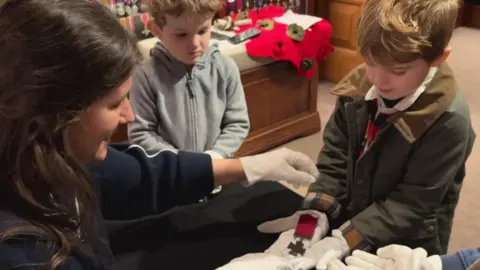
Archie's cousin Oliver, eight, said Bell's bravery came during the Battle of the Somme.
"He ran in a trench and threw a grenade at a German machine gun," he said.
On 10 July 1916, the 25-year-old was killed making a similar attempt on another gun placement at Contalmaison.
The museum tells the stories of the Green Howards Regiment, an infantry regiment raised in 1688.
The nickname survived until it became the official title in 1920, with the regiment forming part of the Yorkshire Regiment in 2006, later becoming the Royal Yorkshire Regiment.
 BBC/Claudia Robinson
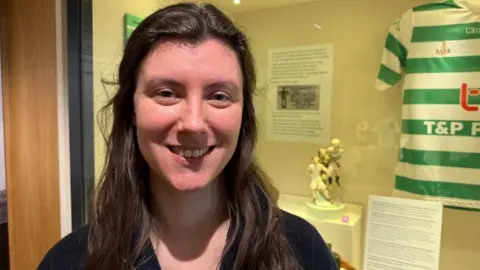
The sporting exhibition enables the museum to "tell the stories of those Green Howards who were footballers as well", said Zoe Utley, head of collections.
"There's so many shared values between the military and football, values of duty, loyalty, commitment to your team, discipline, keeping your kit clean," she said.
"The military used football to help with the mental health of their soldiers coming off the front lines.
"They used it to create that regimental identity because if your team works well on the football pitch, they're going to work well on the battlefield."
 BBC/Claudia Robinson
Bell's VC is currently on loan to the Green Howards Museum from the National Football Museum in Manchester.
His great niece Alison said seeing the medal meant "the little ones could take on the story".
"I often think that Uncle Don would be amazed to think his story and zest for life was still being displayed and documented 110 years later," she said.
Oliver's mother, Victoria, said the family stories became "a reality" for the children after holding the medal.
"It makes them very proud, makes us very proud, so it's a very special day to be able to come and see the medal together."
Listen to highlights from North Yorkshire on BBC Sounds, catch up with the latest episode of Look North.
