Seal pups bottle-fed as rescue numbers rise

 Scottish SPCA
An animal rescue charity has developed a new technique to help the recovery and release of grey seal pups, following an influx of rescues.
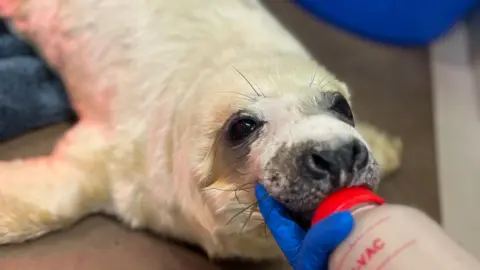
Staff at the Scottish SPCA have started to bottle-feed orphaned and injured pups with a balanced seal-specific milk formula, while managing its busiest period of grey seal rescue and rehabilitation.
The charity said the method, while still in the early stages, provides a more positive and lower stress feeding experience for premature and vulnerable pups compared to a feeding tube in its throat.
It has already helped the recovery and successful release of three grey seals since its development last year.
The Scottish SPCA's National Wildlife Rescue Centre at Fishcross in Alloa brings in about 90 grey seal pups every year in the five months from October to March, during its peak rescue season.
The charity said human interference is driving an increase of admissions of grey seals to the centre as people coming into contact with seal pups can cause the mother to abandon them.
Dog attacks and the disturbance of pregnant seals, which can lead to premature birth and abandonment, are also growing issues.

Caitlin Ganley, a senior wildlife assistant at the National Wildlife Rescue Centre, said she had been feeding a premature grey seal when it began to show signs it would take a bottle.
"Last year a perfect wee seal came in, it had no teeth so it wasn't aggressive or anything like that.
"I was feeding her and noticed she was suckling on me quite a lot so I just went and grabbed a bottle and she suckled all the feed straight away," said Ganley, who has been leading the bottle-feeding project.
For bottle-feeding to be successful the seals must be at the right stage of development as Ganley said grey seals can come across as cute but can be very defensive.
"It's something we'd always wanted to try because it's so much more natural, but we hadn't really managed it before," she said.
Wildlife vet Joe Heaver said the centre normally used a fish-based diet for young pups but it is transitioning to use a mixture of fish and milk-based products.
However it is difficult to recreate.
"The milk that seals would eat from their mother in the wild is extremely difficult to replicate because it is very high in fat and there is not an animal that replicates that that we can take milk from," Heaver said.
Over the past couple of years the centre has trialled using different milk products and feeding the seals in different ways, including bottle-feeding.
"Bottle feeding is a more natural way of feeding seals and more similar to what they do in the wild, but it's not as quick so you're spending more time with the seal, which could be more stressful," he said.
Heaver said the new feeding methods are showing some promise but it is still early days so it is difficult to know how effective it is compared to what was done before.
