How AI is helping to study tourist impact on seals

 Getty Images
Artificial intelligence is helping the study of seal numbers at a protected Scottish site by drastically cutting how long it takes to assess data.
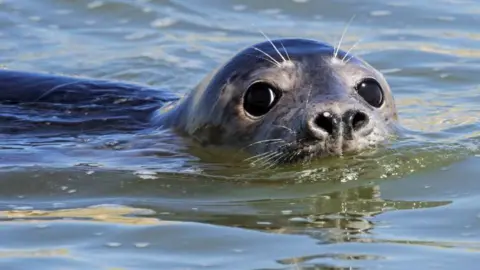
Newburgh beach in Aberdeenshire is home to hundreds of grey seals.
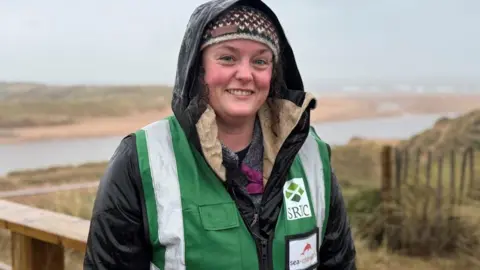
Marine biologist and Scotland's Rural College (SRUC) PHD student Claire Stainfield has been using drone footage to monitor and count the mammals, with the aim of assessing if tourist numbers have an impact on the population.
She said processing the data from the drone would normally have taken her hours, but she is now using an AI tool to do the same job in just seconds. She hopes it can also be used in other areas of ecology.
The Ythan Estuary at Newburgh beach became a designated seal haul-out site in 2017.
These are protected locations on land where seals come ashore to rest and breed.
Claire described it as the perfect location for her research.
"If you talk to anyone from about 50 years ago, there were only about 10 to 20 seals on the beach," she said.
"Now, at their peak, there are over 3,000."
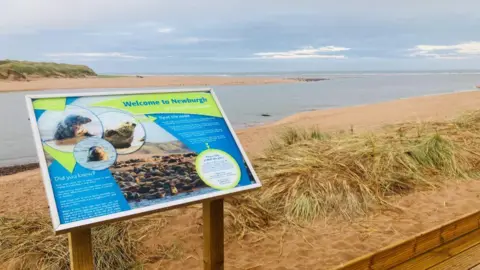
There has been an increase in tourists to the area.
It is an offence to disturb the seals in any way, so members of the public have been asked to stick to the south side of the beach.
Recreational drones are not allowed, but Claire has been given special clearance for research purposes.
She is examining how people and seals share the area, and if the rising tourist numbers are impacting the seal population.
"My research is showing that if we stick to the south side of the beach the disturbance is really minimal, compared to if someone walks along the north side," she said.
 Claire Stainfield
Claire said she was trying to be really ambitious with the scope of the work.
"What I've tried to do is collect a data point once a week for two years and that's right the way through a very Aberdeen winter," she said.
"This gives a really good idea of the seasonality of how the seals use the beach. My drone footage is getting GPS locations of where they're sitting."
She said that during summer the seals are at the mouth of the estuary, where they spend more time foraging and at sea.
This coincides with when the beach is busier with people.
In winter, when they are breeding and moulting, she said they tend to haul out at the high tide mark which is quite close to a new walkway and viewing point for people to use.
The beach is usually quieter due to the poorer weather at that time of year.
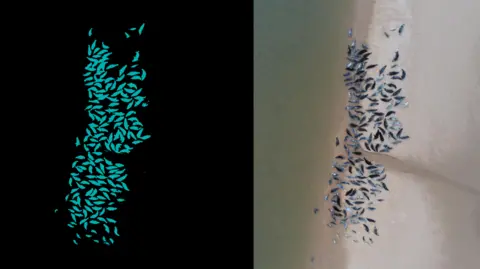
She said artificial intelligence was really helping her process data, rather than having to manually count seals on a screen.
"I was getting 1,000 seals a survey so I needed something which would help me streamline the data," she said.
She said it had not been a "quick fix" to set up, as she had to manually train the AI model to identify the seals.
She said a drone image which shows about 2,500 seals would normally take three hours to process, but that her finished AI model could now do it in seconds.
"It's huge, it's saving a lot of time," she said.
"My study site has been a perfect opportunity to test this AI model because the seals have stuck out from the sandy beach."
She said the next stage would be to try it on different sites, and then on different species.
"Drones and ecology are really taking off, people are using them much more," Claire said.
"They give accurate counts, they're less invasive so you can get to more difficult areas and not disturb the seals as much.
"Having a tool that can be used alongside the drones would really help with a lot of industries wanting to use drones."
