Russia hits Ukraine with rarely used Oreshnik missile in fresh strikes

 Reuters
Russia has used the Oreshnik ballistic missile as part of a massive overnight strike on Ukraine.
Four people were killed and 25 others injured in Kyiv on Thursday night, where loud booms could be heard for several hours, setting the sky alight with explosions.
It is only the second time that Moscow has used the Oreshnik, which was first deployed to hit the central city of Dnipro in November 2024.
Russia's defence ministry said the strike was a response to a Ukrainian drone attack targeting Vladimir Putin's residence in late December, which Kyiv denies carrying out.
While the ministry did not specify what had been the Oreshnik's target, shortly before midnight (22:00 GMT) videos began circulating on social media showing numerous explosions on the outskirts of the western city of Lviv.
President Volodymyr Zelensky and Ukrainian authorities confirmed that a ballistic missile had struck infrastructure in Lviv, about 60km (40 miles) from the Polish border.
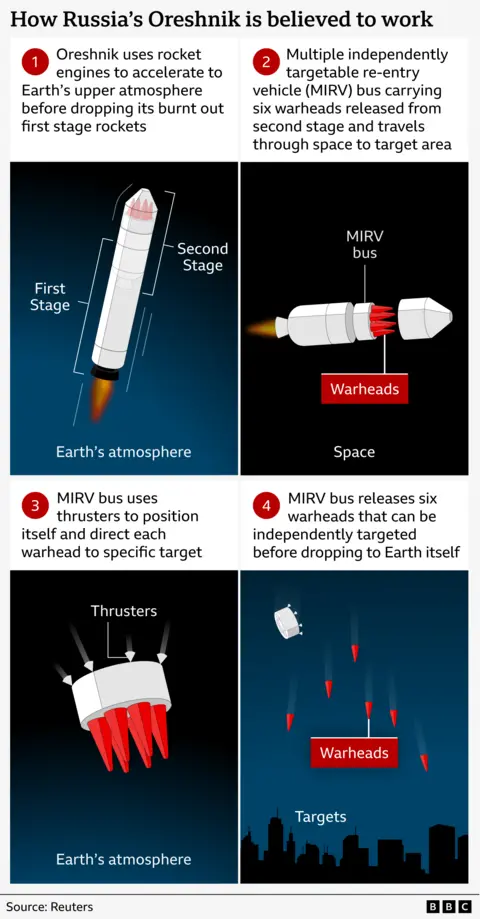
The Oreshnik is an intermediate-range, hypersonic ballistic missile, meaning it can potentially reach up to 5,500km (3,417 miles). It is thought to have a warhead that deliberately fragments during its final descent into several, independently targeted inert projectiles, causing distinctive repeated explosions moments apart.
"Such a strike close to EU and Nato border is a grave threat to the security on the European continent and a test for the transatlantic community," Ukrainian foreign minister Andrii Sybiha said.
The strike was launched "in response to [Putin's] own hallucinations," he added, referring to the alleged drone attack on the president's residence in December.
The EU had immediately cast serious doubt on whether the drone strike ever happened, and last week Donald Trump said he did not think any such attack had taken place.
On Friday EU foreign policy chief Kaja Kallas said Russia's Oreshnik strike was meant as a warning to Europe and the US.
"Putin doesn't want peace, Russia's reply to diplomacy is more missiles and destruction. This deadly pattern of recurring major Russian strikes will repeat itself until we help Ukraine break it," she wrote on X.
Zelensky said in addition to the Oreshnik, 13 ballistic missiles targeted energy facilities and civilian infrastructure overnight, along with 22 cruise missiles and 242 drones.
One damaged a building at the Qatari embassy, he added.
He accused the attacks of aiming "against the normal life of ordinary people" during a cold spell and added everything possible was being done to restore heating and electricity.
As Lviv and other western regions were targeted on Thursday night, more than a dozen missiles and hundreds of drones were deployed during the attack on Kyiv.
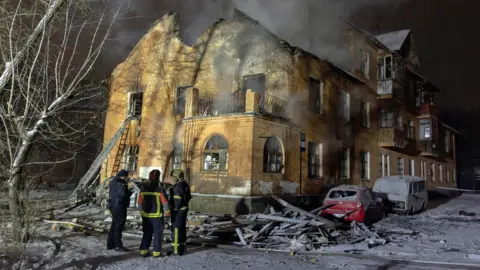
A paramedic was among those killed while arriving at a damaged apartment in Kyiv. The capital's mayor, Vitali Klitschko, and Zelensky said it had been a "double-tap" hit - in which the first strike is followed by a second, killing rescuers who have arrived to help the injured.
Two apartment buildings along the east bank of the Dnipro River and a high-rise building in the city's central district were also targeted.
The morning after, as the clean-up got underway, the businesses that hadn't been damaged were open.
A coffee shop just a few floors down from a destroyed apartment was serving customers. Wreckage from a Russian drone, including its wings and engine, were still scattered over the pavement outside.
At another site, the round, charred entry hole of a missile was visible on the 11th floor of an apartment block in a quiet residential area.
The power supply was disrupted in several of the city's neighbourhoods in the middle of a particularly harsh winter and as Kyiv braces for -15C (5F) temperatures this weekend.
On Friday Klitschko urged Kyiv residents to leave temporarily if they were able to, and find warmth.
"Half of Kyiv's apartment buildings - nearly 6,000 - are currently without heat due to damage to the capital's critical infrastructure caused by a massive enemy attack," he wrote on social media.
Kyiv's streets now relentless hum with the buzz of the diesel generators that businesses rely on for power, but many residential buildings are reliant on central heating and restoring it can be a longer task.
The targeting of power plants has become a constant feature of this war, with Ukraine increasingly responding in kind to Russia's sustained attacks on energy infrastructure that regularly leave millions without access to electricity or heating.
On Thursday night, as Moscow's attack on Ukraine was ongoing, half a million people in the Russian region of Belgorod were left without power following Ukrainian shelling of infrastructure, the local governor said.
Authorities also said that a Ukrainian strike on a Russian power plant in the city of Oryol, further north, affected the water and heating systems.