Zelensky fears Trump's Iran war could hurt Ukraine

 Reuters
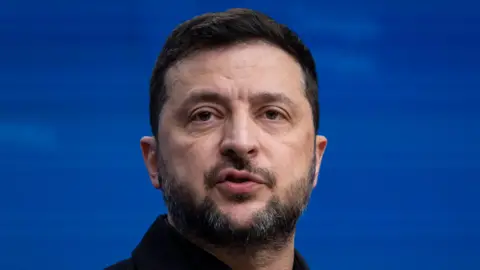
President Volodymyr Zelensky has warned that the war in the Middle East could leave Ukraine struggling to source air defence missiles.
He also said there was "a risk" Ukraine's allies could be distracted by the conflict, and forget his country's defence against Russia's full-scale invasion.
"We could find ourselves having difficulty obtaining missiles and weapons to defend our skies," he told Italian newspaper Corriere della Sera. "The Americans and their allies in the Middle East might need them to defend themselves, for example Patriot missiles."
Asked if there was a risk the United States and the European Union could forget Ukraine's defence while focused on the Middle East, Zelensky replied: "Of course, it's a risk. But I hope the Iranian crisis remains a limited operation and doesn't turn into a long war. We know first-hand how bloody it risks being."
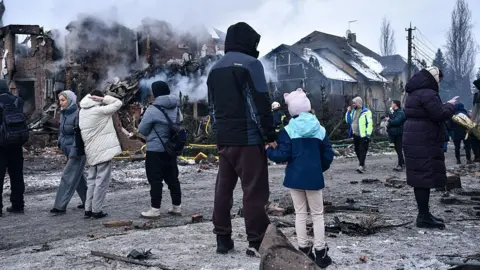
For years Ukraine has become accustomed to being in the eyes of the world. Last week the streets of Kyiv thronged with Western leaders marking the grim, fourth anniversary of the moment Russia launched its all-out war.
But a few days later, people here in Ukraine's capital have felt an almost tangible shift of focus away to another conflict. Some here have pointed out the reaction of Gulf residents to drone strikes that in Kyiv would prompt no more than a shrug. But more fear what the fighting in the Middle East might mean for them.
Zelensky's remarks illustrate that uncertainty. On one hand he is gloomy, pointing to the risks that Ukraine's defence against Russia becomes a forgotten war. There is already uncertainty about whether the latest planned talks with the US and Russia will take place.
He is also aware the vast numbers of air defence interceptor missiles being fired off by Gulf countries could lead to a global shortage, making such weapons more expensive and harder to find.
 Getty Images
That was certainly true last summer when Israel and the US attacked Iran's nuclear facilities. "Israel was under Iranian attack then, and missile delivery programs for us were slowed down," Zelensky said. "It hasn't happened yet, but I fear it could happen again."
On Truth Social, President Trump claimed the US had an "unlimited supply" of arms. But he also used his post to mock Zelensky as "PT Barnum", a 19th-Century US showman and hoaxer, suggesting Ukraine's leader had tricked President Joe Biden into giving away too many US weapons for free.
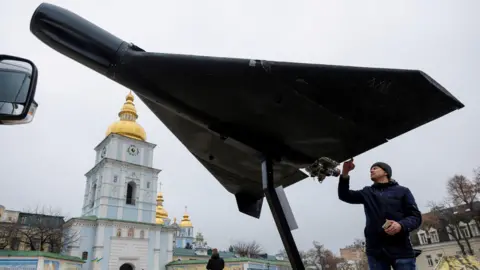
Nonetheless, Zelensky has also looked for positives. Iran has sold Russia tens of thousands of Shahed drones that almost nightly wreak deadly havoc on Ukraine. That may stop. "I think attacking Iranian military targets was a good decision," he said. "The Iranians produce a lot of weapons for Russia, especially drones and missiles, although I don't think they'll be able to do that anymore."
Analysts point out however that Russia now also produces Shaheds domestically, after taking Iran's design and modifying it for attacks on Ukrainian cities.
Kyiv may also benefit, financially and politically, if it could support Gulf partners with drone technology and expertise – but, as Zelensky has pointed out, that could probably happen only if Russia were to agree a ceasefire.
Ukraine's president also believes Vladimir Putin's failure to support Iran shows the Russian president's weakness: "He talks, but doesn't act, demonstrating that he is a weak ally of the Iranians. Just as he was with Bashar Assad's Syria."
That optimistic note was echoed by Oleksandr Merezhko, chairman of the foreign relations committee in Ukraine's parliament. He told me that by supporting US attack on Iran, Ukraine could win favour in the White House: "The US does not view us as allies, but as partners," he said.
"This gives us a chance to show that we are allies. We are fighting against the same coalition – Iran and Russia."
Merezhko also said Moscow had lost influence with the US because it could no longer argue it had influence over Tehran and its nuclear ambitions. "Iran does not have this leverage anymore, so it has become less useful in the eyes of Trump," the MP said.
 Getty Images
Others are less sure. They point out Russia has no formal defence partnership with Iran and had made no commitment to come to its aid in event of a US attack. Some also suggest Putin is deliberately staying out of the conflict, apart from calling Gulf leaders to offer Russia's services as a mediator with Iran.
John Lough, head of foreign policy at the New Eurasian Strategies Centre, said: "Putin's priority is to preserve the relationship with Trump and to use it to help him out of the quagmire he has blundered into in Ukraine."
"In return for not standing in Trump's way in Iran, he can reasonably expect Washington to put more pressure on Ukraine to accept his terms for peace," Lough added.
Russia may also gain if global oil prices continue to soar, fuelling its industrial war machine. The US-based Institute for the Study of War think tank said: "Sustained high oil prices could keep Russia economically afloat and allow Russia to fund its war in Ukraine in the medium term."
But crucially, it added: "It is unlikely, however, that Iran can successfully and indefinitely impose a blockade on the Strait of Hormuz long enough for Russia to reap long-term benefits from the current surge in oil prices." Just one reason why Ukrainian policymakers are hoping the war in the Middle East does not sustain.
The biggest fear, perhaps, in Kyiv is that conflict in the Middle East fuels yet more war fatigue over Ukraine. One diplomat told me that despite rising temperatures as winter makes way for spring, the mood in the capital was grim.
"There is a lot of exhaustion," they said. "The mood is almost brooding. There is a deep sense of betrayal from the Americans. And less trust in the Europeans. And now all this distraction. It's not great."
