Sharp knives removed from children's care homes

 PA Media
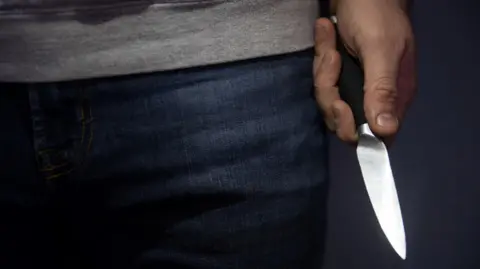
Kitchen knives in children's care homes are to be replaced with utensils with rounded tips to improve safety.
The change at care settings in Doncaster and Sheffield is part of the new Rounded Knife project by South Yorkshire Police.
The region's deputy mayor, Kilvinder Vigurs, who has responsibilities for police and crime, said in a report that rounded knives were a "safer" alternative.
Knife crime campaigner Anthony Olaseinde has already run a pilot project in supported living accommodation and said it had "a really positive effect" on staff and residents.
The force's Violence Reduction Unit has introduced the replacement scheme as phase one of the new project.
In a report to the South Yorkshire police and crime panel ahead of its next meeting, the deputy mayor said: "Rounded knives are being promoted as a safer alternative to traditional pointed-tip knives, particularly in kitchen settings, to reduce the risk of accidental injuries and potentially decrease the severity of knife-related incidents.
"Research suggests that rounded knives, especially those with blunt tips, can perform most common kitchen tasks effectively while minimising the potential for harm.
"Knives with rounded tips are much less attractive than weapons. As phase one of the project, 51 sharp knives have been removed from identified properties and replaced with a safer alternative."

Anthony Olaseinde, of the charity Always An Alternative, did his research by replacing kitchen knives in semi-independent supported living for young people aged 16 to 24 in Barnsley and Rotherham.
He said: "We spoke to 70-plus staff and young people in the homes and it was all positive. It reduced the worries around kitchen knives being left out and used on somebody.
"If you go to a household not at high risk of violence, they wouldn't see the benefit of changing over the knives because they wouldn't see them as a threat or a weapon.
"I've got experience working in children's homes and I know that unfortunately a lot of residents suffer trauma which makes them more high risk of violence. So in that environment kitchen knives are locked away because they're seen as a potential weapon.
"But residents need support with cooking to get them ready to live by themselves, so they were losing out on basic life skills because they weren't allowed to use those kitchen knives or they had to go through a whole process to access one.
"The scheme reduced the amount of knives locked away and it was really positive."
'Reconsidering knife bins'
The police and crime panel will also discuss the 17 knife bins which are installed around South Yorkshire.
The report added: "Eleven knife bins are being co-ordinated and emptied by neighbourhood policing teams and six bins are being managed and emptied by Always An Alternative.
"Discussions are ongoing on the future status of the bins, if more knife bins need to be installed in certain areas or removed altogether. Work is taking place in relation to how effective these bins are or what impact they have as the number of knives collected are small/minimal."
Olaseinde, however, said the bins were effective.
"There is one in Gleadless which has been there around three months and over 60 knives have been put in it.
"The bins get checked once every two weeks by a police community support officer, it's an hour's work, and it seems like a no-brainer because they are successful."
The police and crime panel will discuss the issues at a meeting on 2 February.
Listen to highlights from South Yorkshire on BBC Sounds, catch up with the latest episode of Look North
