The day a sweet factory sang to the nation

 Hull History Centre
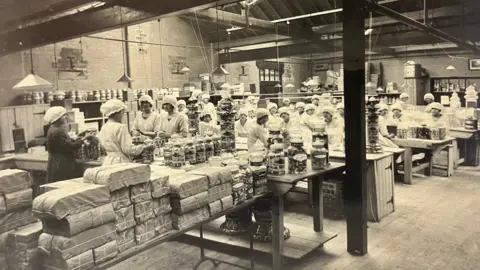
It was a factory renowned for making boiled sweets, toffees and chocolate. But in 1949, Needler's in Hull was the location for an episode of a BBC radio programme that was broadcast to the nation.
Earlier this year, a dusty old reel of tape and a book stuffed with letters and photographs was dug out of the archives at the BBC Radio Humberside office.
On the tape was a BBC Home Service broadcast, which dated back to 1949. It had been donated in 2004, along with a scrapbook explaining its story, by Doreen Hurlock.
The programme was called Works Wonders - a lunchtime concert and, on 16 February 1949 at 12:30 GMT, it was broadcast live from the factory.
But how did this come about?
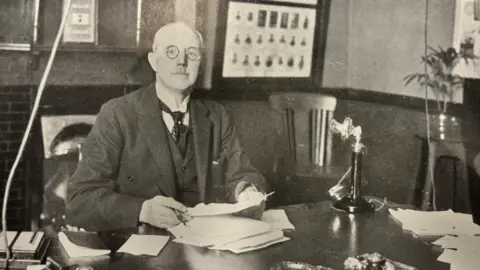
The factory was named after Frederick Needler, who was born in 1864 in Arnold, near Skirlaugh, in East Yorkshire.
By 1871, his family had moved to Argyle Street in Hull, but life changed for Fred the year after, when his father, George, died of typhoid aged 37.
Aged 14, Fred left school and got a job at a tea and coffee warehouse on High Street in the city, before becoming a bookkeeper for a small-scale confectioner, Edward Buckton, at the age of 18.
When this business failed, Fred bought the equipment, stoves, rollers and slabs he used for £100 and, in 1886, opened his first sweet-making business in Anne Street, Hull.
 Hull History Centre
Years of growth followed and, in 1906, he moved the factory to bigger premises on Bournemouth Street, off Sculcoates Lane, and the company became Needler's Ltd.
By 1912, 576 different products were being produced, including boiled sweets, toffees and chocolates, which were sold in clear glass jars.
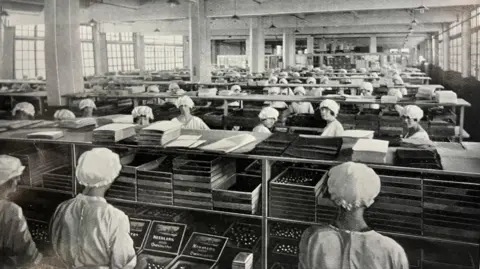
It was a huge employer at the time, with about 1700 people, mainly women, employed at the turn of the 1920s.
Outside of work, Fred became a benefactor. One donation he made was giving Needler Hall in Cottingham to the newly established University of Hull.
Fred died in 1932, aged 67. His health had deteriorated after being diagnosed with Parkinson's Disease.
 Hull History Centre
Fast forward 17 years and the factory was in the spotlight for a slightly different reason.
As described by BBC producer and presenter Barney Colahan, the site's canteen became "crowded with white-coated workers who were just enjoying their midday break".
The building was then filled with the sounds of soloists, musicians and a choir.
At one point in the programme, Colahan said: "Up to now, our audience of workers have been entertained by their work concert party.
"So now we're giving them all a chance to shine as singers by joining in a selection of popular songs. Irene Solo will lead the singing, and off we go with Slow Boat to China and Love Somebody."
After the rendition, Colahan added: "As I doubt you heard, some of our audience were rather too eager to love somebody. Well, we've almost come to the end of today's Works Wonders, and the concert party closed our programme with Show Business.
"So on behalf of the artists and the audience, may I say, goodbye for now."
Almost 76 years later, the tapes may have gone back into the archives but the story of this remarkable day, told as part of the Hidden East Yorkshire podcast, lives on.
Visit BBC Sounds to listen to the full series of Hidden East Yorkshire.
Listen to highlights fromHull and East Yorkshire on BBC Sounds, watch the latest episode of Look Northor tell us about a story you think we should be coveringhere.
Download the BBC News app from the App Storefor iPhone and iPad orGoogle Play for Android devices
