Girl, 14, needs incontinence pads after using ketamine

 Getty Images/BBC
A 14 year-old pupil has been forced to wear incontinence pads to class after ketamine use damaged her bladder, a school worker has told the BBC.
Sarah, not her real name, says the drug is too easy for children to get hold of through social media, as illegal use of ketamine reaches record levels.
Long-term use of ketamine can lead to serious health issues affecting the bladder - known as "ketamine bladder" - and kidney and liver problems.
The government has been consulting with experts on whether to reclassify the drug from a Class B to a Class A controlled substance.
Sarah says some drugs including ketamine are too accessible.
"I've actually seen students come in who've openly voiced that they've been taking recreational drugs," she says. "We're talking about ages 13, 14, sometimes as young as 12."
She says people are sending "menus for drugs" via social media, adding: "I've heard there are large groups of slightly older youths coming down from London to the coast and they're bringing drugs with them.
"One student in particular was quite open about her partying at the weekend and she openly admitted that she had to wear an incontinence pad."
Urinating 'every 10 minutes'
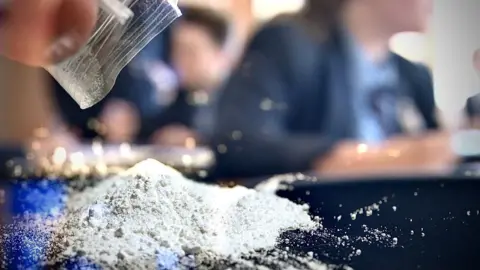
Ketamine, also known as "Ket" or "K", is widely used in the NHS as an anaesthetic, sedative and pain reliever, and is also commonly used on animals. It usually comes as a crystalline powder or liquid.
Because of its hallucinogenic effects, it is also thought of as a party drug.
Tolerance is known to build up quickly, so users need more and more to feel an effect.
Ketamine was upgraded from a Class C substance to a Class B in 2014 due to concerns about its physical and psychological dangers.
The Advisory Council on the Misuse of Drugs (ACMD) says it should not be reclassified as a Class A drug and should remain a Class B controlled substance.
The ACMD stated that reclassification alone would not reduce the harm caused by ketamine.
It advocates that police forces and health care professionals must receive greater support to better identify, prevent, and respond to ketamine‑related harms.
The government says it is considering the report before responding.
There has been a surge in the drug's prevalence among 16 to 24 year olds, with the Office for National Statistics estimating the use of ketamine has doubled in a decade.
A survey of more than 13,000 secondary school-age children in England in 2023, found 11% of 15 year-olds surveyed had been offered the drug at some point.

Joel started using the drug when he was 14, and now, in his late 20s, is facing an operation to re-model his bladder.
He says: "I'd be going [to the toilet] every five minutes, 10 minutes.
"I take 31 tablets a day just to mask my pains and my toilet troubles, this drug has ruined my life.
"I've lost friends over it. It should 100% go Class A."
Fellow recovering addict Saul says he sometimes goes to the toilet up to six times an hour and describes it as like having an open wound.
He says he doesn't believe a law change would make any difference.
"As an ex addict, I don't think it really matters," he says.
"If I want to use, I'll find some to use, so it doesn't matter if it's a Class A, Class B or Class C."
'Destroying lives'
Joel and Saul are supported by the Kenward Trust in Kent, which provide residential rehabilitation for people with addictions.
Manager Mark Holmes says over half of their current residents are in recovery from ketamine use.
"Some residents have had to have urine bags fitted because their bladders cannot work or function properly," he says.
Mohammed Zaheen Ahmed works at Primrose Lodge, a drug and alcohol rehabilitation centre in Guildford, Surrey, which treated 54 people for ketamine addiction in 2025.
He says: "Last year I was called to a school. They were saying children have been found using ketamine, they were in pain and suffering and they contacted us.
"It's destroying young people's lives."

Prof Seshadri Sriprasad, a consultant urological surgeon at Darent Valley Hospital in Dartford, says he has seen an increase in the number of patients with ketamine bladder in the last 12 months, with his youngest patient just 17 years old.
He says: "Once it goes into the bladder the lining gets damaged, you get ulcers, they start to bleed, so this leads to continuous damage, which makes the bladder smaller and smaller as time goes by."
Speaking to BBC South East, he says one of his patients died recently from liver failure, due to the effects of using ketamine.
"We are seeing the tip of the iceberg, so I think we need to have the right education and awareness of this habit and they need to try their best to get off this," he says.
- If you have been affected by any of the issues raised in this article, you can find advice at BBC Action Line.
The maximum penalty for possession is up to five years in prison, an unlimited fine, or both.
A Home Office spokesperson said: "Ketamine is an extremely dangerous substance and the recent rise in its use is deeply concerning.
"Conversations with those affected are essential to understanding what more needs to be done to tackle supply and addiction.
"We are grateful to the Advisory Council on the Misuse of Drugs for publishing their assessment.
"We will now consider the report carefully and respond as a matter of priority."
Additional reporting by Jonathan Fagg, Senior Data Journalist, England Data Unit
Follow BBC Kent on Facebook, on X, and on Instagram. Send your story ideas to southeasttoday@bbc.co.uk or WhatsApp us on 08081 002250.
