Highly unusual sperm whale strands on two beaches

 Cetacean Strandings Investigation Programme/ Zoological Society of London
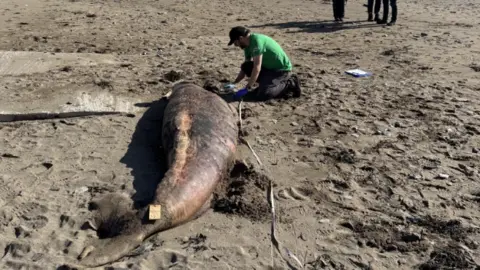
The youngest and smallest sperm whale to wash up in England and Wales since records began has stranded in the South West.
Devon Wildlife Trust's marine stranding network was first alerted to the calf, which was 3.6m (11.8ft) long and originally thought to be a dead dolphin in Seaton, Cornwall in early February.
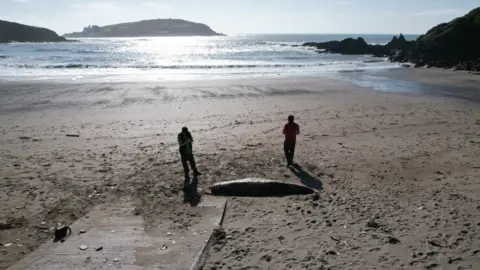
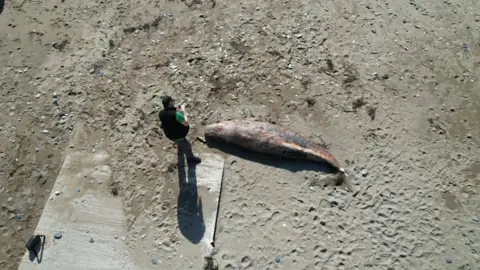
Rob Deaville, project manager for Cetacean Strandings Investigation Programme (CSIP) at the Zoological Society of London (ZSL) said the decomposed whale "must have re-floated" and was found again at Challaborough beach in Devon on 21 February.
He said it was a "highly unusual" case as it was the first sperm whale to ever strand in Devon since records began nearly 120 years ago.
 Rob Deaville
Deaville said average birth length for the species was about 3.5m (11.5ft) which meant this calf was an "exceptionally young individual".
"There was one in Scotland a few years ago, but for our patch, it was certainly unusual," he added.
He said historically, nearly all sperm whale strandings in the UK had been subadult males around 10m (32.8ft) to 14m (45.9ft) long, reflecting our proximity to the normal distribution of sperm whale "bachelor pods".
Female sperm whales and their young aggregate in matriarchal pods in warmer waters much further south, he added.
 Rob Deaville
Although the cause of death could not be ascertained due to the whale being decomposed, the team was able to conduct a basic field necropsy.
It also gathered a wide range of samples that may help "inform future research in areas such as contaminant exposure and population structure".
A small quantity of "sand and grit" material was found within its stomach chambers, suggesting the whale may have stranded live at or around the time of death.
Deaville said otherwise the stomach was empty as it should have been "maternally dependent and feeding on milk".
He said: "It's likely it stranded much further south and then these conveyor belts of storms pushed it up eventually onto the south west coast.
"It's very much out of habitat and died weeks ago, if not longer."
 Devon Wildlife Trust Marine Strandings Network
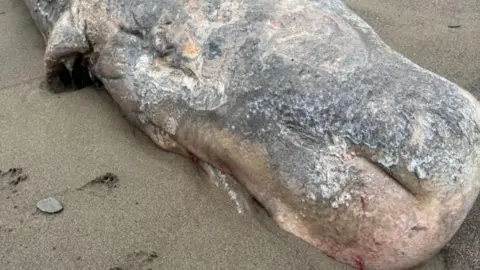
The whale has since been removed from the beach, but the team took the head to see if it can be used for future use.
On Friday, Deaville said they had collected bones from the head and would be discussing potential use with its partner museums in case it was of value to collections.
'Incredibly busy'
Marine awareness and engagement officer Coral Smith from Devon Wildlife Trust said it had been an "incredibly busy start to the year" for both Devon and Cornwall marine strandings networks.
She said it was the "busiest February ever in Devon" with the puffin wreck as well as a significant number of other cetacean and grey seal standings.
Deaville said a lot of the strandings were storm related: "I know there's been a lot of marine turtles washing up, some alive and dead, and there's been a lot of puffins turning up too."
