Chinook helicopter used to restore giant kiwi

 Crown
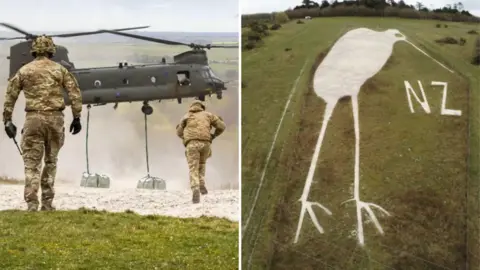
CrownTen tonnes of chalk has been dropped by an RAF Chinook helicopter on a giant kiwi as part of a major restoration project.
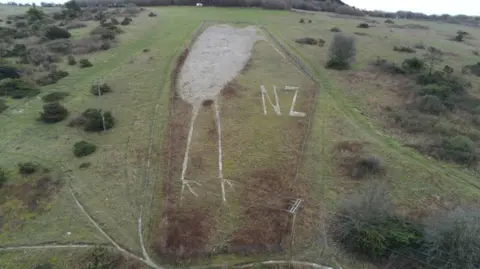
The Bulford Kiwi is set in the chalk on Beacon Hill, above the village of Bulford on Wiltshire's Salisbury Plain.
Constructed in 1919, it was carved by soldiers from the New Zealand Expeditionary Force who were waiting to return home following the end of World War One.
Richard Osgood, senior archaeologist from the Defence Infrastructure Organisation (DIO), the team behind the restoration, said the annual re-chalking reinforces the bonds between the countries.
"DIO is responsible for looking after 772 scheduled monuments across the MOD estate dating from the pre-historic era right up to the Cold War," he added.
Osgood said while the Bulford Kiri is one of the youngest, it was of "national and international importance, given its association with the Armed Forces of New Zealand".
He also said the work reminds people of the sacrifices made in World War 1.
 Crown
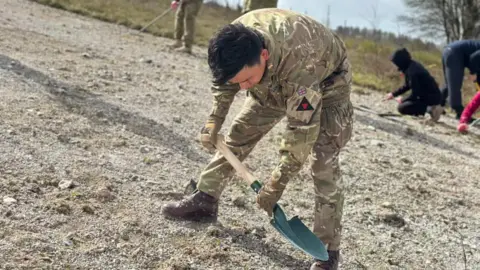
CrownAfter the chalk was dropped by the RAF Chinook helicopter, the chalk was then raked into place by personnel and volunteers from the New Zealand High Commission, local conservation groups, contractor Landmarc and the 3rd (UK) Division Signal Regiment and Operation Nightingale.
 Crown
CrownTo honour the annual re-chalking, a Waiata - a traditional Māori song - and Kukuri dance - which blends Māori haka traditions with the traditional dance of the Nepalese Gurkhas - was also performed.
Operation Nightingale, which started on Salisbury Plain in 2011, is a UK military archaeology initiative which uses archaeological digs to aid the recovery of wounded, injured, and sick military personnel and veterans.
Follow BBC Wiltshire on Facebook, X and Instagram. Send your story ideas to us on email or via WhatsApp on 0800 313 4630.
