'My husband died of cardiac arrest waiting for ambulance'

 BBC
BBCThe wife of a man who had a cardiac arrest and died while waiting for an ambulance has said his death "is not fair".
David Field died at home in Builth Wells, Powys, on 7 December 2024, after developing chest pains and turning "grey".
His wife Carol, 55, said an ambulance crew took an hour-and-a-half to arrive, months before new measures were introduced in July, which aim to respond to a cardiac arrest within six to eight minutes.
These showed an improvement in November, with ambulances on average arriving in around seven minutes.
Latest NHS figures show the service has experienced more of the most urgent calls and more hours of crews waiting to hand over patients to hospital staff are being "lost".
The Welsh Ambulance Service said it was investigating its response to Mr Field.
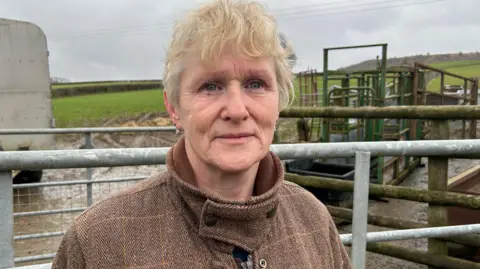
Mrs Field said that when she first phoned 999, "they told me that it would be three to six hours".
She said she was told she would have to take her husband to hospital herself, meaning a 45-minute drive to Hereford.
When she asked what to do if he went into cardiac arrest on the way, she said she was told to pull over "and ring for an ambulance".
But Mr Field's condition deteriorated while she was on the phone to ambulance control.
"He sat in the chair and he went into cardiac arrest, and from there we then started CPR," she said.
"They knew the situation and how bad the situation was, and it just still took an hour-and-a-half for the ambulance to get to us from my initial call.
"That is not right. Why should he have had to have suffered like that?"
Mr Field had a stent fitted in his heart earlier that week, which his wife said meant he should have been categorised as high risk.
"We were on the phone the whole time being instructed to give the CPR. They knew the severity of the situation," she said.
"I had a nurse in my house that was performing CPR and my neighbour, who is a retired fire officer that was helping, so they were medically trained, first aid trained - and still they didn't send the ambulance."
 Getty Images
She described her husband, who was a well-known local butcher, as "the face" of Builth Wells, adding: "All you ever saw was David on the street.
"The King used to drive past when he used to go to Llandovery and even slow down to wave to him in the shop."
She said his loss has been "absolutely devastating".
Speaking to BBC Wales just over a year after her husband's death, she described her community as "neglected" by ambulance and healthcare services in the area.
"If we need an ambulance, we need an ambulance," she said.
"We don't have taxi services around here, we have to rely on our own car if we cannot get an ambulance.
"And the people that need an ambulance for serious situations - strokes and heart attacks and serious accidents - we can't get an ambulance."
'Changes to 999 call responses'
Liam Williams, executive director of quality and nursing at the Welsh Ambulance Service, said there has been a "significant number of changes to the way we respond to 999 calls" since 2024.
"Under the new approach, rapid clinical screening by paramedics and nurses in the control room also helps to clinically identify time-sensitive conditions, like heart attacks, more quickly to improve outcomes for patients," he said.
"Health boards continue to take steps to reduce the delays our crews experience in handing patients over to hospital colleagues."
Official figures, which now measure average ambulance response times, showed "purple" calls - to cardiac and respiratory arrests - arrived in an average of seven minutes and two seconds, which is within the target range and the best performance since the new targets came in, last July.
For "red" emergency calls, the average response was eight minutes and 27 seconds, the quickest over the last five months of the new targets, although slightly outside the target range.
