Maternity services under strain as report finds insufficient staffing levels

 Getty Images
There are insufficient staffing levels to meet the rapid increase in caesarean births and induction of labour compromising safety, a report into maternity services in Wales has found.
There is also a need for stronger national co-ordination, to help improve vulnerabilities and weaknesses in maternity and neonatal care.
The team also found many strengths in the services and committed staff.
The Welsh government, which commissioned the assessment, accepted the recommendations and said as a result national oversight would be strengthened.
The report said families who had experienced loss or serious injury were further traumatised by the "defensive responses" and inconsistent processes, which limit the capacity to learn and improve.
Of the families who reported poor experiences, concerns included post-natal support, the involvement of fathers and unmet mental health needs.
Staff morale had also been hit hard by the perception of "a relentless negativity" in the public domain.
The report added that national organisations tasked with delivering, monitoring and holding services to account were too often working in parallel.
It also stated there was a shortage of obstetric theatre provision and post-natal care especially was inadequately staffed and supported.
Mental health care in maternity and neonatal units lagged behind Scotland and England.
The report said the medical workforce (obstetrics, paediatrics and anaesthetists) in these departments had increased consistently over time - a rise of 32.5% since 2015, however these groups also cover other services.
Full-time equivalent midwives had also increased by 13.3% in that time, with a significant shift towards a younger, less experienced workforce.
However, monthly sickness rates for midwives rose substantially in 2021, to around 9%, the report said, but that had since fallen to 6.3% in July 2025.
The number of neonatal nurses had increased 24.1% since 2015, though staff sickness was around 8.5%.
Julie Richards, director for Wales of the Royal College of Midwives said: "There is real compassion and commitment across our workforce but there are serious and urgent challenges that must now be addressed.
"Staffing shortages must be treated as an immediate safety issue and we are calling on the Welsh government to address this urgently, with dedicated funding and a commitment to fully implement these recommendations."
The team, led by Prof Sally Holland, heard from more than 600 women, parents, families and staff across Wales.
It said that over the past decade maternity and neonatal services in Wales had been subject to more than 500 recommendations from reviews and inquiries, but instead of adding to those, it had drawn up eight priority areas, including:
- Joined up national leadership
- Urgent attention to critical clinical safety issues in triage and induction of labour
- Enough staff and the right spaces for safe care
- Support for mental health and wellbeing
- Improved planning of neonatal care
- Timely learning from family-centred incident reviews
- Listening and improving from feedback
The report comes at a time when a wider review of maternity services in England is being led by Baroness Amos.
The assessment in Wales was commissioned by Health Secretary Jeremy Miles in response to ongoing concerns and variability in the safety, quality and experience of maternity and neonatal care.
It makes the distinction it is not a review, but an assurance assessment, which does not assign blame.
Instead the point was to "evaluate the current state" of services in Wales, rather than focus on past incidents.
It pointed out that with so many reviews and recommendations emerging for the sector over the last decade, it had created "a vast, uneven landscape" where it was difficult to distinguish the "urgent from what is aspirational" which "contributes to improvement fatigue".
The report heard "passionate pleas" that change was needed after previous reviews and recommendations had not delivered those changes in practice.
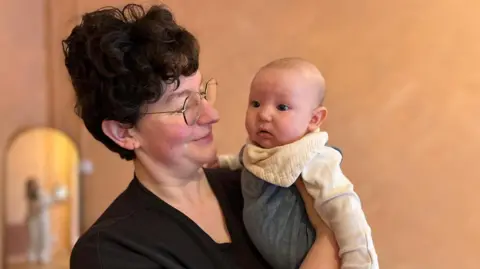
Zosia Dowmunt, 39, from Cardiff, said she spent a lot of time processing the trauma of her son's birth two and a half years ago, to be better informed when her daughter arrived four months ago.
For her first delivery she felt staff had not believed her when she tried to explain things were not progressing well and her baby was not in the right position.
"From that moment on we were very much at odds," she said, adding that poor communication caused what she considered to be preventable issues.
Her son was eventually delivered via caesarean.
"When you're disempowered in birth it disempowers you as a mother.
"I didn't feel capable of taking care of my son and it took me months to trust my instincts.
Speaking about her second delivery, she said it was "wildly different" and the midwives and consultants really supported her decision for a home birth.
"I felt respected - they really understood why I was making those choices, so it was wildly different from the first time."
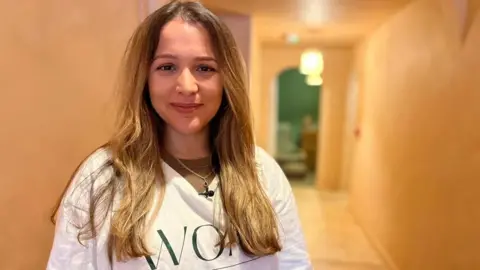
Sinnead Ali, 36, set up Womb in Cardiff - a community yoga hub "with a focus on menstrual and maternal wellbeing", and is expecting her first child in May.
She said she was very aware of the difficulties midwives are faced with.
"I would really love for them to recognise that a midwife's working conditions are what women are birthing in.
"They're having to work extremely long hours and not really be able to look after themselves. So how can we expect them to look after women if they're not able to do that? There needs to be more midwives and more training."
In Holland's opening she said "our recommendations will require action, funding and accountability".
Holland told BBC News that responses to women were "inconsistent across Wales".
"We're particularly concerned about how families are responded to when they've had the tragedy of a loss or serious injury and that actually the way that health boards respond to them at the moment is not clear.
"It compounds their distress and trauma. It makes them feel blamed. This is what we've heard directly from families, and it goes on for far too long and it doesn't give them the answers that they need."
Miles told BBC News: "I don't want any mum, child or family to have anything other than the best possible experience here in Wales.
"Where people have experienced something which has not lived up to the standards we want - we are sorry about that.
"We've looked at the recommendations - we've accepted them and now we've got a plan to implement them."
The Welsh government said a three-year improvement programme would strengthen leadership with a "national strategic oversight board", implement real-time safety monitoring systems, set up a national forum to share best practice, ensure birth discussions become routine and develop a service specification for the induction of labour.
Perinatal workforce plans would also be redeveloped "so health boards have safe staffing levels".
Stillbirth rates fell between 2014 and 2023 in Wales, but rates across the country remain the highest in the UK, the report said.
Wales also had the highest rate of neonatal deaths in the UK in 2023.
Dr Kim Thomas, chief executive of the Birth Trauma Association said: "Many parents tell us how distressing it is that, after a serious incident, such as the loss of a baby, the processes for investigating the incident often compound the trauma experienced by the family.
"We are really pleased that the review team recommends the introduction of a standard operating procedure for neonatal incidents that will make sure mistakes are identified and learnt from more quickly."
She added that "for too long, maternity services in Wales - and elsewhere - have failed to take the concerns of women and their families seriously" and this report puts women and families' needs at the heart of its proposals for change.
Plaid Cymru spokesperson for health and social care, Mabon ap Gwynfor, welcomed the report saying the recommendations must "urgently be carried out".
"Plaid Cymru have called for a national investigation into maternity services to get to grips with these issues, ensuring the best care and outcomes possible."
Peter Fox, Conservative health spokesman, said families were being led down by poor post-natal care.
"This report lays bare a maternity system that is overstretched, under-supported and lagging behind the rest of the UK.
"Families are being let down by poor post-natal care, inadequate mental health provision and inconsistent investigations when things go wrong, while staff are left battling unsafe staffing levels and rising intervention rates."
Meanwhile, Reform UK's James Evans said: "The report is clear: staffing levels do not meet the requirements of current population needs."
