Earth's heat to power 10,000 homes in renewable energy first for UK

 GEL
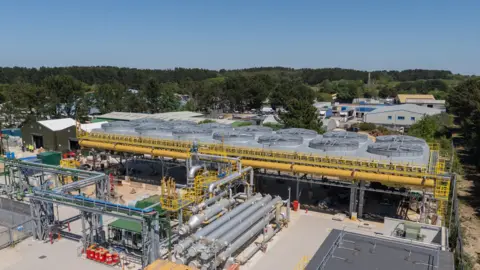
GELThe UK's first geothermal power plant has been turned on, providing a completely new type of renewable electricity using hot water from underground.
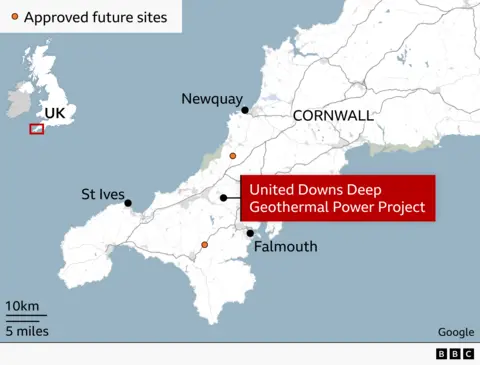
On Thursday morning, the Cornish plant will be switched on after nearly two decades in development which required Geothermal Engineering Ltd (GEL) to drill the deepest on-shore well in the UK.
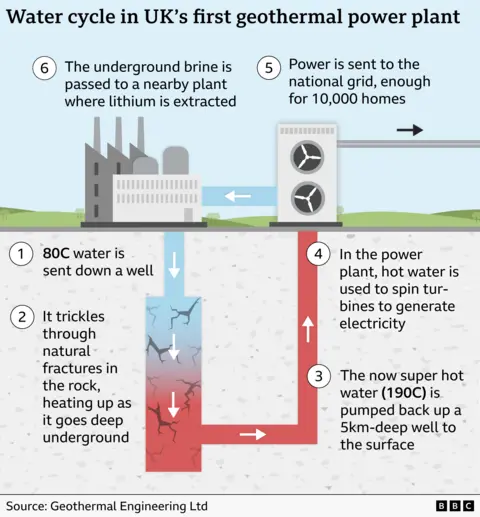
The water, super-heated by rocks, will help drive turbines to generate electricity for 10,000 homes, but will also provide the UK's first domestic supply of lithium - a critical mineral used in green technology.
The British Geological Survey said it was a "major step forward" for geothermal but high drilling costs could make replicating the project difficult.
The Earth generates heat which can be harnessed by drilling down below the surface to provide a renewable, and continuous source of energy to heat and power our homes – known as geothermal energy.
The further down you go the hotter it gets. At shallow depths the heat is enough to warm our homes and businesses. This is already done in some parts of the UK – for example, ground source heat pumps are a form of geothermal technology,and in places like Southampton, heating is provided to hundreds of homes via a local network.
But this project has drilled to far greater depths - three miles below the surface - where temperatures climb to nearly 200C, and this is enough heat to generate electricity.
"You drill deep boreholes into the ground, and then fractures within the granite rock are used to circulate the water that pick up the heat [that is] used for electricity production," explained Dr Monaghan, head of geothermal at the British Geological Survey (BGS).
Granite is particularly ideal for this technology as it is very effective at holding and conducting the Earth's heat.
This is the first time the feat has been achieved in the UK because drilling this far down is a technically and financially costly endeavour. The project has cost £50m to date, funded through private investors and the EU.
Ryan Law, CEO of GEL, told the BBC: "[I'm] tremendously excited after 15 years of hard graft, difficulties, we're finally there."
He said geothermal power was "really important" for the UK because there are no price fluctuations like with gas.
"And unlike other renewable sources like wind and solar we are constantly on, 24/7 electricity," he added.
The power generated at the United Downs site has been sold to Octopus Energy who will deliver it, via the national grid, to meet the electricity needs of up to 10,000 homes.
"This project is a genuine game-changer. For the first time, we're tapping into "always-on" green power in the UK, providing a steady stream of clean, home-grown energy," said an Octopus spokesperson.
Drilling and pushing fluid through rock can increase the risk of earth tremors - small movements in the earth's rock - known as 'enhanced seismicity'. This was considered during the drilling and testing phases, but Dr Monaghan said the company has shown this can be "adequately managed and doesn't pose a risk to the community".
GEL has two other sites it plans to develop into power plants, although one additional proposed site has been initially turned down over environmental concerns, but the company is appealing.
The funding for the initial site has come from a mix of private investors, and £15m from the European Development Fund - a fund for economic development that the UK had access to when it was part of the EU.
Generating electricity from geothermal - known as deep geothermal - is also technically feasible in Scotland and the Northeast of England, but there are currently no approved plans to do so.
"We have a great energy resource, underneath our feet in the UK, but we're not maximising its potential," said Anne Murrell, head of industry body Geothermal UK.
She said the cost of deep geothermal is comparable to other forms of electricity generation, but a lot of spend is upfront.
"The challenges we have include investment, and to unlock investment and increase investor confidence, we need a supportive government policy framework - geothermal needs to be recognised by government as a key part of our energy strategy," she said.
At the end of last year, the government appointed Lord Whitehead as the country's first geothermal minister in a nod to its growing interest in the sector.
In advance of the switch on, he said it was a "groundbreaking moment for UK energy innovation".
 AFP via Getty Images
Most of the growth in the industry is currently focused on expanding shallow geothermal because the costs are lower. Currently, there are 30,000 ground source heat pumps in UK homes, with the government offering grants to reduce the cost.
Businesses and councils have also started to embrace the technology. Gateshead council uses heat from water in flooded mines to heat hundreds of homes. It is estimated that a quarter of homes sit above abandoned coal mines which could be used in the same way.
In Europe, they have even bigger plans - the Netherlands is aiming for a quarter of homes to be heated using geothermal by 2050.
But the International Energy Agency has said that global investment in deep geothermal for electricity is growing rapidly – up 80% year-on-year since 2018 - in part, because of growing demands for electricity from tech giants.
"Data centres have major power needs, and we all know that this is very challenging for our current and future anticipated grid," said Ms Murrell. "What's happening worldwide is companies like Google, Meta, Microsoft are looking to geothermal to provide the energy for their data centres."
The excess heat produced by the centres can use the same system and be sent underground.
Geothermal electricity projects can also pose another benefit for tech companies – they could also be a source of important minerals for the green transition.
GEL will also be able to extract lithium carbonate, as well as heat, from the fluid underground – the first commercial source of the 'critical mineral' in the UK and crucial for the production of electric batteries.
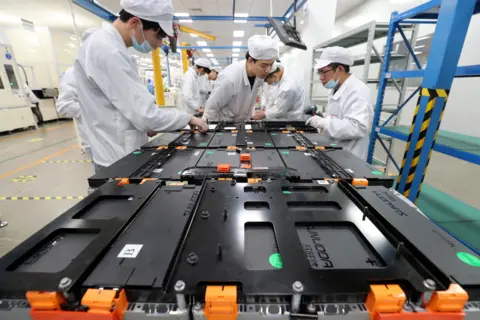
The site will only produce 100 tonnes of lithium - enough for batteries in 1,400 EVs annually - but GEL said it plans to scale this to 18,000 tonnes annually.
With the growth of green technology, the UK alone could see its demand for the mineral increase by between 12 and 45 times in the 2020s, according to the British Geological Survey.
The UK government gave a £1.8m grant, or 50%, towards the cost of the initial lithium extraction.
Clarification May 11: This article has been edited to include additional information about the risk of earth tremors -'enhanced seismicity'- associated with drilling in this instance.

Sign up for our Future Earth newsletter to get exclusive insight on the latest climate and environment news from the BBC's Climate Editor Justin Rowlatt, delivered to your inbox every week. Outside the UK? Sign up to our international newsletter here.
