Victim of 'Celtic Curse' spent years blaming herself for poor health

 BBC
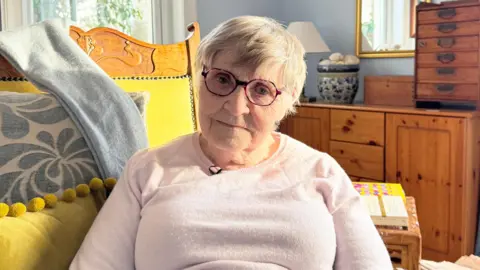
BBCA woman who believed it was her fault she was always tired and in pain has said it is a relief to learn in her 80s that her life-long health problems are caused by a genetic disease linked to her Hebridean ancestry.
London-born Anne Campbell took early retirement from teaching when she was 44, after doctors were unable to explain why she did not have the energy to work.
A test two years ago revealed she has haemochromatosis - a genetic disorder nicknamed "the Celtic Curse" that she inherited from her Lewis-born father.
"I spent a lot of time blaming myself and I always felt I was letting people down," said Campbell, 83. "It was an amazing relief - I wasn't imagining it and it wasn't my fault."
Haemochromatosis is a hereditary disease that causes a dangerous build-up of iron in the body and if left untreated can lead to liver cancer and arthritis.
In a new study, published in the journal Nature Communications, scientists suggest people from the Western Isles and north-west Ireland are at the highest risk of developing the disease.
Campbell was diagnosed with haemochromatosis just before her 81st birthday, after her GP did a genetic test while investigating the cause of stomach pains.
The test showed she had a gene mutation which had been passed down from her Hebridean father - and that her mother also had it.
"I got a double dose of it," said Campbell.
She has suffered fatigue and muscle pain since childhood but specialists were unable to identify the cause.
"I got used to living with pain, got used to not being able to catch up with my peers," she said.
"If we went for a walk by the time I arrived with the group they had already had their packed lunch and were leaving.
"I was always that one step behind and I spent a lot of time blaming myself for that."
Mystery illness
Campbell later worked as a teacher, but found it hard to get through the working week.
When the school holidays came she spent days in her bed in a deep sleep.
Campbell said her health took a toll on relationships and then her professional life, when finally one morning she was unable to catch her train to work.
She was again referred to specialists but they remained mystified by the cause of her poor health and recommended she change her lifestyle.
Campbell felt she was left with no choice but to give up her job and she moved to her father's home island of Lewis where she worked in the voluntary sector.
She is fascinated by the fact her disease is closely associated with her adopted home.
"I have travelled all round the world and thought 'could I live here?' And I would say to myself: 'No, I don't belong to this beach, or I don't belong to these mountains', but here I thought I was in the right place," she said.
Haemochromatosis symptoms can evolve over decades as high iron levels in the body cause damage to organs.
Early diagnosis and treatment to reduce iron levels can prevent liver and kidney damage and arthritis.
The disease is caused by small changes in DNA, known as genetic variants, which can be passed down through families and the most important risk factor in the UK and Ireland is a genetic variant called C282Y.
Scientists at the University of Edinburgh analysed genetic data from more than 400,000 individuals in the UK BioBank and Viking Genes studies to determine the prevalence of C282Y.
They found that people with ancestry from the north-west of Ireland have the highest risk of developing haemochromatosis, with one in 54 people estimated to carry the genetic variant.
This was followed by people from the Western Isles - one in 62 - and those from Northern Ireland at one in 71.
The researchers said mainland Scots, particularly in Glasgow and south-west Scotland, were also at increased risk of the condition, with one in 117 people estimated to carry the variant.
Prof Jim Flett Wilson, chairman of human genetics at the University of Edinburgh, said: "We have shown that the risk in the Hebrides and Northern Ireland is much higher than previously thought, with about one in every 60 people at risk, about half of whom will develop the disease.
"Early detection prevents most of the adverse consequences and a simple treatment – giving blood – is available."
He added: "The time has come to plan for community-wide genetic screening in these high-risk areas, to identify as many people as possible whose genes mean they are at high risk of this preventable illness."
 Getty Images
Western Isles MP Torcuil Crichton was diagnosed with the disease in 2008 and has called for screening for the disease.
"There is more iron in my blood than on the Forth Bridge," he said.
"The good news about haemochromatosis is that once diagnosed it is very easy to treat.
"You just go and give blood once a week, a bit like giving a blood donation, and you do that until your iron levels are reduced."
Crichton said the Western Isles' population of about 21,000 people might be small enough to be screened for the disorder, as well as other potential health conditions.
The UK National Screening Committee has been approached for comment.
Why is it called the Celtic Curse?
The gene mutation that causes most cases of hereditary haemochromatosis is believed to have originated in the Celtic population of Europe.
DNA analysis of the genomes of a Bronze Age farmer on Rathlin Island off the coast of County Antrim showed that it was already established by that period.
Earlier still, the remains of a Neolithic woman found at Ballynahatty near Belfast show that she carried a different variant also associated with an increased risk of the disorder.
