The miscarriage cradle: Invention inspired by trauma launched in Scottish hospitals

 BBC
BBCThree Scottish hospitals are introducing a device designed to bring dignity and practical support to women experiencing miscarriage.
The miscarriage cradle was created by engineer Laura Corcoran after suffering the loss of her third baby.
Forced to fashion her own method of collecting her baby's remains, she invented a way to take care of the physical issue so that women could deal with their emotional loss.
NHS Greater Glasgow and Clyde is the first UK health board to roll out its use.
The Royal Alexandra Hospital in Paisley, the Queen Elizabeth University Hospital and Princess Royal Maternity in Glasgow will offer the device to support women through miscarriages at home and in hospital.
It is believed to be the first time a group of hospitals in the UK has committed to embedding this type of support across multiple sites.
The Scottish government estimates that about 25,000 miscarriages happen per year in Scotland.
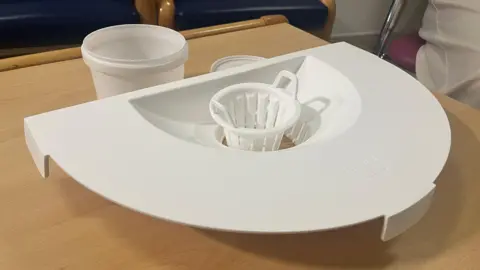
The miscarriage collection cradle sits over the toilet and ensures the dignified collection of pregnancy tissue.
Laura's invention came out of one of the darkest moments of her life, as she began to miscarry for the third time.
She was bleeding but was told there was no space for her in hospital an that she would have to manage the process at home.
Laura told BBC Scotland News: "Within the NHS, you have to miscarry three times before you are eligible for testing to try to find some answers."
She asked the early pregnancy unit how to collect the baby and they said "just to manage".
She said: "My husband and I are both engineers – we went into problem-solving mode and we ended up using a kitchen sieve to collect baby over the toilet and then we used a Chinese takeout container to store baby in the fridge over the weekend – the hospital said I wasn't allowed to bring them in out of hours and I miscarried on a Friday evening."
Laura described the ordeal as "a really awful time" and said she felt very vulnerable.
"It was completely undignified and it felt like I didn't matter, my baby didn't matter, there was nothing fit for purpose," she added.
During her recovery, Laura became angry that she had not been given the tools she needed to navigate the process.
But then she realised it wasn't just her – there was nothing fit for purpose for any woman dealing with baby loss.
"Using my background as an engineer, I started cutting up cardboard, taping bits together, sketching ideas. When I had something, I went to the 3D printers and printed the first prototype," she said.
After going through some patient and clinical feedback, she arrived at the device now in use.
"It allows women not to have to think of the practical aspects, to think about the emotional aspects, the grief. It gives them some space and time.
"The possibility that you might not be able to collect the baby and get access to testing adds weight to the problem," she added.
"To be able to collect the baby respectfully and without cross-contamination means women can get access to testing, find potential causes and then prevent them going through it again in their next pregnancy."
How does the miscarriage cradle work?
The device is in a semi-circular shape and sits under the toilet seat. In the centre of the circle is a removable sieve.
It filters everything that is not needed, and just keeps the baby.
It then goes into a watertight storage container which can be taken to the hospital for testing, or to have a burial or cremation.
Laura said an independent economic report for NHS England showed that 50% uptake would save the NHS in Scotland £11.2m, free up 12,000 gynaecology surgery slots and save 10,000 emergency department visits.
Funding of £1.5m from the Scottish government to support the new Scottish Miscarriage Framework provides funding for health boards to adopt this device.
She said: "It has been a difficult journey. Knowing that it is helping other women has been incredibly empowering."
'The cradle would have made a huge difference to me'
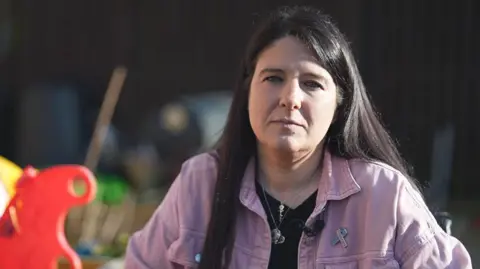
Zara Gavin, an engineer from West Lothian, wishes she had access to the device when she suffered a miscarriage in 2021.
She told BBC Scotland News: "I was due to have my 12-week scan and we found out that the baby had died.
"At that, point our lives turned upside down. We had no idea what we were in for.
"We were given a leaflet and told we could go home and things would 'progress'.
"I was sent home with no idea what 'things' actually meant. The next few days were the worst ever."
Zara was in severe pain.
She recalled: "I was back and forward to the bathroom and myself and my husband were just left to process this - to deal with it physically and mentally - and it was just horrific."
Zara believes the cradle would have made a huge difference as she was unaware what was about to happen.
She added: "Even discussion about the cradle and why it may be important might start the thought process in your head."
'Parents' stories are devastating - anything that helps is worth it'

Nicola Welsh from baby loss charity Held in our Hearts thinks anything that makes the process less traumatic is worth doing.
She said parents had no idea how to navigate it.
"Sometimes they say if it happens naturally at home you will be fine. But they then think, where am I going to actually collect my little one?
"There is something there and where do we put it, how do we get that to hospital or if it needs testing further or if we want to do something with them to make a memory.
"People were finding things in kitchens, or in the toilet – lots of very sad, devastating stories that when they are done they are done, and that becomes part of the story that we can't go back and amend again."
Nikki Harvey, lead nurse in gynaecology and early pregnancy at NHS Greater Glasgow and Clyde, said: "We understand how upsetting a miscarriage can be for many women and we have processes in place to ensure they feel supported when this happens to them.
"We're pleased to be gradually introducing the Collection Cradle, offering it to women where it is clinically appropriate, starting with the Royal Alexandra Hospital and then into our other sites.
"This is another positive step in how we're supporting women to feel more in control of their care, enabling them to have dignified experiences at home.
"It is also a holistic approach to care, considering both a women's mental health and wellbeing involved in miscarriage as well as the physical side."
Details of support for miscarriage and pregnancy-related issues are available at BBC Action Line
