Leaky dams being installed to manage flooding

 Alison O’Connor
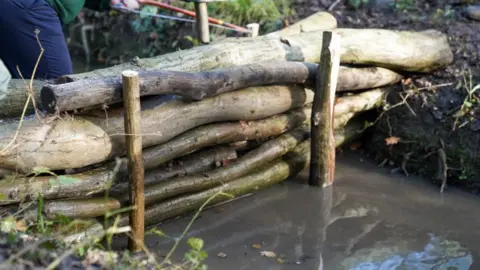
Hundreds of purposefully-designed leaky dams are due to be installed across Epping Forest to help slow down and manage flooding.
The City of London Corporation said that 374 of the dams - which involve placing branches and twigs across small waterways - would be built over the next year.
The corporation, which manages the forest, claims it is the biggest natural flood management project of its kind in the south east.
Caroline Haines, the chairwoman of the company's Epping Forest and Commons Committee, said the strategy would help safeguard homes.
"It will also create conditions where wildlife can thrive, enhance the forest's ability to store carbon and improve air quality," she said.
Epping Forest, which sprawls from north London into Essex, is recognised as the largest open space in the capital at just over 6,000 acres.
 City of London Corporation
The project is expected to support tree health by retaining more soil moisture and create wetter habitats for plants, fungi and other wildlife.
Conservationists hope the dams will mean the forest can hold about 10,000 cubic metres of additional water – the equivalent of four Olympic-sized swimming pools.
Tanith Cook, head of conservation for the corporation's Epping Forest charity, said: "There's much more science behind these leaky dams than people might realise — what started with a simple review of the forest's streams and ditches led to an extensive hydrological modelling exercise."
The City of London Corporation said the project was funded with £200,000 that it had received from the Environment Agency, and £150,000 from its own climate action strategy.
Follow Essex news on BBC Sounds, Facebook, Instagram and X.
