They lost their homes in World War Two - now they shelter others

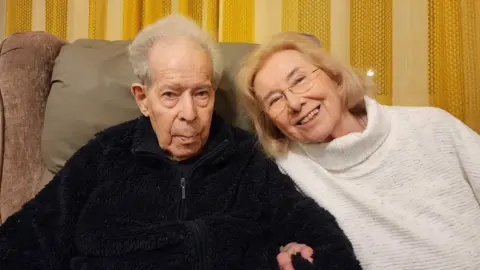 King family
"I suppose I would say the reason that we're both quite socially conscious is because of our backgrounds," says Eva King, from the room where she acts as a full-time carer for her 101-year-old husband Herbert.
The pair met and live in London but both were born in the Austrian capital of Vienna during the first half of the 20th Century.
While there they were affected by separate experiences which they say mean they want to provide a roof over the heads of those in need, through the charity Refugees at Home.
"I have actually experienced homelessness... while Herbert came on the Kindertransport," explains 86-year-old Eva.
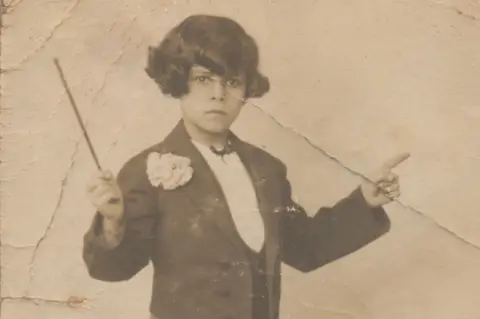 Herbert King
Herbert now struggles to remember parts of his past, often answering that "it was a long time ago" to questions about his life.
But upon his retirement he set out on paper the journey which led him to calling London his home.
Born in June 1924 in a Jewish family, he describes how he had a relatively normal childhood until the Anschluss of 1938 - when Austria was annexed by Nazi Germany - meant that life "took a completely different meaning and survival became the only aim".
"Jewish shops and premises, synagogues, offices and anything where there was a Jewish connection quickly became a target for violence, fire, destruction, robbery, and personal attack," he writes.
"In many instances they took delight and pleasure in their sadistic way of making Jews do things, however stupid, just to humiliate them and to stand there laughing or kicking and hurting anybody at will."
He remembers his mother being marched out of their flat without warning by Nazi soldiers who ordered her to carry out humiliating tasks for hours, like cleaning filthy cooking stoves with a nail brush or sweeping the pavement outside the house with a toothbrush.
He says he had a similar experience as he was walking with some schoolfriends when "we were stopped and told to scrape off some old posters from a shop window with a razor blade and they just stood and laughed at us... calling us all sorts of names.
"Fortunately, nothing worse than this happened to me, but we heard many stories of people being beaten, locked up for hours or days without any food," he says.
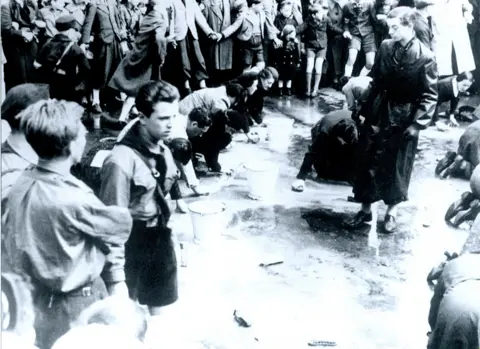 Universal History Archive via Getty Images
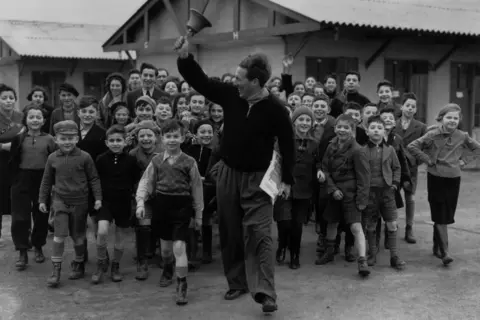
With his school having been closed and his home under threat of being confiscated, Herbert says his family then heard about the possibility of his getting to Britain through the Kindertransport - the rescue effort that brought about 10,000 mostly Jewish refugee children to Great Britain from Nazi-occupied Europe ahead of World War Two.
Having queued up with his mother "for two days and nights just to register and be put on a list in case", the family learnt he was one of those selected.
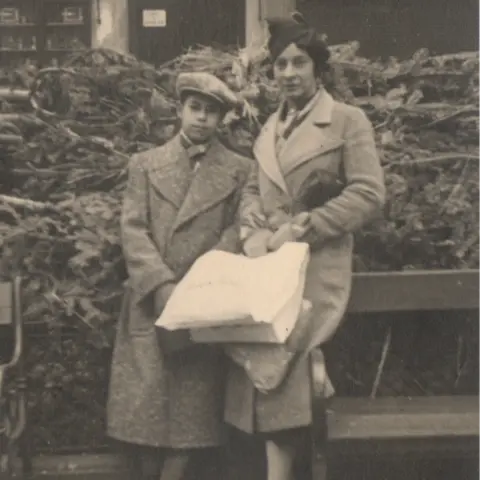
On 10 December 1938, carrying with him only a small suitcase, five German marks and a passport stamped with a swastika, he said goodbye to his mother and father and boarded a train to the Netherlands, then a ship to Britain.
By May 1939 he was in London, joining his mother who also managed to escape Austria with an offer of a job.
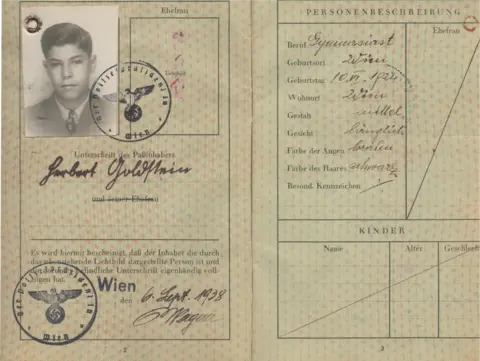 Herbert King
As the war progressed Herbert says he and his mother learnt more about what happened to other members of their family. Some escaped to different countries, like his father who ended up in an Italian labour camp with Herbert's uncle, but others lost their lives in prison camps.
"Thank God I had the luck to have come to England and escaped the final terror against Jews in Nazi Germany and its satellite states," he wrote.
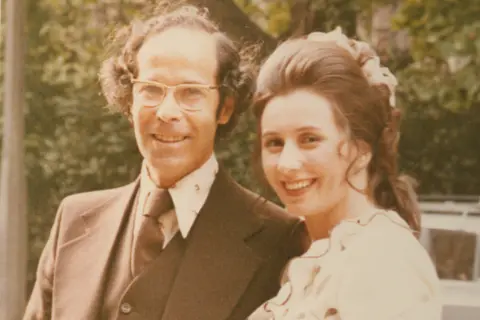
Herbert stayed in London after the war, changing his name from Goldstein to King and working in various businesses including setting up coffee stalls and at a clothing company, which brought him into contact with Eva, whose sister ran a boutique.
 Fox Photos via Getty Images
Born in 1939 and not of a Jewish background, Eva experienced a very different upbringing, having lived in Vienna throughout the war.
"I remember being in the cellar with bombs flying and things like that, the building shaking and people crying," she tells the BBC.
At the end of the conflict, she says the occupied city was split between the Allies with her family living in the French section.
But with the Allied forces needing places to billet their troops, they lost their home and had to move into her father's factory, before the family crammed into a few rooms shared with a tailor her mother knew.
"I remember there was a bunk bed. I was on the top, my sister was there, my other sister was in between my parents... and then the tailor slept also there and then the nanny.
"We must have lived like that a few years," she adds.
Eva's childhood would also see her regularly travelling across Europe to attend different schools, being taken in by various people as she moved around the continent.
She describes how on one occasion her purse was stolen while she was on a train from Spain, meaning she had to sleep on a beach before visiting a local convent, which helped her get home.
 Herbert King
Eva says for her and Herbert, such experiences have made it an "instinct" to provide a home for people who have nothing.
"I just feel that if somebody is really in desperate straits, I'm willing to give somebody a bed," she explains.
As such they signed up with Refugees at Home, which seeks to find a safe place to stay for refugees who arrive in Britain, to provide short-term accommodation for people to live with them in their west London home.
The pair have hosted people from countries including Yemen, Sudan and Egypt, many of whom have remained in touch.
With a smile, Eva recalls how the first person they hosted had arrived at a time when he was facing questions from the authorities about whether he was a child or an adult and during his stay, she arranged some help for him.
"I didn't hear anything for a couple of years and then somebody rang the bell. I opened the door and somebody sort of hugged me and kissed me. And he says, 'do you remember me?'
"He was grown up, looked very nicely dressed and everything... It was so rewarding. And I didn't do anything apart from welcoming him," she says.
 Eva and Herbert King
She says she is still regularly surprised by the experiences that hosting provides.
This month a 20-year-old man from Colombia has been staying with them, who she says has become a firm friend.
"With hosting, I didn't know how much fun it is... Yesterday we were giggling like two 14-year-olds around the kitchen table until one o'clock in the morning."
She has asked him to join them over Christmas, in a home which is already crowded with friends staying over from China and a great-grandson who is bringing four friends over from Israel.
"I just thought to myself, the more the merrier," she says. "If we have to rough it, we will."
Listen to the best of BBC Radio London on Sounds and follow BBC London on Facebook, X and Instagram. Send your story ideas to hello.bbclondon@bbc.co.uk
