The families forced to move hundreds of miles for a home

 BBC
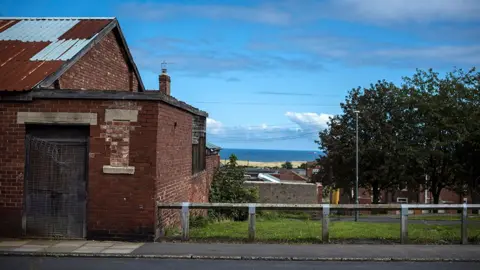
BBCHundreds of people have been relocated to deprived parts in the north-east of England because the councils in their original areas do not have enough housing of their own. Some of them have never heard of the towns they must now call home and say they have been left to struggle.
Margaret and her husband had jobs in London, and their children went to school in the city. They had been in the UK for two years and were settled.
But one winter's day, three months after being granted the right to remain, they found themselves in a taxi, driving the 270 miles north to County Durham. With no spare housing to give them in the capital, this was their local authority's only offer.
They arrived at what they say was a barely furnished property, with no jobs and no school for their son.
Margaret, whose name we have agreed to change to protect her family's identity, said the administration needed to take him off the roll at his old school and enrol him at a new one took five months, during which time he became depressed.
The teenager said everyone in the family had wanted to stay in the capital.
"I felt bad because I was going to leave London and I already had friends," he said. "But I did feel a little bit good because I'm going to have my own house."
The transition had been difficult but "the church gave us almost everything" and now they were beginning to make friends and settle in, he said.
 Diamond Dust
To deal with the growing shortage of housing, local authorities in the capital are resorting to relocating people to private rented accommodation around the country.
London Councils (LC), the body representing all 32 authorities, said it had sent 49 families to the North East since 2020. Of those, it says, 22 went to County Durham.
But the body's figures do not match those given by Durham County Council (DCC) and it acknowledges data from the last two years has "significant gaps".
DCC said, during this period, it had been alerted 94 times that families were being moved to the area by London councils, via Section 208 notices which are required when an authority places a household outside its district.
The council said it believed the actual number of families was higher but it currently had no database to gather information from different teams to verify this. Local charities, and one company facilitating the moves, suggest different numbers again.
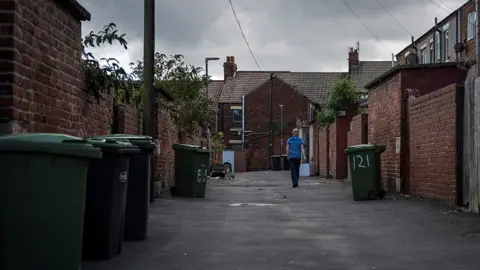
Companies such as Reloc8 UK are paid to arrange transport and accommodation when councils need to move people to different areas. Its director, Kelly Davies, said it had been relocating an average of 10 families a month to the North East for the last year and a half, an increase on numbers at the beginning of its contract in October 2023.
She said London authorities paid for a package that included beds, cooker and fridge freezer and, in some cases, furniture. The company also helped families register with schools and doctors, and find work, she said.
But DCC said some relocation firms did not provide any information about the property or the area families were being moved to. The authority said it had also found some living in homes with wet floors, no central heating, loose electrical sockets and even nails poking through the lino flooring of the bathroom.

One mother said she and her daughter were brought by Reloc8 from London to a house in County Durham, where they found "no furniture, only a bed in the rooms with no pillow or duvet".
The woman, who we have agreed not to name, said they had to roll up towels to use as pillows for their first night and, a couple of days later on her daughter's birthday, they still had no furniture and had to sit on the floor to eat a small cake.
"She was sitting on the floor all alone, me and her and no one was there," she said.
They were supposed to be contacted by their housing team 10 days after the move but "they never called", she said.
Reloc8 said it was unable to comment without knowing the householder's name and address.
Charities like The Ark in Horden, Horden Together, the Ladder Centre in Ferryhill, the Angel Trust in Bishop Auckland, the East Durham Trust in Peterlee, and Citizens Advice have supported or referred families for help.
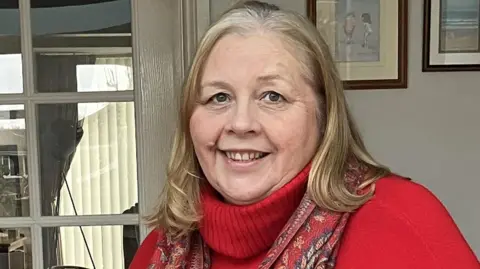
Communities Together Durham project manager Joanne Thorns said her organisation began to notice families being transferred a "couple of years ago".
Most of those she has helped "had never heard of County Durham and did not know the local area or how far it was from London", she said.
Those who had been refugees or asylum seekers were always confused about where they were, she added.
 Supplied
One family Thorns supported arrived at a remote village late on a Friday evening with no knowledge of the area, no link to social services, nobody to ring when they arrived, and no schools to sign up to, she said.
They survived on basics from a corner shop over the weekend before turning up at a local church looking for help on Sunday morning. Between them, members of the congregation supplied the family with second-hand basics such as pans and kitchenware. A couple drove the family to a local supermarket.
There are a number of companies relocating people, but Reloc8 UK said all families should have a universal credit claim in place and there was an "expectation that they are able to save like other families need to for their furniture and any further essential items".
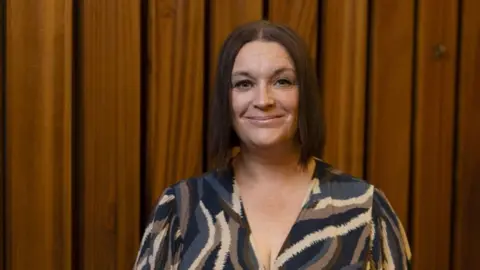
DCC's cabinet member for communities, Nicola Lyons, previously worked at Citizens Advice where she said she helped more than 40 families in this situation in 2025 alone.
"I think it's absolutely scandalous," she said. "I feel as though the families who I've spoken to personally have been forced to be moved.
"It's morally wrong and, to be quite frank, they're [the London councils] not doing due diligence checks when they move them into places of high deprivation."
LC deputy chair Grace Williams said the capital did not have enough resources to deal with its homelessness problem but was "determined to make sure we're doing better in terms of notifications, in terms of quality".
"Any local authority already has a legal duty to place near to where a family or an individual is to begin with so we work really, really hard to do that," she said.
"It shows you the depth of the homelessness crisis, that families are having to be uprooted and placed that far away in County Durham."
 Durham County Council
Lyons said DCC sometimes did not know when people had been moved into the area until the family contacted community support groups, and these then approached the council for assistance.
She said the authority was not always alerted via Section 208 notices and families who did not contact local support services were at risk of falling through the gaps, getting no help at all.
The Ministry of Housing, Communities and Local Government said councils "must avoid placing homeless households out of their local area as this can be extremely distressing for those it affects".
"Unfortunately, out-of-area placements are symptomatic of the housing crisis we have inherited and, where they happen, councils must ensure that accommodation is suitable and that they notify the local area," a spokesperson said.
