'Massive increase' in flu cases hits hospitals and schools

 Getty Images
Flu cases across Scotland jumped by 45% in a week, rising from 555 to 805 laboratory-confirmed cases, official figures show.
In the week ending 23 November, the infection rate stood at 14.5 per 100,000 people - an increase from 10 per 100,000 the previous week, according to Public Health Scotland (PHS).
Hospital admissions have also increased from 279 to 391, as has test positivity, rising from 11.0% to 15.8%.
PHS reports that all age groups are now affected at levels not previously seen at this time of year.
Meanwhile two councils - South Ayrshire and East Lothian - reported an increase in pupil absence at schools across their regions over the last week.
Dr Victoria Shotton, a GP who is based in Glasgow's east end, said her surgery was seeing three times the number of patients with flu than last year.
She told the BBC's Radio Scotland Breakfast programme: "We are seeing a massive increase in presentations on a daily basis. It has started early this year and is more severe than last year."
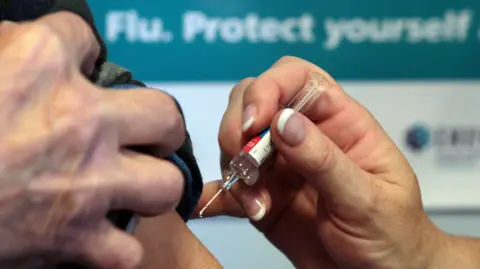
She said this year's flu jab was not proving to be as effective as hoped due to a new mutation that was circulating.
"Unfortunately it looks like this year's jab isn't offering the same protection as last year," she said.
"Through no fault of anyone involved, it isn't quite covering the main strain that's going around.
"However, that doesn't mean that it's not worth getting because it will still offer some protection and prevent the flu from getting so serious that you need to go to hospital."
What is the impact on hospitals and schools?
BBC Scotland News contacted all 14 health boards and 32 councils to find out about the impact of the flu spike on hospitals and schools.
Here are a selection of replies from those that responded:
- South Ayrshire Council says it is aware of an increase in pupil absence across its schools in the past week
- East Lothian Council says its pupil sickness absence rate was 8.1% of the school population last week, compared to 5.3% in the same week last year
- Falkirk Council has seen higher staff absence compared to this time last year but pupil absences are broadly the same.
- Midlothian Council says school staff absence is high at the moment for a variety of reasons including colds/flu. Pupil absence rates are broadly similar to this time last year.
- NHS Borders says it has seen an increase in flu cases and a small number of rooms/ bays in wards have been temporarily closed as a precaution in recent weeks
- NHS Dumfries and Galloway says outpatients, staff and visitors are required to wear masks and there are hospital visitor restrictions
- NHS Greater Glasgow and Clyde says flu season has hit earlier than previous years so cases are higher at this point than they normally would be
- NHS Grampian says it has increased hospital occupancy levels and the flu rate is higher than in previous years
- NHS Western Isles has seen an increase of people with respiratory symptoms across the region and across age groups. Some hospital wards have had temporary restrictions
- NHS Lanarkshire - Healthcare services are experiencing high levels of demand due to flu and other respiratory illnesses
- NHS Highland reports a slight increase in flu cases but it has not required any ward closures.
- NHS Ayrshire and Arran have seen a significant increase in cases and additional infection control measures have been implemented.
In NHS Greater Glasgow and Clyde there were 272 flu cases in the week ending 23 November - an 18% increase on the previous week when 230 cases were recorded.
The infection rate stood at 22.3 per 100,000 people - an increase from 18.9 per 100,000 the previous week.
The health board has been telling patients to stay at home to treat themselves, and to avoid A&E when suffering mild or moderate flu symptoms.
GP practices have been sending out texts and some parents have received a letter from the heath board via their children's schools.
It says the A&E department at the Royal Hospital for Children has experienced an increase in the number of young patients presenting with respiratory conditions in recent weeks.
And it offers advice on the best way to seek treatment, while avoiding A&E for less serious cases.
In Dumfries and Galloway some hospital wards have been closed to new admissions, due to an early rise in seasonal flu and norovirus infections.
Visiting has been restricted across all sites and the use of masks reintroduced - as the combination of illnesses prompted appeals for public co-operation.
Dr Kenneth Donaldson, medical director for NHS Dumfries and Galloway, said: "These illnesses are circulating widely in the community and are now having a major impact on services."
He urged people not to visit hospitals, care homes, or other healthcare settings if they were unwell.
"Even mild symptoms can easily pass to others and have serious consequences for vulnerable patients," he said.
What are the main symptoms of flu?
- A sudden, intense fever
- Breathing difficulties
- Severe chest pains
- Aches all over
- Feeling hot and cold
- Feeling lethargic
- Having sensitive skin
- Suffering from vomiting and diarrhoea
 PA Media
Dr Shotton advised people when to seek medical help.
"If you are struggling to breathe or getting severe pain in your chest or suffering from vomiting and diarrhoea, those are the three big areas that suggest you need further support," she said.
She added that everyone eligible for a flu jab should have received a text message, a phone call or a letter by now but they could go onto the NHS Inform and book an appointment.
"All over-65s, children of nursery school and school age and people with certain pre-existing health problems, like chronic lung conditions or on cancer treatment, are eligible," she said.
Health Secretary Neil Gray said: "Do everything you possibly can to make sure you are getting the immunisation you are entitled to because that is the best way that we protect ourselves from flu.
"It was a particular problem last year and caused us significant issues across the system, so that's the number one message."
