Smiles and wonder: How the US reacted to King Charles
The United States declared independence from the British crown 250 years ago - but this week, it could not get enough of it.
From the minute King Charles and Queen Camilla stepped onto the White House South Lawn, US networks dumped their standard diet of political warfare and breaking news for something rare: pure pageantry.
In a country that seems to agree on almost nothing, the British royals managed something close to a clean sweep - drawing warm receptions from both sides of a political spectrum where neutral ground is rare.
The visit came at a fraught time in US-British relations, with the White House and Downing Street at odds over the war in Iran, straining a relationship both governments insist remains unshakeable.
The reviews following the King's appearances at the White House, in Congress and in New York were warm across the political divide.
A commentator in the conservative Washington Examiner wrote that the UK needed more than conventional diplomacy - and that King Charles delivered.

 PA
PA"His Majesty's Government under scandal-plagued Labour Prime Minister Keir Starmer needed the monarchy to do what only the king could do," the editorial said.
The King's comments in Congress and at the White House's lavish banquet on Tuesday - mixing humour with history and a call for unity - also were widely praised.
Some saw them as a subtle rebuke of President Trump.
"Sometimes it takes an outside perspective to see what's really going on," an opinion writer wrote in the Arizona Republic. "It's striking to have a king remind us of what democracy is all about."
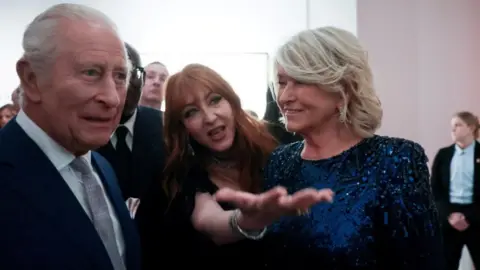
For months, Donald Trump - a committed Anglophile and avid fan of the Royals - repeatedly told reporters that he was excited for the King's visit. That excitement was on full display throughout the King's visit to Washington, in which the world saw a warmer version of a president not shy to make his feelings known.
 Reuters
Uncharacteristically, Trump largely stuck to a script, making no mention of policy disagreements with Downing Street and lauding the long ties between the US and Britain.
"Before we ever proclaimed our independence, Americans carried within us the rare gifts of moral courage," he said. "And it came from a small but mighty kingdom from across the sea."
On Capitol Hill, where the King became only the second British monarch to address a joint session of Congress, Charles received a standing ovation - though some in the room heard something more pointed in his words.
"As opposed to Keir Starmer, who is looked at...as a leftist weenie, we saw in King Charles - someone who is proud of Britain," Washington Republican Representative Michael Baumgartner told the BBC. "I think that was good."
 Reuters
The warm welcome on Capitol Hill was not lost on President Trump.
"He got the Democrats to stand, I've never been able to do that. I couldn't believe it," Trump said at the banquet a few hours later. "They liked him more than they've ever liked any Republican or Democrat, actually."
Elizabeth Holmes, an expert on the Royal Family and author, told the BBC that many members of the American public are broadly interested in the family, even as that interest has ebbed and flowed over the years.
"I think the fascination is rooted in a combination of novelty and distance," she said. "It's not something we have here."
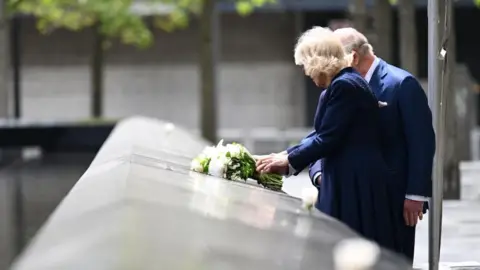
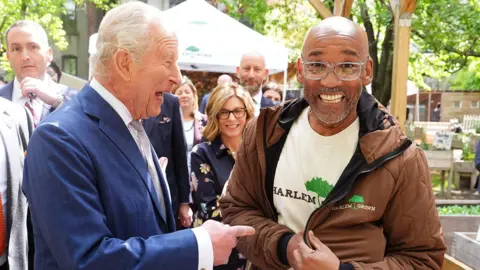
The King and Queen traveled to New York City on Wednesday where they made a few stops, including one at the 9/11 Memorial. Jacob Knutton, who manages a British-themed restaurant and store in New York, says business has been "a lot busier" around the King's visit.
"There's definitely been a lot of people talking about it," said Knutton, who grew up in London and Australia. "Americans are talking about it and trying to get our opinions on it."
But not every American is as enthused.
While recent statistics are hard to come by, a YouGov poll conducted in 2024 found that only 42% of Americans held a favourable view of King Charles.
 Getty Images
In comparison, his mother, Queen Elizabeth, garnered a 67% approval rating. Over three quarters of those polled - 76% - held a favourable view of the King's ex-wife, Princess Diana, who died in 1997.
According to Holmes, in the eyes of some Americans, Charles had a "far less compelling" narrative than his mother, who became Queen at a young age.
US feelings about King Charles are further complicated by his complex relationship with son Prince Harry, Holmes added.
Data from Google Trends suggests that US-based searches for the King during the visit spiked by 20 to 25 times over normal, and by 50 times during his speech to Congress.
Others who haven't followed the royal visit closely, still are excited. "I think it's cool that he's here," said Harry James, 21, who works in a fish and chips shop in New York. "It's cool we can keep these traditions going."
Holmes believes the visit already has improved US perceptions of the King. "Trump is such a polarising figure, and I think people were very eager to see their interactions," she said.
His dinner comments, in particular, have "really taken off".
"I think people are delighted to see British wit on display," she added.
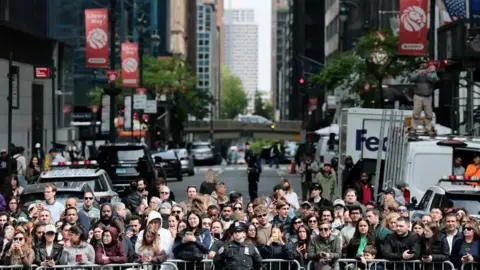
Near the White House on Tuesday, some of those who turned out to watch the King's motorcade pass said they felt hopeful.
"It's natural for human beings to disagree," said Maribeth Massie, of Maine, who watched the King's motorcade near the White House on Monday. "Hopefully they'll lay some common ground together and move forward."
Knutton also hopes the visit helps - in part for his business' sake. His store imports nearly all of its goods from the UK, and feels the pinch of Trump's tariffs, he said.
"I'm sure it will have an effect," he said. "But I'm not expecting magical wand-waving."
(With additional reporting from Nada Tawfik in Washington DC and Sakshi Venkatraman in New York)
