Wildlife photographed 'reclaiming' former mining site

 Andrew Mason
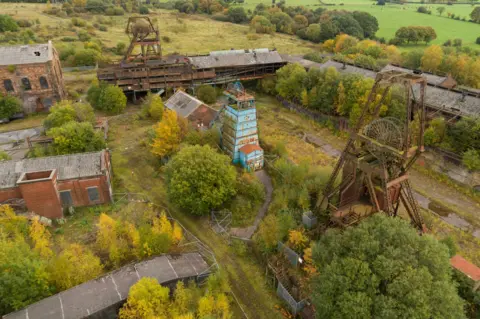
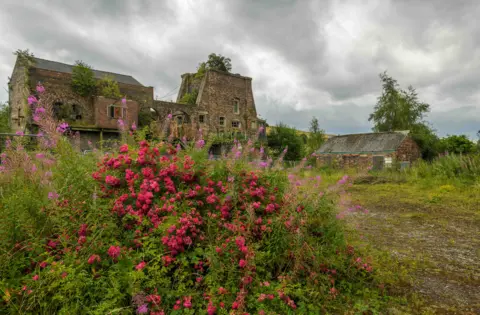
Images show how nature has partially reclaimed a disused former coal mine, and the colliery buildings that still stand on site.
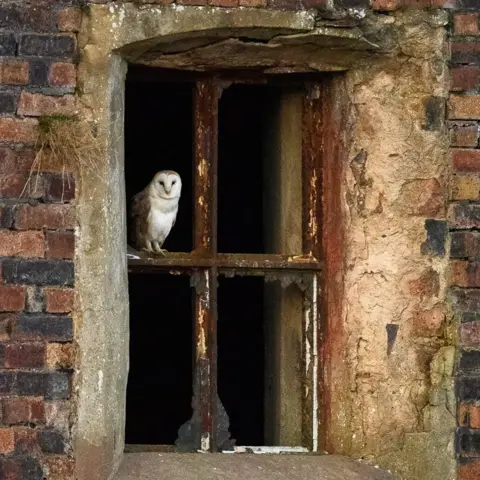
Owls, foxes and other creatures have been seen at the abandoned Chatterley Whitfield mine, in the heart of Staffordshire.
Photographer Andrew Mason has documented some of them over recent years at the Stoke-on-Trent pit, which closed in the 1970s after operating for more than a century.
It has been described as the most comprehensive surviving deep mine site in England.
The colliery was a "living example of rewilding", said the photographer.
 Andrew Mason
Mason had started taking images of barn owls from outside the private site, before gaining permission to enter from Stoke-on-Trent City Council.
The local authority is increasing security measures there, after urban explorers and children were seen trespassing on what is a dangerous site.
It has 15 listed buildings and was included on Historic England's heritage at risk register due to its deterioration since the colliery's closure.
The Chatterley Whitfield Friends group now has a Heritage Centre on site and conducts monthly public tours for those who want to explore it safely.
 Andew Mason
Mason assisted the BBC Natural History Unit at the former pit with the production of a film - BBC Earth - After We've Gone - which documented the presence of wildlife at the site.
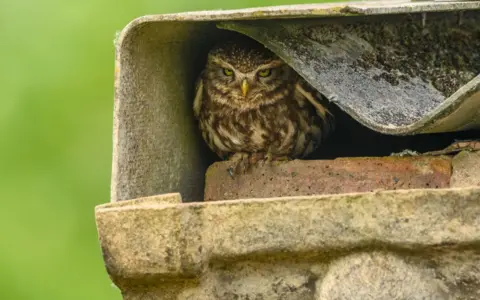
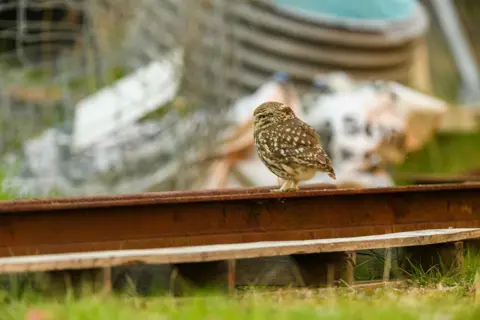
There have been no recent sightings, but at the time of his access, he was able to photograph a number of little owls that were nesting in one of the buildings.
Trail cameras also picked up badgers and foxes going into some of the buildings.
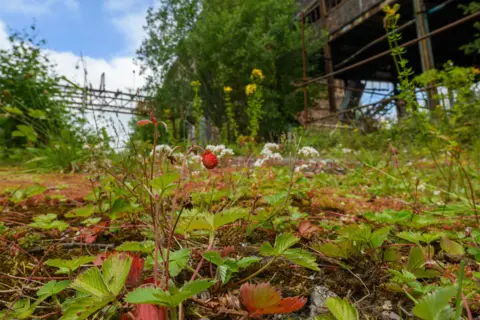
"One of the strangest things I saw was wild strawberries growing on old bits of coal slag heap," he said.
"It was quite fascinating to see how nature was taking over."
 Andrew Mason
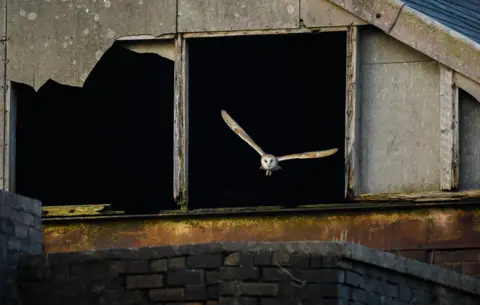
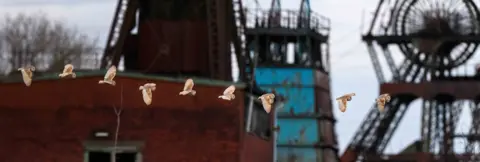
One panoramic image shows a single barn owl flying past headgear at the former mine.
"There is a strange beauty in the juxtaposition of this ghostly white owl of the night flying amongst these former industrial buildings that still stand," said the photographer.
The image was made by compositing nine separate images he made of the owl as it flew past.
 Andrew Mason
Like many in the area, the photographer said he had a "very personal connection" with the coal mining industry.
His father, John Mason, worked at several mines in Staffordshire as an electrical engineer, including at Chatterley Whitfield.
"I think he helped put the headgear into the Winstanley building," he said.
After retiring, "he's really got into bird watching," he added. "So he's really liked seeing the photographs."
 Andrew Mason
Chatterley Whitfield was once the biggest coal mine in north Staffordshire and the first in the UK to produce a million tonnes of coal in a year.
It ceased production and closed its doors to working miners on 25 March 1977.
In 1979 it opened as a mining museum, attracting tens of thousands visitors a year to its underground tours, but was closed in 1993 and the site handed back to the city council.
 Andrew Mason
Coal mining has long since ceased in Staffordshire but Chatterley Whitfield "stands as a reminder of this former industry that powered the Industrial Revolution," Mason added.
"Whilst fossil fuels have, and are still, contributing to climate change, Chatterley Whitfield is a very important historical site that should be preserved as part of our heritage for future generations."
 Andrew Mason
Follow BBC Stoke & Staffordshire on BBC Sounds, Facebook, X and Instagram.
