Hidden history dug up during major road project

 Leeds Museums
Artefacts unearthed during the construction of a major new road in Leeds have been revealed for the first time.
A prehistoric arrowhead, a Bronze Age axe and a 300-year-old pair of nutcrackers were among the thousands of items dug up during work on the East Leeds Orbital Route (ELOR).
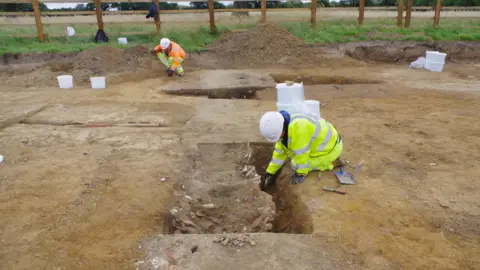
Experts from Wessex Archaeology were commissioned to carry out detailed surveys and digs along the the four-mile (7km) route to gather evidence of sites of historical significance.
The road in the north east of the city, which opened in 2022, was the biggest infrastructure project undertaken by Leeds City Council in 50 years.
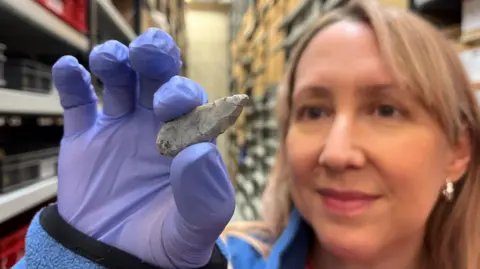
Wessex Archaeology said 6,454 items were discovered in total, with a Neolithic leaf-shaped arrowhead dating back about 6,000 years.
Carefully shaped from flint, each individual knapping mark - the ancient process used to shape and sharpen the stone - are still visible along its edges.
 Wessex Archaeology
Ashley Tuck, Wessex Archaeology research manager, said the items helped to tell a story that spanned almost every period in the region.
"These artefacts tell us who we are, they tell us what's happened in that part of Leeds and that's really important for us to understand how history has evolved," he said.
Other objects included a bronze-alloy axe head from about 4,000 years ago, a glass bead from the late Roman period and pottery predating the Norman Conquest.
Experts worked for two years on the project, identifying which parts of the route to focus on before beginning to dig.
 Leeds Museums
Tuck said the findings would be published later this year and described working on the project as a "real privilege".
"When I'm in the field and I find something, a piece of pottery or something else, I feel a real connection to the people who made it and used it," he said.
"It's almost like they're standing next to me in the landscape."
He added: "There's all this incredible stuff just down there.
"It's been stable in the ground, in some instances for thousands of years, and been perfectly happy.
"Now we've taken it out I think we've got a great duty to look after it."
The collection will now be preserved for future generations at Leeds Discovery Centre.
Kat Baxter, Leeds Museums and Galleries' curator of archaeology, said: "What makes this such a fascinating archive is its sheer scope and scale.
"What we can see is a snapshot of different people and communities who have been in this part of Leeds over thousands of years."
Listen to highlights from West Yorkshire on BBC Sounds, catch up with the latest episode of Look North.
