Silver Saxon cross found in field goes on show

 Leeds Museums and Galleries
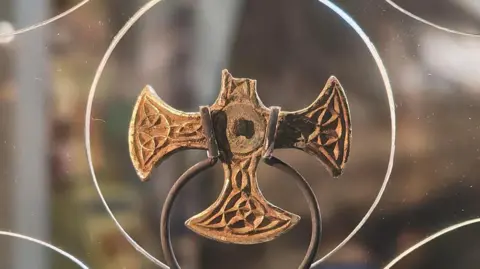
A solid silver Saxon cross has gone on display for the first time in more than 1,200 years after it was discovered by a metal detectorist.
The thinly gilded early medieval pendant, which has one of its four arms broken and its central stone missing, was found in a field in Leeds last year.
It has gone on show at Leeds City Museum after it was bought under the Portable Antiquities Scheme Treasure process.
Kat Baxter, Leeds Museums and Galleries' curator of archaeology, said: "Despite its small size, the pendant is a significant find in terms of helping us to build a more complete picture of life in early medieval Leeds, along with other discoveries made locally."
"Objects representing less wealthy people are less likely to survive, so we do still have a great deal to learn and discover about the local population and how they lived at what was a fascinating period in the history of Leeds," she said.
 Leeds Museums and Galleries/John Prudhoe
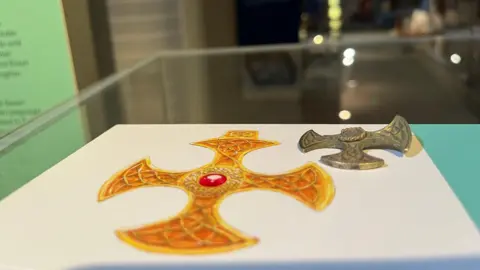
The pectoral cross has been displayed alongside a series of illustrations showing how it would once have looked, Ms Baxter said.
"Much of archaeology involves visualising how ancient, often incomplete, artefacts might have looked and how they may have once been used," she explained.
"Seeing these beautiful illustrations recreate how this tiny pendant might have looked is a rare, vivid glimpse into the past."
The drawings, by archaeological illustrator John Prudhoe, showed how the cross was decorated with a distinctive interlacing Saxon pattern, a thin layer of gold leaf and a central garnet, Ms Baxter said.
It is believed that the pendant, made at a time when Leeds was part of the Saxon kingdom of Northumbria, would have been worn by a church official.
The cross has been displayed near the West Yorkshire Hoard, a group of seven objects found by a metal detectorist in Leeds in 2008 and 2009.
Dating from the 7th to 11th Centuries, the hoard includes the type of high-quality jewellery which would only have been worn by people of exceptional wealth in Saxon society.
Listen to highlights from West Yorkshire on BBC Sounds, catch up with the latest episode of Look North.
