History of Hull's cream phone boxes - and a Hollywood connection

 KCOM
KCOMThe red telephone box has been a British icon for the past century, familiar up and down the land.
Except in Hull.
The Yorkshire city is instead known for its cream phone boxes – and they have become an enduring source of local pride, as the Hidden East Yorkshire podcast has been hearing.
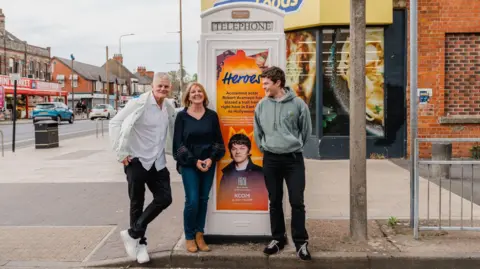
Earlier this week, the Bafta-winning film star Robert Aramayo posed with his parents outside one decorated in his honour.
"I grew up around here and I remember walking down this street to get my bus to school – and now there's a phone box with a picture of me on the corner. It's mad really," he says.
So how did Hull come to stand out from the rest of the country?
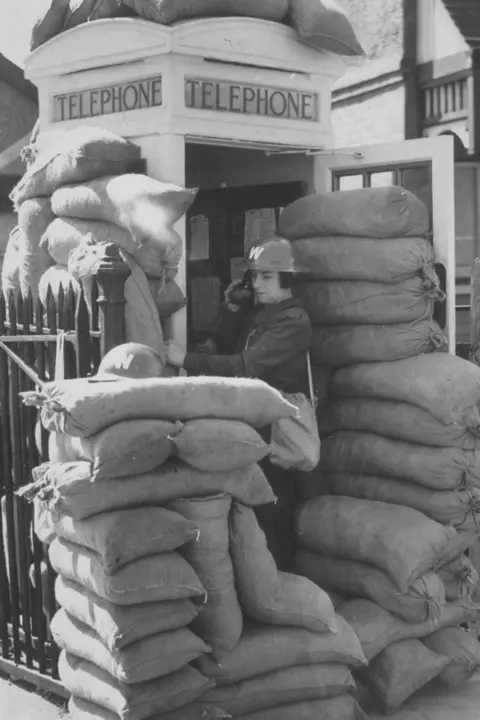
The city's cream phone boxes are a legacy of a time when it was the only place in the UK to have its own telephone network.
While the Post Office, which ran most of the national network, was rolling out red phone boxes in the 1920s and 30s, Hull was ploughing its own furrow.
"At the turn of the century, we were allowed to stand alone," says Ian Sheperdson, from Kcom – the company that grew out of Hull's Corporation Phone Department.
"In 1902, they gained a licence to set up the first telephone exchange in Hull."
 Keystone/Getty
But why cream and not red?
"The colour actually comes from what was used in the telephone exchanges, which is called light straw," Ian explains.
Today, Hull has 289 phone boxes. Many are in the classic K6 design – a rectangular kiosk with a domed top – which was introduced 90 years ago.
"It was first designed by Sir Giles Gilbert Scott," adds Ian, who is the company's chief technical officer.
"It's about the Silver Jubilee of King George V. It's about a classical design."
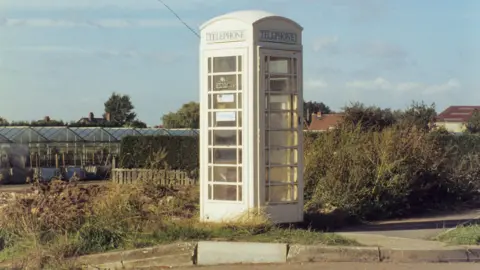
The other defining characteristic of Hull's kiosks – apart from their colour – is the absence of three crowns on the side of the dome.
"Because we were never part of the Post Office, owned by the crown, we actually ground off that royal crest, so we are completely different from the rest of the country," Ian says.
Over the past few decades, phone boxes have become somewhat obsolete, but Ofcom regulations mean a certain number must be kept in working order.
"It is something that we have to report on to Ofcom annually, so people can make emergency phone calls."
What they will not do these days is take incoming calls, which Ian says is to stop them being used for illegal activity.
 Getty Images
Seven of Hull's cream phone boxes are listed by Historic England, including two near the old post office on Lowgate and one on Alfred Gelder Street.
They have become something of a tourist attraction – ideal for selfies – and in recent years have been adapted to celebrate local success stories.
Along with Rob Aramayo, phone boxes have been adapted to celebrate local heroes Bee Lady Jean Bishop, who raised nearly £125,000 for Age UK, and nurse Cath Lyon, who retired from the NHS aged 80.
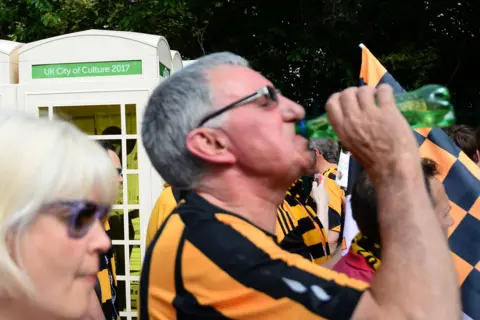
Some even found their way to London to promote Hull's year as City of Culture in 2017.
For Ian, who is Hull born and bred, the unique phone boxes are a big part of local culture.
"I work all over the country and, when I come back to Hull, the cream boxes always gives me a huge sense of pride, knowing that we are different," he said.
Listen to highlights fromHull and East Yorkshire on BBC Sounds, watch the latest episode of Look North.
Download the BBC News app from the App Storefor iPhone and iPad orGoogle Play for Android devices
