'As a clog maker, I'm an endangered species'

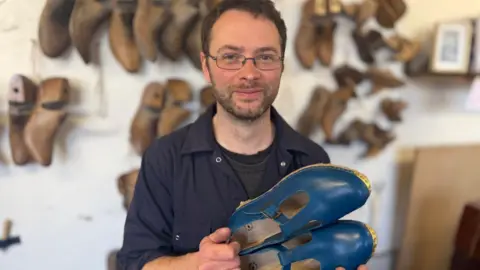 Simon Brock
One of the UK's last remaining clog makers has said crafting the old-fashioned footwear in his workshop remains his "happy place".
Simon Brock, who is based in Walkley, Sheffield, switched to shoemaking from a career in woodwork and sold his first clogs in 2018.
"I need to be making things to be happy," he says.
"At the end of the day if I've got nothing that I can hold in my hands and say I've done that today, it feels like a day wasted."
After leaving school, Brock trained as a furniture maker then qualified as a timber specialist in 2015, before teaching himself leatherwork.
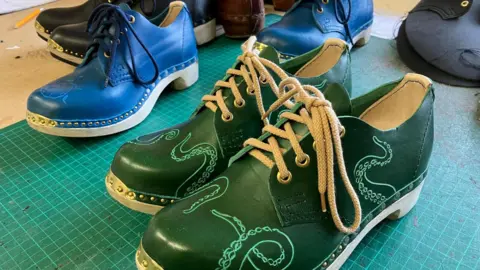
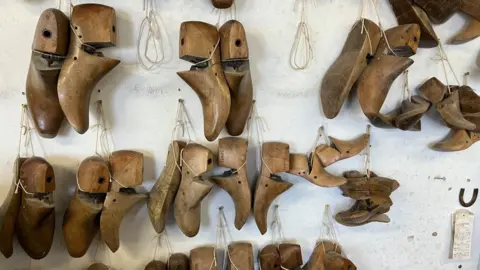
Clog making allowed him to combine both materials - and he set up shop after acquiring equipment and patterns from retired clog maker Rick Rybicki.
Brock uses a device called a blocker to make his clogs - and admits it took some getting used to.
"When I first started using it, it felt like a wild animal," he says. "It would have been used to rough out the soles in the days before machines.
"There's a handle about 3ft long and then there's a blade on it that's about 1ft wide and a hook on one end.
"I couldn't see how you could possibly keep it under control but with enough practice I've got the hang of it now."
 Katie Galbraith
The charity Heritage Crafts, which promotes traditional craftsmanship, first published its Red List of Endangered Crafts in 2017.
The report ranks handmade traditional crafts by the likelihood they will survive to the next generation.
Clog making was on the original list and is still there in 2026.
Daniel Carpenter, executive director at the charity, defines a heritage craft as one that has been "practised for two or more generations in the UK".
"It doesn't have to have originated in the UK," he says.
"It could have come from other parts of the world through migration and diaspora communities, but it does require a high degree of hand skill at the point of production and an intense knowledge of materials and processes."
Carpenter admits that the art of clog making might not survive.
He says: "As we find with many crafts, when there are very few practitioners remaining, these small businesses, they're making enough money to continue their craft and pay themselves a modest living.
"But they don't have the money within the business in order to take somebody on and train them and distract them from the production, the work that they need to do in order to keep that business going."
The process of clog making takes a week for Brock from start to finish.
"The leather needs time to dry properly," he says.
Brock can pinpoint the exact number of clogs he has sold.
"The soles have all got a serial number on," he says.
"The first two numbers are of the year, so this is 26 11 73, so that's year 2026 and this is pair 1,173."
Although clog making had its heyday in the UK during the Industrial Revolution when they were mainly worn in factories, there is still demand today through traditional clog dancing and Morris dancing groups.
Brock himself is currently Dance Captain at Handsworth Traditional Sword Dancers, a Sheffield group stretching back more than 130 years.
His clogs are also sold overseas.
"The most obscure place where they go is Patagonia," he says."There's a little community where they speak Welsh and Spanish but not English.
"They're descended from Welsh people so they do Welsh step dancing and every now and again I'll get an order from the Patagonia Instrument Project who want me to make so many pairs and I'll put them in suitcases and take them out and distribute them to the people of Patagonia."
 Katie Galbraith
While the future of clog making remains unclear, protecting traditional crafts remains vitally important for Carpenter.
"These practices are part of our heritage, just like the monuments and museum collections and stately homes," he says.
"We wouldn't ever think of not supporting their continuation into the future.
"They're an important part of what made our communities and our working lives and they have to continue into the future."
Listen to highlights from South Yorkshire on BBC Sounds, catch up with the latest episode of Look North
