I was being treated for dehydration - when suddenly I couldn't move

 Carmel McConnellogue
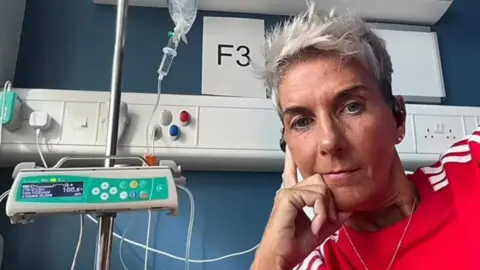
Carmel McConnellogue was in hospital, being treated by medical staff for dehydration, when she suddenly felt she could no longer move her body.
She said she could not speak or feel her face and "everything was numb".
Initial symptoms suggested McConnellogue might have had a stroke - but an MRI scan confirmed that was not the case.
McConnellogue said she was then told by her doctors she had Functional Neurological Disorder - meaning there was a problem with how her brain received and sent information to the rest of her body. She said she never expected to be diagnosed with a condition she had never heard of.
"I could not believe it," she told BBC Radio Foyle's North West Today programme.
"It was explained to me by a doctor that your brain is perfect but it's like a computer and it has too many tabs open.
"My brain went offline, and the body crashed."
McConnellogue, who was being treated at Altnagelvin Hospital in County Londonderry, was told that the condition was brought on by stress and trauma.
"I felt paralysed, trapped and I couldn't stop thinking – I can't move, what is going to happen to me?"
What is FND?
FND is estimated to affect 50,000-100,000 people in the UK.
It limits the brain and nervous system's ability to send and receive signals.
Its underlying cause is not known, but some experts think it could be linked to stress, trauma or a response to a virus or other inflammatory condition.
Symptoms can vary from person to person, but can include limb weakness, paralysis, seizures, walking difficulties, spasms, sensory issues and cognitive problems.
Some people may experience short-lived symptoms, while other can have them for many years.
Most treatment options come in the form of rehabilitation therapy, according to NHS Inform.
This can include physiotherapy, occupational therapy, speech and language therapy, and psychological therapy.
 Carmel McConnellogue
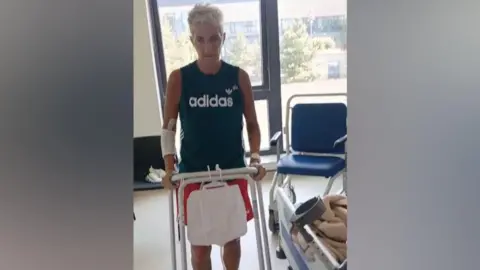
McConnellogue had no power in the left side of her body, and her speech was seriously impacted.
In the initial stages, she could not lift her legs or wiggle her toes.
She stayed in hospital for five weeks while therapists helped her regain her ability to move independently.
The road to recovery has been challenging for the life-long Derry City supporter.
Before her diagnosis, McConnellogue described herself as a "non-stop Duracell bunny, on the go 24/7".
"The physical part is very tough; I walk with a zimmer frame or a crutch and I have to be helped up the stairs, my husband has to physically put me to bed," she added.
She said the diagnosis had "floored" her and she had relied on counselling services to keep her going.
"My independence is gone. I cannot drive, I can't go to the shop on my own - all those things I took for granted," she said.
Country music singer Lisa McHugh spoke publicly last year about being diagnosed with FND.
According to the NHS, there is no cure for FND but it is treatable providing you adapt your life as much as possible to manage it.
McConnellogue has been sharing her recovery journey on social media.
"I do believe FND is misunderstood and I want people to know they are not alone," she said.
"It is a very real neurological condition, and I want to show others you can recover."
'Postcode lottery'
 Helen Dickson
FND Matters NI is the only FND charity in Northern Ireland.
The charity estimates there around 5,000 people living with FND in Northern Ireland but they have struggled to obtain specific figures as Northern Ireland's health trusts do not record FND as a primary condition.
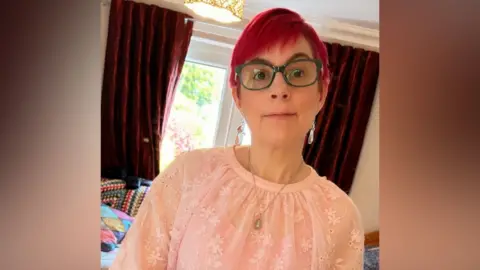
Trustee Helen Dickson was diagnosed with the condition in 2022.
"Treatment for FND can be a postcode lottery," she said.
"More awareness and changes in attitudes are needed, and we need FND specific services.
"There can be a misconception that FND symptoms are imagined or 'all in someone's head' but it's very real."
She said healthcare professionals have asked the charity for advice.
 Carmel McConnellogue
The Department of Health has previously said in response to a question put forward at Stormont that precise numbers of patients with a diagnosis of FND are not currently captured due to limitations in coding and data systems.
The department estimates there are several thousand people in Northern Ireland with FND.
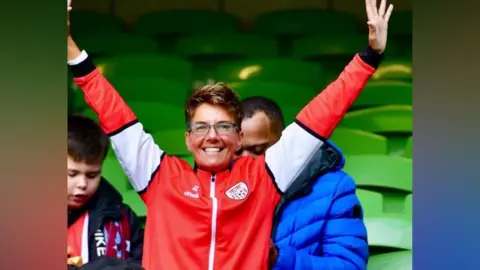
For Carmel McConnellogue, her next recovery goal is to be able to go to watch a football game.
"I am working towards being at Derry City's next home game, I have come through a lot in life and I will overcome FND," she vowed.
"I know my brain computer is going to come back online, and I will be at the Brandywell again."
