'We don't know where we are going': Asian businesses brace for more Trump tariff turmoil

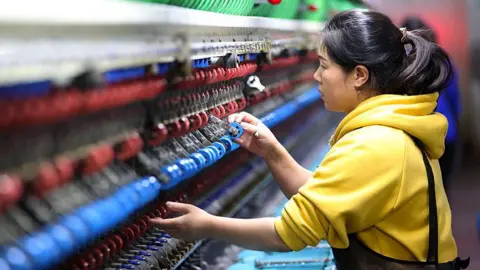 Getty Images
When the US Supreme Court struck down a central pillar of President Donald Trump's sweeping tariff regime last week, businesses across Asia did not celebrate.
Instead, exporters, manufacturers and logistics companies were left grappling with more confusion over access to the world's largest consumer market.
"No-one likes uncertainty," said Push Sharma, founder of Singapore-based wellness brand Haldy, which had spent years preparing to enter the American market before abruptly shelving its plans last year.
"We had already done the trademark registrations, the groundwork, discussions with distributors," he said. "Then everything suddenly felt very drastic. We had to defer our plans."
Trump's tariffs were designed to reduce global dependence on China among other things.
But exporters now warn that shifting US trade policy could have the opposite effect – and reinforce Beijing's manufacturing dominance, rather than weaken it.
New year, same problems
On Friday, the US Supreme Court ruled that the emergency powers law used by Trump to impose tariffs did not authorise his policy regime, effectively invalidating billions of dollars in levies.
Within hours Trump signed an executive order to impose a new 10% global tariff, using legislation that allows the president to impose import taxes for 150 days without congressional approval. The next day he threatened to raise it to 15%.
When the duty actually came into effect on Tuesday official documents showed the rate was 10% as no new directive had been issued to increase it.
Anyone hoping for clues on Trump's tariffs plans in Wednesday's State of the Union address would have been disappointed.
He repeated his criticism of the ruling and said levies "will remain in place under fully approved and tested alternative legal statuses", but offered little in the way of detail on his plans.
Later on Wednesday, US Trade Representative Jamieson Greer said the president will raise the global tariff to 15% in the coming days "where appropriate" but did not name which countries would be effected.
"The ruling only adds to the uncertainty right now," said Monica Gorman, a former White House trade official, describing the new tariffs as a "stop-gap" while Washington prepares fresh measures.
Dan Ives of Wedbush Securities said in a briefing note that companies embedded in Asian production networks now face investment decisions without guidance from Washington.
"Should we move supply chains from one country to another without knowing the rules of the game? Welcome to navigating tariffs in 2026."
 Push Sharma
The previous year was no easier. Manufacturers have faced higher costs since Trump's initial tariff announcements in April.
"It was a big slap in the face when the tariffs were announced," said Tomi Mäkelä, general manager of Thailand's Lanna Clothing, a garment exporter.
Clients renegotiated or cancelled orders before shipments could go out, Mäkelä added, amid the uncertainty.
"I can't eat the cost forever," Mäkelä said. "So I need to increase the price."
Pricing is also the central problem for Sharma's Haldya brand.
"If you don't know what your final costs will be," Sharma said, "the cost of doing business becomes very difficult because you can't price your products."
Lynsey Lim, founder of Singapore skincare brand Handmade Heroes, said tariffs were making companies focus less on pricing, and more on efficiency and diversifying beyond the US market.
"Early feedback suggests that uncertainty - rather than the headline tariff rate - is the bigger drag on business confidence," Kok Ping Soon, chief executive, Singapore Business Federation said.
"Businesses can plan for a known cost increase, but they struggle when the target keeps moving, and some are holding back on major investment and routing decisions as a result."
Some companies are now changing their strategies entirely.
Haldy has expanded retail operations in Malaysia and has begun exploring markets in the Middle East.
"I've made a conscious decision to look at things that are within my control," Sharma said.
Mäkelä of Thailand's Lanna clothing is ramping up the firm's business in Canada and looking to Australia and Europe for new customers.
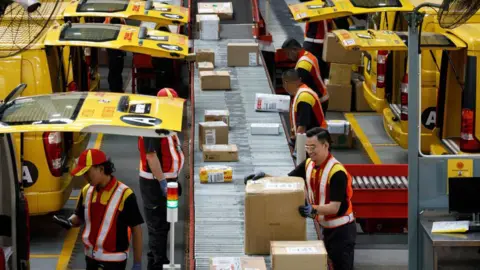 Bloomberg via Getty Images
These uncertainties are having an impact across the supply chain.
Logistics giant DHL said businesses are having to navigate "a more complex operating environment".
While the Supreme Court ruling halted collection of some tariffs, it has left other duties in place - and many operational questions remain unresolved.
"It is too early to assess how potential refunds may be processed or what they will look like," said Niki Frank, chief executive of DHL Global Forwarding Asia-Pacific. "We are closely monitoring the evolving legal developments to ensure customers can fully exercise their rights under the law."
Given the environment, DHL said it was too soon to predict if shipping volumes might change. Supply chains, Frank added, typically adjust slowly.
"These decisions require years of planning," he said. "Tariffs are just one part of the context companies take into account."
Separately, rival delivery firm FedEx has filed a lawsuit for a "full refund" of Trump's emergency tariffs.
FedEx said in a statement on Monday that it had "taken necessary action to protect the company's rights as an importer of record to seek duty refunds" from US Customs and Border Protection following the Supreme Court's ruling.
'More worried about China'
Even as the US adjusts its trade policy, China remains the unavoidable hub of manufacturing in Asia.
Tariffs tied to "country of origin" rules still apply regardless of where a company is headquartered, meaning businesses cannot easily sidestep Chinese supply chains.
"It's very hard to keep China out of play," said Sharma whose firm Haldy's turmeric mints and packaging are produced in China. "If it's made in China, there's a 25% tariff."
Chinese manufacturers are also raising prices for regional clients, like Sharma, to keep their factories going - lower demand in the US means Chinese factories are not operating at capacity.
And China's biggest advantage remains: its ability to produce at scale and do so efficiently and cheaper than competitors.
South East Asian exporters are stuck: they could gain from companies diversifying away from China, but if Beijing benefits from lower tariffs, it could make these businesses less competitive globally.
"I'm more worried about China," said Tomi Mäkelä of Thailand's Lanna Clothing.
"They can do everything on a bigger scale… production costs for them will be even cheaper than for us here in Thailand."
And no matter how competitive other countries can be, firms say they will always rely on China for some parts of the process, such as packaging, for instance.
 AFP via Getty Images
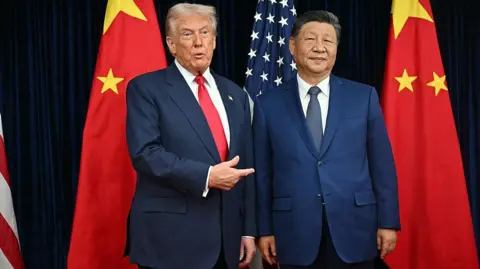
Trump's upcoming visit to China at the end of March, and the possibility of an agreement between the two countries, could be the source of more uncertainty for businesses in the region.
The ruling has also further complicated relationships between Washington and its other Asian trading partners.
Even as many Asian exporters are set to benefit from the lower global rate they "are unlikely to celebrate the US tariff reset too quickly," said Reema Bhattacharya, head of Asia research at Verisk Maplecroft.
"While the immediate burden has eased, the legal pivot increases the risk of more targeted trade tools down the line, shifting uncertainty from country-wide exposure to sector-level vulnerability."
As tariffs push up prices for American consumers and slow discretionary spending, the effects are now rippling back to Asia.
Companies usually decide months in advance where to produce goods, how much stock to hold and which markets to prioritise – decisions that are made all the harder when tariff rules keep changing.
"It doesn't feel good," Mäkelä said. "You don't know what's going to happen or where we are going."
While the US market remains too large for Asian exporters to ignore, after a year of shifting tariffs, many companies are no longer waiting for clarity from Washington.
Instead, they are reshaping their supply chains and entering new markets as they try to deal with the new normal.
For governments, businesses and financial markets only one thing is certain: more uncertainty.
