Work starts on historic pub restoration

 Historic England
Restoration work has begun on a historic timber-framed pub in Birmingham.
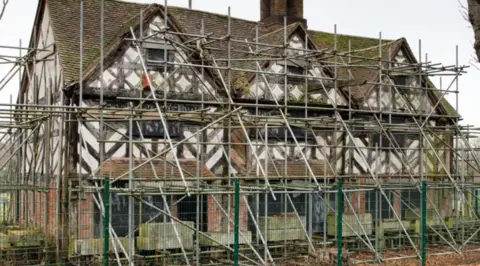
The Grade II listed Golden Lion was built in the 16th Century and survived attacks from Royalists in the English Civil Wars and from suffragettes.
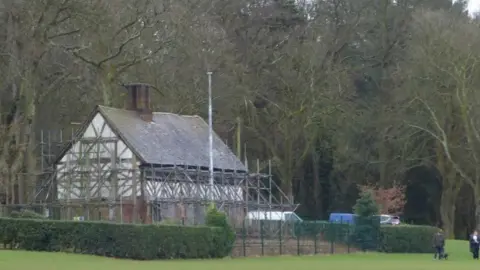
It was relocated to the city's Cannon Hill Park in the early 20th Century but in recent years fell into disrepair and is covered in scaffolding.
Birmingham City Council said the work would stabilise and protect the structure and it was seeking funding to fully repair the pub and "support its future use as a valued heritage asset".
Majid Mahmood, the councillor responsible for the environment and transport, described the building as "one of Birmingham's most historic timber‑framed buildings".
It originally stood in Deritend High Street and had to be rebuilt between 1616 and 1644, after it was believed to have been damaged during a Royalist attack on Birmingham in the Civil Wars.
As well as serving as a pub, it was used as a culler's house, six small homes, a scrap shop and a rangers' hut, the Birmingham Conservation Trust said.
The Golden Lion was dismantled by the Birmingham and Warwickshire Archaeological Society in 1911 before it was rebuilt at its current location in Cannon Hill Park, where it was used as a cricket pavilion.
During the votes for women protests, it was badly damaged in an arson attack carried out by suffragettes in 1912.
 Elliott Brown
In August, the city council said the repair work would include fixing the roof, chimneys, walls, floors, windows and doors, as well as adding French doors to the rear.
Commenting as work started, Mahmood said the council knew there was "strong public interest in the building" and that it was "committed to ensuring that it is preserved for generations to come".
He said the current phase of the restoration was being carried out in partnership with the Birmingham Conservation Trust with money from Historic England.
Follow BBC Birmingham on BBC Sounds, Facebook, X and Instagram.
