'Being a musician is really expensive - an artists' fund could help'

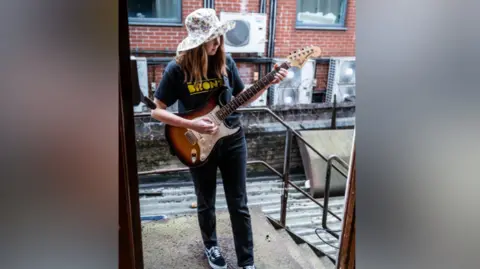 Casey Ryan
From lessons and instruments to travelling to gigs and paying out of pocket for those first demos - the cost of following your dreams can quickly add up.
As singer-songwriter Sonja Sleator said, the cost of her passion "comes out of my own pocket".
She is one of three musicians who say they would like to see the government in Northern Ireland provide a basic income for artists, similar to the Republic of Ireland where a scheme paying €325 (£283) a week to some musicians and artists was recently made permanent.
Sleator said it would give artists "the chance to be able to produce more work, just be creative and just actually have the time to invest in something that I love to do".
Sleator, who is based in Belfast and also performs in a band, believes it would have a knock-on benefit for struggling venues because it would "give us a chance to get in there and play and bring the people in".
Being an artist in 2026 isn't limited to playing an instrument or singing, many have had to become their own social media and marketing managers, booking their own gigs and publishing new songs on platforms like Spotify.
"Being a musician is a really expensive way of work. You have to pay for recording, you've got to pay for petrol to get to the gigs, you have to pay for practice space," she said.
A Department for Communities spokesperson said: "The work of artists and the contribution they make to the quality of life of people in Northern Ireland is understood and valued.
"This is a programme that we continue to follow but there is currently no provision in the budget and no plans at this stage to replicate it."
'Almost impossible'
 Lauren Dawson
A weekly income would also "ease a lot of money worries" for Lisa Dawson, a singer and pianist who lives in Islandmagee.
She said she's "fortunate" because, for most of the year, she works as a teacher and receives a set wage, but during the summer "there's months where I have nothing coming in".
"Something like that would really get you through those couple of months."
She has to budget for those quieter months throughout the year and is "constantly planning ahead".
While there are some grants that artist can apply for in Northern Ireland, Dawson said they can be "almost impossible" to find.
"A lot of the projects I do are just self-funded and I just kind of hope I make money back from tickets, or the odd time that I'll get a gig from the council if they've received funding."
'It's hard to plan'
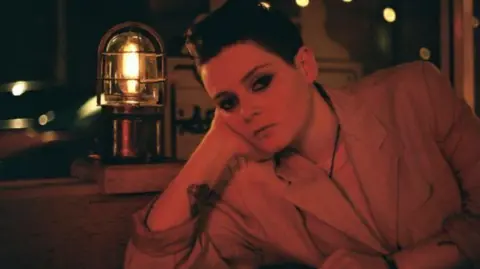 Megan Doherty
Susie Blue, a singer-songwriter who lives in Belfast, is passionate about her craft saying "art isn't a luxury, it's a necessity".
Funding "would mean that musicians could actually take time to be musicians rather than have to worry about their day job," Blue said.
"Every musician that I know has a day job, whether it's in the arts or not. Sometimes it's in a cafe or in an office or it is within the arts itself, booking gigs or doing production or something.
"It would be great to have something where we could just take a minute and actually do what we want."
The Arts Council of Northern Ireland (ACNI), funded by the Department for Communities and the National Lottery, provides some financial help to support artists.
Blue says that there are some grants in Northern Ireland that musicians can apply for but "they can't help everyone" adding that: "you're very lucky if you get those grants".
"It's hard to know what you want to do next year when you're a musician, because you don't know if you'll have the funds.
"It's hard to plan something and apply for funding just to have the funding cancelled or denied.
'A huge difference'
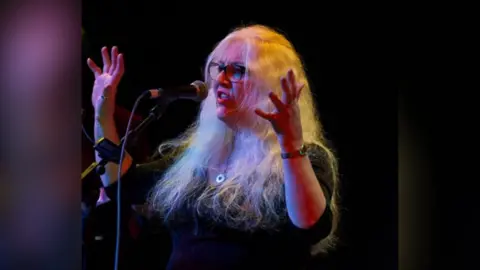 Marc Lynch
Singer-songwriter Alison O'Donnell lives in Dublin and was one of the first recipients of Ireland's Basic Income for the Arts (BIA) project.
She said the scheme is "the envy of a lot of countries".
For the 73-year-old musician the scheme is invaluable as she "can't get a pension because I've spent the last 29 years making music".
Before receiving BIA, O'Donnell said she hadn't "been able to put as much money into my craft as I would like", but that the money has "made a huge difference" to her.
With the income, O'Donnell has been able to pay a PR company for promotion of an album, paid for production work for her music, and has been able to pay a cellist and a violinist, "which I would not have been able to do before," she said.
She was also able to "do a lot of things in the home" and said it has allowed her to offer guidance and support to other musicians.
"I'm able to give a bit more of my time because I feel a bit more supported by getting the BIA," she said.
