'Tagging these tiny birds takes years of training'

 BBC
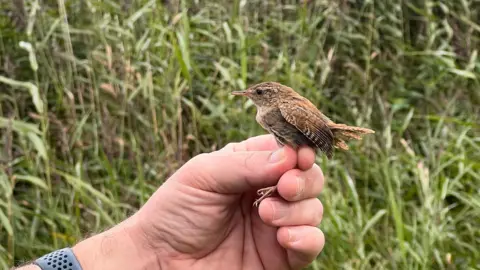
BBCThe conservationists catching wild birds to fit small rings to their legs and track their movements across the world have said the skill takes years of "intensive" training to master.
Dr Stuart Sharp has worked as a licensed bird ringer for more than 25 years and is part of a team restarting efforts to study the birdlife around Leighton Moss RSPB nature reserve in Carnforth, Lancashire.
The method sees rings placed around a captured birds leg which can then allow researchers to gather data that can help in conservation efforts.
Dr Sharp said once the birds are released, "in a perfect world somebody else will catch" it and the ring can be used to provide valuable information.
Anyone who wants to ring birds - which is used to understand and monitor bird populations - in the UK must have a licence.
Licensing and training for bird ringing in the UK is overseen by the British Trust for Ornithology.
Bird ringing has returned to Leighton Moss RSPB after it was stopped due to the Covid pandemic and an outbreak of Avian flu.
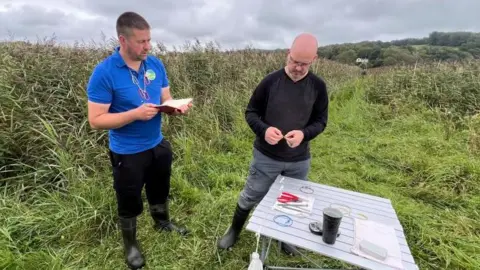
Dr Sharp, an animal ecologist, and Mr Godden, assistant warden at Leighton Moss have put specialist nets up at the nature reserve to catch the birds.
Mr Godden is nearly at the end of his training and said it has taken years to get to this point.
"It's quite intensive, it's not just about putting the ring on the bird, even putting up the nets is many, many, many sessions of learning there," he said.
They first identify the species, record details about the bird, and then attach the ring with a unique number like an ID tag to the bird.
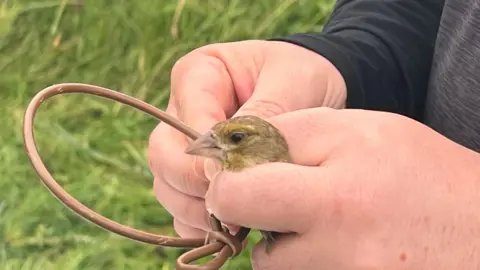
Dr Sharp, who is also senior lecturer at Lancaster University, said: "Once you've got birds individually marked then of course that allows you to definitively study where they go, how long they live, whether they've bred successfully.
"And the idea is that in a perfect world somebody else will catch your bird."
He said at Leighton Moss, a sedge warbler wearing a Belgian ring had recently been caught.
"We now submit that information to the ringing scheme in Belgium and then hopefully over the next month or so we'll find out where it was ringed," he said.
Dr Sharp said all the evidence showed that fitting the rings has "no measurable effect on the birds".
He said: "It doesn't weigh anything, it weighs proportionally less than a wristwatch.
"If it's done properly by license holders, then there's no evidence of any impact."
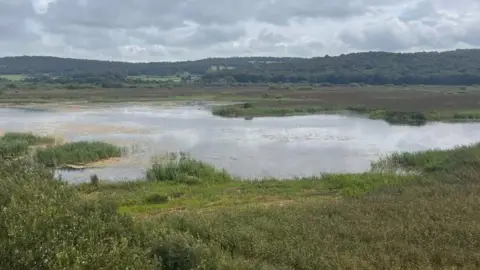
One hundred and 50 species of birds visit Leighton Moss, which is home to the largest reed bed in north-west England, every year with 80 of these species breeding there.
Listen to the best of BBC Radio Lancashire on Sounds and follow BBC Lancashire on Facebook, X and Instagram. You can also send story ideas via Whatsapp to 0808 100 2230.
