Park Street car ban could end Clean Air Zone early

 BBC
BBCBanning cars from a Bristol street could allow for the city's Clean Air Zone (CAZ) to be removed a year earlier than planned, according to new models.
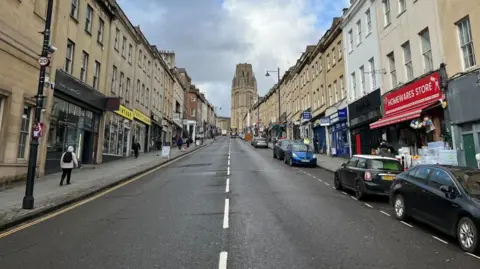
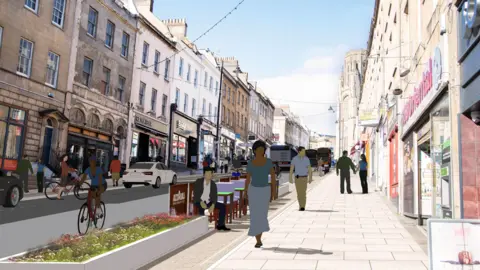
Green councillors on Bristol City Council will try to push forward a £13m plan to ban through-traffic from Park Street on Thursday.
Models from air quality experts Kalaco, commissioned by the council, found the scheme would reduce pollution in some key areas but cause a slight increase along the alternative route past the Bristol Royal Infirmary (BRI).
"Our plan for Park Street is forecasted to bring down by a year the time it will take us as a city to be compliant with air quality targets," said chair of the council's transport committee Ed Plowden.
He said this in turn could allow for CAZ charges to be removed a year earlier than projected.
"This is because it has been modelled to reduce air pollution more quickly along Colston Avenue — the most problematic area within Bristol's Clean Air Zone," Plowden added.
The plan would see drivers diverted away from Park Street and towards the Bearpit and past the hospitals on Upper Maudlin Street before ending up on the Triangle.
The West of England Mayor Helen Godwin refused to fund the plan this week, citing concerns about increased traffic around BRI and the Bristol Royal Hospital for Children.
But the scheme could go ahead regardless, with the council using £8m of CAZ income and a £5.3m government grant to pay for it.
 Bristol City Council
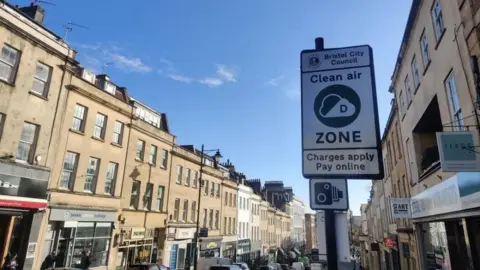
The CAZ, which was introduced in 2022, led to a 12.6% reduction in air pollution in its first year and a 5.1% reduction in its second year, according to council data.
But the most recent data shows legal pollution levels are still being breached on Bond Street and Colston Avenue.
Kalaco said the Park Street scheme would reduce pollution along Colston Avenue, Lewins Mead and Rupert Street which would take "a significant step toward compliance".
 Bristol City Council
The Local Democracy Reporting Service said that Conservative and Liberal Democrat councillors are opposed to the scheme, so the Greens need Labour to either support or abstain on Thursday's vote.
Nicholas Coombes, a Liberal Democrat councillor, said restricting through-traffic on Park Street would be "the wrong decision for Bristol".
"Diverting vehicles from Park Street makes lives harder for many businesses, residents and visitors, and it increases congestion on Park Row and Anchor Road," he added.
"Newly published modelling confirms our warnings from last year — that this scheme would see air quality worsen outside the hospital."
According to Kalaco's models, air pollution levels near the BRI would remain below the legal limit even with a "slight increase" caused by Park Street's closure.
Follow BBC Bristol on Facebook, X and Instagram. Send your story ideas to us on email or via WhatsApp on 0800 313 4630.
