Australia soars into Eurovision final as UK song debuts
 Getty Images
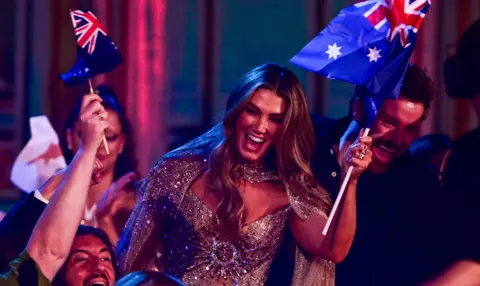
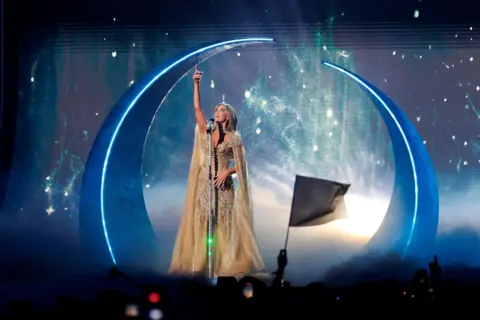
Pop star Delta Goodrem has dramatically increased Australia's odds of winning the Eurovision Song Contest, after a stunning performance of her power ballad, Eclipse, at Thursday's semi-final.
The singer and actress is now second favourite for the competition, and is rapidly closing in on Finland, who have long been tipped to lift the trophy.
If she succeeds on Saturday, it would be a first for Australia - who joined the contest as a one-off wild card entry in 2015 but quickly became a permanent fixture.
Eurovision is phenomenally successful in the country, despite its distance from Europe, with more than a million people regularly tuning in to watch the show.
Goodrem, who is known to TV fans for her role in the Australian soap opera Neighbours, is one of the biggest-selling female artists in her home country.
She signed her first recording contract at the age of 15 and has scored four number one albums.
Speaking to the BBC, she called her Eurovision experience "surprisingly beautiful".
"To see people flying the flags for music and being with us has been an awesome thing to see."
The BBC also confirmed that La Voix, a former Strictly Come Dancing and RuPaul's Drag Race UK contestant, will be the UK's first Eurovision "spokesqueen", delivering the national jury results live from Salford during Saturday's final.
She said she was "absolutely delighted", adding: "It's the one night where sequins are en masse, key changes are compulsory, and absolutely anything can happen – so naturally I feel right at home. I'll do my best to behave... but no promises!"
 Getty Images
As well as Goodrem, nine other acts survived the cull at Thursday's semi-final, and will perform again in the grand final in Vienna on Saturday night.
In alphabetical order, the qualifiers were:
- Albania: Alis - Nân
- Australia: Delta Goodrem - Eclipse
- Bulgaria: Dara - Bangaranga
- Cyprus: Antigoni - Jalla
- Czechia: Daniel Zizka - Crossroads
- Denmark: Søren Torpegaard Lund - Før Vi Går Hjem
- Malta: Aidan - Bella
- Norway: Jonas Lovv - Ya Ya Ya
- Romania: Alexandra Căpitănescu - Choke Me
- Ukraine: Leléka - Ridnym
Five countries - Azerbaijan, Luxembourg, Armenia, Switzerland and Latvia - were eliminated.

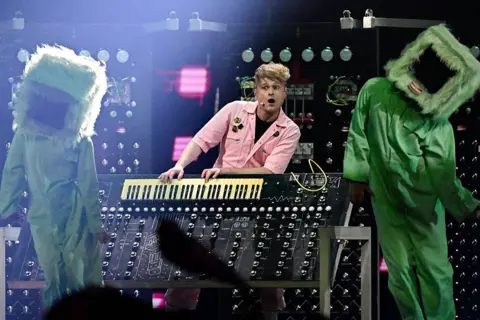
The UK's entrant Look Mum No Computer - aka musician Sam Battle - gave the first performance of his song Eins, Zwei, Drei during the second semi-final.
However, the song was not up for the public vote and received an automatic pass to the final, due to the UK's role as one of the "Big Four" countries who make the largest financial contributions to the song contest.
On stage, Look Mum No Computer gave a dynamic performance, starting at an office desk, before escaping into a colourful and surreal vista of circuit boards and robotic dancers.
His performance met a mixed reception on social media.
"UK might actually get some points this year," wrote Dan on Threads. "He showed lots of energy and personality," agreed Karen Robinson.
On Reddit, one user criticised the staging, which they described as a man "huffing and puffing around an exam hall".
"I don't think it's our year," sighed C Grinbergs on Bluesky.
Speaking to BBC News this week, Battle said the BBC had given him a "stress test" to ensure he could cope with the pressure of the contest.
 Getty Images
More on the Eurovision Song Contest 2026:
- A guide to all 35 Eurovision songs
- Israel qualifies but Boy George is out of Eurovision
- Eurovision boss: 'We're watching the voting very carefully'
- Another year, another controversy for Eurovision - but fans are sticking by it
- Why Eurovision's fallout over Israel may change the competition forever
- Meet the UK's Eurovision entrant: 'The BBC is taking a risk on me'
- Everything you need to know about Eurovision
Earlier, the second semi-final kicked off with Bulgarian singer Dara, who burst onto the stage in a riotous blur of chair choreography and ferocious hair tossing.
Although the lyrics to her song Bangaranga seemed like typical Euro-nonsense, the 27-year-old said it was about "being bold" and confronting a personal "battle with anxiety".
Featuring one of the year's most kinetic stagings, it looks set for a top 10 placing on Saturday night.
Other highlights included Romania's Alexandra Căpitănescu, who provoked controversy in the run-up to the competition with the lyrics of her smouldering rock song Choke Me.
Campaigners criticised the track for glamourising sexual violence, but Căpitănescu said it was really about suffocating under the weight of societal expectations.
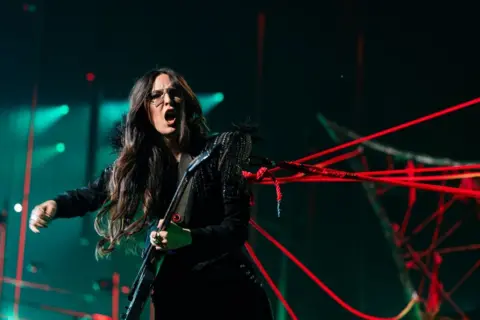
On stage, she represented the struggle by straining against two giant neon ropes tied to her bodice.
By a strange quirk of coincidence, ropes became a recurring theme of the second semi-final.
Azerbaijani singer Jiva fought against restraints as she sang Just Go, a furious exorcism of a toxic relationship.
And Switzerland's Veronica Fusaro was trapped in a cat's cradle of blood red rope during Alice - a song that deals with the horrors of stalking and abuse.
Despite strong performances, neither song picked up enough votes to qualify.
 EBU / Corinne Cumming
Lighter fare came from a Londoner - albeit one representing Cyprus.
Her name was Antigoni, and her hip-shaking party anthem Jalla ("And More") incorporated belly dancing and traditional Cypriot instrumentation, perhaps taking inspiration from Shakira.
Maltese singer Aidan brought a similarly Mediterranean flavour to his tender-hearted ballad, Bella, while French singer Monroe advised us all to find moments of peace to appreciate the world around us, in her operatic chanson Regarde!
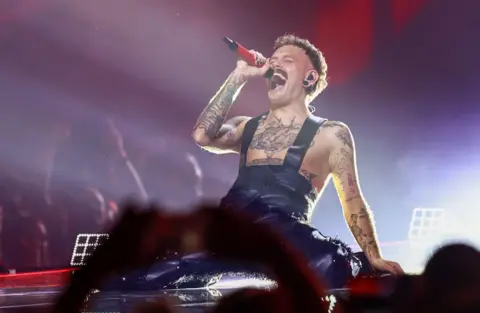
Finally, Norway's Jonas Lovv rounded off the show with Ya Ya Ya - a big dumb rock song that echoed the sound of 2021 Eurovision champions Måneskin.
Lovv got into trouble during rehearsals, with organisers telling him to tone down the "sexualised movements" in his choreography.
"I don't know what they are talking about! I'm the least sexual person in the delegation," he laughed, revelling in the scolding.
But for the semi-final, at least, he swapped out his hip thrusts for a little waggle of his bum, the cheeky scamp.
 EPA
EPAThe 10 countries who qualified on Thursday night will now compete for the Eurovision trophy alongside Belgium, Croatia, Finland, Greece, Israel, Lithuania, Moldova, Poland, Serbia and Sweden - who all qualified on Tuesday.
They'll be joined by the "Big Four" - the UK, Italy, Germany and France - and hosts Austria, who have all qualified automatically for the final.
However, five countries - Ireland, Spain, the Netherlands, Slovenia and Iceland - are missing from the contest this year after boycotting it because of Israel's participation.
You can tune into the grand final on BBC One, BBC iPlayer, Radio 2 and BBC Sounds from 8pm BST on Saturday night. And there'll be full coverage, including a comprehensive live page, on the BBC News Website.
In preparation, you can download a Eurovision score card to record your opinions of the 25 finalists.
The running order for Saturday night is listed below:
Correction 15 May: This article has been amended to add Israel to the list of qualifiers from the first semi-final after being omitted in error, and to correct the day from Monday to Tuesday.
